
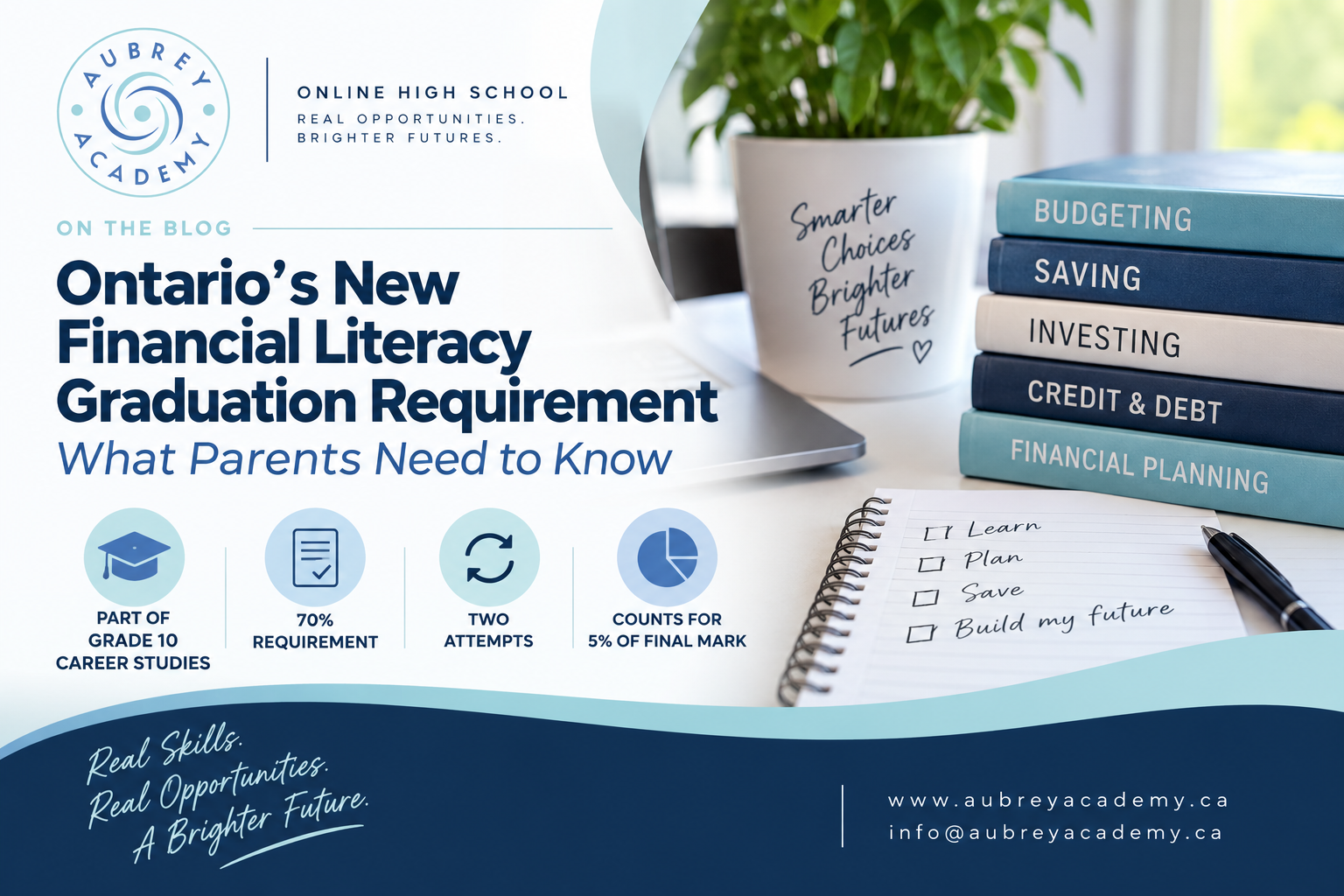
Ontario's New Financial Literacy Graduation Requirement: A Parent's Guide
Ontario is introducing a new Financial Literacy Graduation Requirement for eligible Grade 10 students beginning in 2026–2027. Learn what parents need to know about the 70% requirement, two attempts, and how it fits into Grade 10 Career Studies and the OSSD.
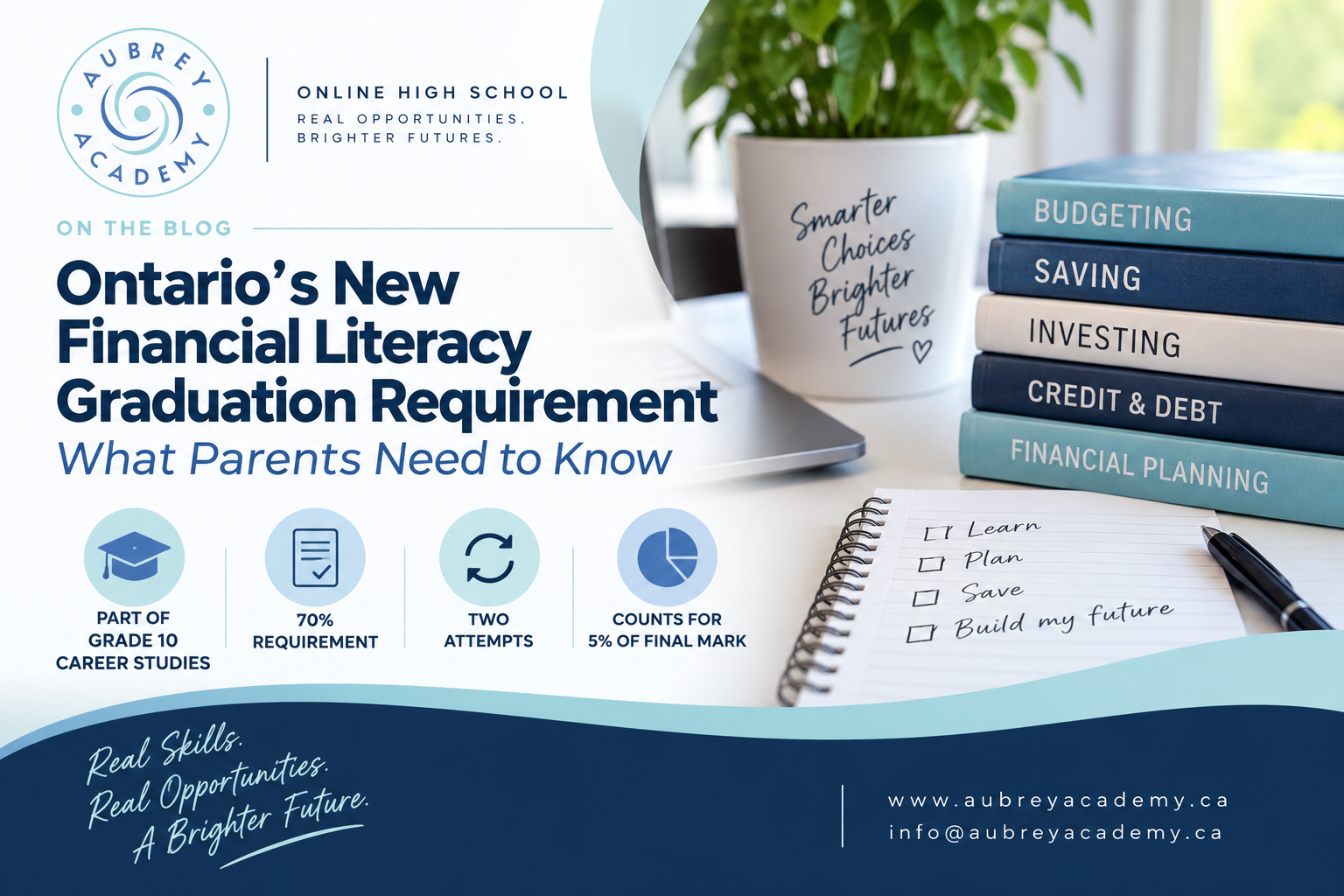
Ontario’s new Financial Literacy Graduation Requirement begins in the 2026–2027 school year for eligible Grade 10 students. Learn what parents need to know about the 70% requirement, two attempts, and how it affects the Career Studies course.
Starting in September 2026, a new financial literacy requirement will become part of earning an Ontario Secondary School Diploma (OSSD) for eligible students.
For parents, this raises some important questions: What is the new financial literacy graduation requirement? Does my teen have to take a test? What mark do they need? What happens if they don't pass? And how does this work for students taking Grade 10 Career Studies online?
The good news is that the requirement is completed as part of the compulsory Grade 10 Career Studies course (GLC2O). Students will have opportunities to prepare, receive support, and try again if they are unsuccessful on their first attempt.
Here is what Ontario parents need to know about the new financial literacy graduation requirement for 2026.
What Is the New Ontario Financial Literacy Graduation Requirement?
Beginning in the 2026–2027 school year, eligible Ontario high school students must successfully complete a Financial Literacy Graduation Requirement to earn their OSSD.
The requirement is completed within the compulsory Grade 10 Career Studies course, GLC2O.
The Ministry of Education has introduced the requirement to make sure students leave high school with practical financial knowledge they can use in everyday life. The assessment focuses on financial literacy concepts that students have encountered through the Grades 1 to 9 curriculum and their Grade 10 Career Studies learning.
The requirement consists of learning modules and assessment questions developed by TVO and provided to schools. Students must earn a minimum mark of 70% to successfully complete the requirement.
Once successfully completed, the requirement is recorded on the student's Ontario Student Transcript.
Who needs to complete the financial literacy requirement?
The requirement applies to students who began Grade 9 in the 2025–2026 school year or later.
In practical terms, students entering Grade 10 in the 2026–2027 school year who are taking GLC2O will generally need to complete the requirement as part of that course.
The financial literacy requirement is now one of the requirements students must meet to earn an OSSD, alongside their credits, literacy requirement, community involvement hours and other applicable graduation requirements.
What Is the Grade 10 Career Studies Financial Literacy Test?
Parents may hear this requirement referred to as the Grade 10 financial literacy test, financial literacy exam, or 70% financial literacy test.
Officially, Ontario refers to it as the Financial Literacy Graduation Requirement.
Students complete TVO-developed learning modules and assessment questions during their Grade 10 Career Studies course. The assessment is designed to measure whether students understand important financial concepts rather than simply testing whether they can memorize information.
Students have two attempts during the Career Studies course to meet the requirement. They need to achieve at least 70%.
The results also have a small impact on the student's GLC2O course grade. The financial literacy results count for 5% of the student's final Career Studies mark, with the highest attempt mark used if the student makes more than one attempt.
What Does the Ontario Financial Literacy Requirement Cover?
The goal is to give students practical knowledge they can use when they begin managing their own money.
The financial literacy requirement covers topics including:
Budgeting
Interest rates
Earning and saving money
Taxes
Credit and debt
Consumer awareness
Financial fraud and protecting personal information
These are skills students will encounter in real life, whether they are getting their first job, opening a bank account, applying for a credit card, paying bills, saving for post-secondary education or eventually taking on larger financial responsibilities.
TVO's financial literacy resources are designed to help students understand these concepts and make informed financial decisions.
What Happens If a Student Doesn't Get 70%?
This is one of the biggest questions parents have — and there is no need to panic if a student does not achieve 70% on the first attempt.
Students have two attempts during their Grade 10 Career Studies course.
If a student is unsuccessful on the first attempt, they can review additional resources and receive support before completing a second attempt. The school will provide information about the next steps.
If a student is still unsuccessful after two attempts, Ontario provides additional pathways to complete the requirement. These can include another supervised attempt, additional instructional support before attempting the modules again, or completing alternative financial literacy learning activities developed by TVO.
These options can remain available until the student successfully completes the requirement.
In other words, not passing the first attempt does not automatically mean a student cannot graduate.
Does the Financial Literacy Requirement Count Toward the GLC2O Grade?
Yes.
The results from the financial literacy modules count for 5% of the student's final Grade 10 Career Studies mark.
If a student completes more than one attempt, the highest attempt mark is used as part of the final Career Studies grade. Once the student successfully meets the graduation requirement, it is recorded on their Ontario Student Transcript.
This means students should take the requirement seriously, but it is only one component of their overall GLC2O course.
Who Is Exempt From the Ontario Financial Literacy Graduation Requirement?
There are some exceptions.
Students who completed their Grade 10 Career Studies course before the beginning of the 2026–2027 school year do not have to complete the new financial literacy graduation requirement.
There are also special rules for some students who transfer into Ontario from outside the province.
For example, students who enrol in an Ontario school in Grade 11 or Grade 12 from outside Ontario may not have to complete the requirement if they receive Grade 9 and 10 credits through the equivalency process, including the Grade 10 Career Studies credit.
There is also a transition rule affecting students who take a locally developed Grade 9 Mathematics course instead of MTH1W before September 2027. Beginning in September 2028, all students will be required to complete the financial literacy graduation requirement.
Because individual student pathways can vary, families who are unsure about whether the requirement applies to their teen should speak with their school or academic advisor.
How Does the Financial Literacy Requirement Work for Online Students?
This is especially important for families considering online high school.
Ontario has specific rules for administering the Financial Literacy Graduation Requirement in online and remote learning environments.
For publicly funded school boards, students taking an online or remote Career Studies course may be required to complete the requirement in person unless the course includes approved online proctoring and security measures.
Ontario also states that inspected private schools may administer the requirement through online proctoring.
At Aubrey Academy, students can complete GLC2O through a flexible online learning environment while receiving teacher support throughout the course.
Explore GLC2O – Grade 10 Careers at Aubrey Academy
How Aubrey Academy Supports Students With GLC2O
Aubrey Academy offers GLC2O – Grade 10 Careers as an Ontario OSSD credit course.
The course already includes important financial management learning, including personal financial management, saving and borrowing tools, and creating a budget for a student's first year after secondary school.
Because Aubrey Academy uses a flexible, asynchronous learning model, students can work through their coursework at a pace that fits their individual circumstances, while still having access to Ontario-certified teacher support.
This can be particularly helpful for students who:
Need a more flexible school schedule
Are balancing academics with athletics or other commitments
Need to catch up on an OSSD credit
Prefer working independently
Are completing high school courses online
Need additional time to review concepts before an assessment
Want to fast-track a course when appropriate
Aubrey Academy offers Ontario OSSD courses for students in Grades 9–12, with flexible start dates and pacing options.
View All Aubrey Academy OSSD Courses
Why Financial Literacy Matters Beyond the Graduation Requirement
Although the new requirement is connected to graduation, the skills students learn have value well beyond Grade 10.
Many teenagers will soon be making financial decisions independently for the first time.
They may need to understand how much money they actually take home from a part-time job, how interest affects borrowing, why minimum credit-card payments can become expensive, how to create a realistic monthly budget, or how to recognize a financial scam.
These are not just school topics. They are everyday life skills.
Learning about financial literacy before students leave high school can give them a stronger foundation as they move into university, college, apprenticeships, employment or other post-secondary pathways.
Frequently Asked Questions About Ontario's Financial Literacy Graduation Requirement
What is the financial literacy graduation requirement in Ontario?
The Financial Literacy Graduation Requirement is a new OSSD graduation requirement beginning in the 2026–2027 school year. Eligible students complete it as part of compulsory Grade 10 Career Studies (GLC2O) and must achieve at least 70% to successfully meet the requirement.
Is there a Grade 10 financial literacy test in Ontario?
Yes, although the official name is the Financial Literacy Graduation Requirement. It consists of learning modules and assessment questions developed by TVO. Students complete it as part of their Grade 10 Career Studies course and have two attempts during the course to achieve the required 70%.
What happens if my child fails the Ontario financial literacy test?
Students who do not achieve 70% on their first attempt can receive additional support and have a second attempt. If they are unsuccessful after two attempts, Ontario provides additional options for completing the requirement, including further instructional support and alternative learning activities.
Does GLC2O include financial literacy?
Yes. Grade 10 Career Studies includes personal financial management as part of the course. Students learn about saving and borrowing tools and develop a budget as part of preparing for life after secondary school. The new Financial Literacy Graduation Requirement is completed within GLC2O.
Can I take GLC2O online in Ontario?
Yes. Aubrey Academy offers GLC2O – Grade 10 Careers as an online OSSD credit course. Students can learn through Aubrey Academy's flexible online model with teacher support and pacing options designed to accommodate different student schedules.
Learn More About GLC2O at Aubrey Academy
Need Help With Grade 10 Career Studies?
The new Ontario financial literacy graduation requirement may feel like one more thing for families to keep track of. The important thing to remember is that it is built into GLC2O – Grade 10 Career Studies, and students have opportunities to learn, prepare, and try again if necessary.
At Aubrey Academy, students can complete GLC2O online with the flexibility and teacher support they need to stay on track toward their OSSD.
Interested in enrolling in GLC2O or another Ontario high school course? Contact Aubrey Academy to learn more about course availability, registration, and the best pathway for your student.
Email: info@aubreyacademy.ca
Call or text: (416) 998-3354
Ontario's New 10 Percent Attendance Mark: What It Means for Student Athletes and Flexible Learners
Ontario’s new 10 percent attendance and participation mark is here. Learn what the changes mean for students, parents, and flexible learners in the 2026–27 school year.
Ontario high school students are starting the 2026–27 school year under significant new assessment rules — and one of the biggest changes is the addition of attendance and participation to the final course mark.
Under the province's new assessment requirements, attendance and participation now account for 15% of the final mark in Grades 9 and 10 and 10% in Grades 11 and 12.
For families of student-athletes, performers, students who travel frequently, and other learners whose schedules don't fit a traditional school day, this raises an important question:
How will time away from school affect my child's grades?
The answer depends on how a school defines and measures attendance and participation and for students with demanding schedules, the learning model matters more than ever.
What Is Bill 101?
The Putting Student Achievement First Act, 2026 (Bill 101) introduced changes to Ontario's education system, including new assessment and evaluation requirements for secondary students.
The legislation received Royal Assent on May 7, 2026, and provisions affecting education have come into force in stages. The new attendance and participation requirements apply beginning with the 2026–27 school year.
The Ontario Ministry of Education now requires final secondary school marks to include attendance and participation.
This means attendance is no longer simply something recorded by a school. For students in Grades 9–12, it can now form part of the final course grade.
How Are Ontario High School Grades Calculated in 2026–27?
The new grading structure divides a student's final course mark into three components.
Grades 9 and 10
65% — Classroom work completed throughout the course
20% — Mandatory final evaluation
15% — Attendance and participation
Grades 11 and 12
65% — Classroom work completed throughout the course
25% — Mandatory final evaluation
10% — Attendance and participation
For a Grade 9 or 10 student, that means attendance and participation can represent 15 marks out of the student's final 100%.
For a Grade 11 or 12 student, it represents 10 marks.
That is a meaningful change from the previous assessment model, where attendance and participation were not directly included as a percentage of the final course mark.
Do Excused Absences Lower a Student's Mark?
No.
This is one of the most important points for parents to understand.
The Ontario Ministry of Education states that excused absences do not negatively affect a student's mark.
Schools may consider a student's attendance, engagement and participation when determining this component of the final grade, but an absence that is properly excused should not result in a reduction to the student's mark.
This distinction is particularly important for students whose schedules include legitimate commitments outside the classroom.
Parents should always follow their school's process for reporting or documenting an absence.
What About Student-Athletes Who Travel?
This is where the new attendance and participation mark becomes especially important for student-athletes.
Competitive athletes may spend significant amounts of time:
Travelling to tournaments
Competing outside Ontario
Attending training camps
Participating in showcases
Training multiple times per week
Travelling internationally
Attending recruitment events
Preparing for provincial, national or international competitions
A traditional school schedule can make this difficult.
A student may be an excellent learner, complete their assignments, communicate with teachers and maintain strong academic performance but still have a schedule that doesn't fit neatly into a conventional classroom timetable.
The question isn't simply: "How often is the student physically in a classroom?"
For today's student-athletes, an increasingly important question is:
How is the school measuring meaningful participation?
That distinction matters.
Why an Asynchronous Online School Can Be a Better Fit
At Aubrey Academy, our online OSSD model is designed around students who need flexibility without giving up academic support.
Our courses are asynchronous, meaning students do not have to be online in a traditional classroom at a fixed time each day.
Students can work around their actual schedules — including training, travel and competition — while continuing to complete their coursework and stay connected with their teachers.
This can be particularly valuable for student-athletes.
Instead of requiring a student to be physically present in a classroom at a specific time, an asynchronous model allows learning to happen around the student's schedule.
Explore Aubrey Academy's Online OSSD Courses
What Does "Participation" Look Like in an Online School?
Participation doesn't have to mean sitting in a classroom from 9 a.m. to 3 p.m.
In an online learning environment, meaningful participation can be demonstrated through engagement with the course and learning process.
At Aubrey Academy, our asynchronous model allows students to demonstrate engagement through their coursework, learning activities, communication and ongoing progress with teacher support.
For an athlete travelling to a tournament in another province, for example, the student isn't necessarily stepping away from school.
They may be completing coursework from a hotel room.
They may be working through a lesson between training sessions.
They may be communicating with their teacher remotely.
They may continue progressing through their course while travelling with their team.
The location may change. The learning doesn't have to stop.
That is one of the major advantages of flexible online education.
A Realistic Example
Imagine a Grade 11 student who plays competitive hockey.
During the season, the student may travel regularly for tournaments and competitions. Some weekends may involve long-distance travel, while weekdays may include several hours of training.
In a traditional school environment, the family may need to carefully coordinate missed classes, absences and make-up work.
With an asynchronous online course, the student can structure their learning around their athletic schedule.
They can continue working through their course while travelling, complete assignments according to their course requirements and maintain communication with their teacher.
For families considering an online school, this flexibility can make a significant difference.
Does This Mean Student-Athletes Don't Have to Participate?
No.
The new rules do not mean students can simply ignore their courses because they attend an online school.
Students still need to demonstrate meaningful engagement and complete their academic responsibilities.
The difference is that an asynchronous model can allow students to demonstrate that engagement without requiring them to follow a traditional classroom timetable.
That's an important distinction.
Flexibility does not mean less accountability.
It means the structure of learning is designed differently.
Written Exams Are Also Part of the New Rules
The attendance change isn't the only major assessment update for 2026–27.
Ontario has also introduced mandatory final evaluations, including written exams for many secondary courses. The Ministry states that most secondary courses will have mandatory written exams, with specific course and subject exemptions.
English, mathematics and science courses have written examinations as part of their final evaluation structure.
Some courses are exempt from the mandatory written exam requirement, including certain locally developed compulsory credit courses, Grades 11 and 12 workplace preparation and open courses, Co-operative Education, Interdisciplinary Studies and specified Guidance and Career Education courses. These courses still require a final evaluation.
For families choosing an online high school, it is important to understand not only how coursework is delivered, but also how final evaluations and exams are administered.
What Should Parents Ask an Online School?
If your child is considering online high school for the 2026–27 school year, don't just ask whether the school is "online."
Ask how the school handles the new assessment requirements.
Here are five questions worth asking:
1. How is attendance measured?
Ask what the school considers attendance and how it contributes to the student's final mark.
2. How is participation measured?
For an asynchronous student, this is especially important.
Ask how the school evaluates meaningful engagement when there isn't a traditional daily classroom.
3. What happens when my child travels?
If your child is an athlete, performer or frequently travelling student, ask how travel affects course participation and deadlines.
4. How are final evaluations and exams completed?
Find out whether exams are written online, in person, remotely proctored or administered another way.
5. Can the school accommodate an athletic schedule?
A school may technically offer online courses while still requiring rigid schedules.
Make sure the learning model actually fits your child's life.
Why This Matters for Families Choosing an OSSD Pathway
The new Ontario grading rules don't mean that traditional school is the wrong choice.
But they do make school structure and assessment practices more important considerations for families.
For some students, a traditional classroom environment is exactly what they need.
For others — particularly student-athletes, performers, working students, frequent travellers and learners who thrive with greater flexibility — an asynchronous online model may be a better fit.
At Aubrey Academy, we believe students shouldn't have to choose between their academic future and the activities, goals and commitments that matter to them.
Our Ministry-inspected Ontario private high school offers flexible online OSSD credit courses supported by Ontario Certified Teachers, with academic pathways designed around each student's goals.
See How Aubrey Academy Supports Student-Athletes
The Bottom Line
Ontario's new attendance and participation mark is now part of the high school grading system.
Starting in the 2026–27 school year:
Grades 9 and 10 include 15% attendance and participation
Grades 11 and 12 include 10% attendance and participation
Excused absences do not negatively affect a student's mark
Mandatory final evaluations have been introduced
Many courses now include written final exams
Schools must follow the province's updated assessment requirements
For student-athletes and other flexible learners, the key question isn't simply how much time a student spends inside a classroom.
It's whether their school environment allows them to stay engaged, keep learning and demonstrate meaningful participation while managing the realities of their schedule.
Looking for Flexible OSSD Credits?
If your child is balancing high-performance athletics, training, travel, work or other commitments, Aubrey Academy can help you explore an OSSD pathway that fits.
Contact Aubrey Academy to discuss flexible online OSSD credits and find out whether our asynchronous learning model is right for your student.
Aubrey Academy
Ontario Ministry-Inspected Private High School
BSID #665140
📧 info@aubreyacademy.ca
📞 (416) 998-3354