
U SPORTS vs NCAA: Academic Requirements for Ontario Student-Athletes
Compare the academic requirements for NCAA, U SPORTS and JUCO as an Ontario student-athlete, and learn how to plan your high school courses so every pathway stays open.
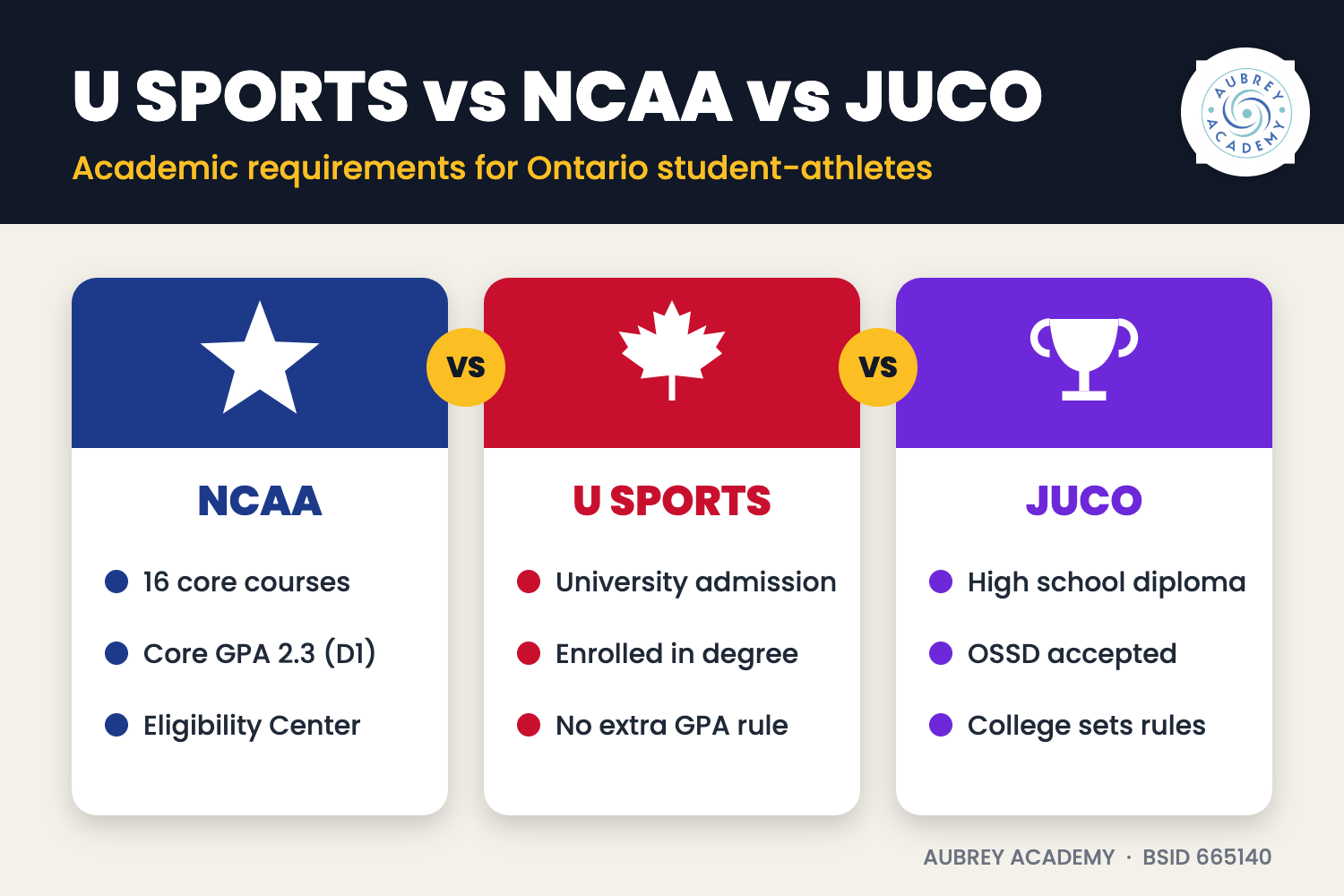
Ontario student-athletes often have three realistic paths after high school: NCAA schools in the United States, U SPORTS teams at Canadian universities and junior colleges (JUCO) in the United States. Each one checks your academics differently. Here is a side-by-side look so you can plan your courses once and keep every option open.
The quick comparison
NCAA (D1 and D2)
Who checks your academics: NCAA Eligibility Center
Entry requirement: 16 core courses and a minimum core GPA (2.3 for D1, 2.2 for D2)
What matters most: U and M courses in core subjects, marks converted to a 4.0 scale
Standardized tests: Not required for NCAA eligibility
U SPORTS
Who checks your academics: The university you are admitted to
Entry requirement: Admission to the university and enrollment in degree courses
What matters most: Your admission average and program prerequisites
Standardized tests: Not required by most Ontario universities
JUCO
Who checks your academics: The college you enroll in
Entry requirement: Proof of high school graduation
What matters most: Your diploma, then college grades once enrolled
Standardized tests: Generally not required
NCAA: a course-by-course standard
The NCAA is the most detailed of the three. Division I requires 16 core courses, including 4 years of English and 3 years of math, with 10 core courses completed before your final year and a minimum core GPA of 2.3. Division II requires 16 core courses and a 2.2 core GPA. For Ontario students, only University (U) and University/College (M) courses count as core courses. Learn more in our step-by-step NCAA eligibility guide.
U SPORTS: admission is the key
Since the 2024-25 season, first-year U SPORTS student-athletes can compete and receive athletic scholarships once they are admitted to a university and enrolled in degree courses. There is no separate first-year grade minimum. That means your Ontario admission average and program prerequisites are what really count. Competitive programs often require strong averages across six Grade 12 U and M courses, so upgrading one or two marks can make a real difference.
JUCO: your diploma opens the door
Junior college athletics programs require proof of high school graduation. For Ontario students that is the Ontario Secondary School Diploma (OSSD). Once you are enrolled, you need to keep up your college grades and course load to stay eligible. JUCO can be a strong path for athletes who want to develop and then transfer to a four-year school.
How to plan for all three at once
Choose U and M courses in English, math, science and social science from Grade 9 onward. They satisfy the NCAA and support university admission.
Protect your marks. An 80 counts as a 4.0 for the NCAA and also helps your U SPORTS admission average.
Watch the timeline. Complete 10 NCAA core courses before your final year.
Graduate on time. Your OSSD is required for every path.
Plan your pathway with Aubrey Academy
Aubrey Academy is a Ministry-inspected Ontario private online high school (BSID 665140) built around training and travel schedules. Our NCAA Eligibility Pathway Planning service (CA$250) covers D1, D2, D3, U SPORTS and JUCO. It includes a transcript review, your NCAA core GPA, your U SPORTS admission average, a course-by-course academic plan and an academic profile for coaches. Your first NCAA consultation is free. The service is open to student-athletes everywhere, not only in Canada, including international and U.S. students. Visit our student-athlete page to learn more.
Rules can change. Always confirm requirements with the NCAA Eligibility Center, U SPORTS, the NJCAA and each school.
How to Calculate Your NCAA Core GPA in Ontario
A simple guide for Ontario student-athletes: which courses count toward your NCAA core GPA, how Ontario percentages convert to a 4.0 scale, a worked example and how to raise your core GPA.
Your NCAA core course GPA is one of the two numbers that decide whether you can compete in your first year at a Division I or Division II school. It is not the same as your Ontario average, and many students are surprised by the difference. Here is how it works for Ontario students.
Which courses count
Only NCAA core courses are included. For Ontario students these are University (U) and University/College (M) courses in English, math, science and social science, plus approved additional core courses. College (C), Open (O), Workplace (E) and Locally Developed courses are left out of the calculation completely, even if your marks in them are high.
How Ontario marks convert
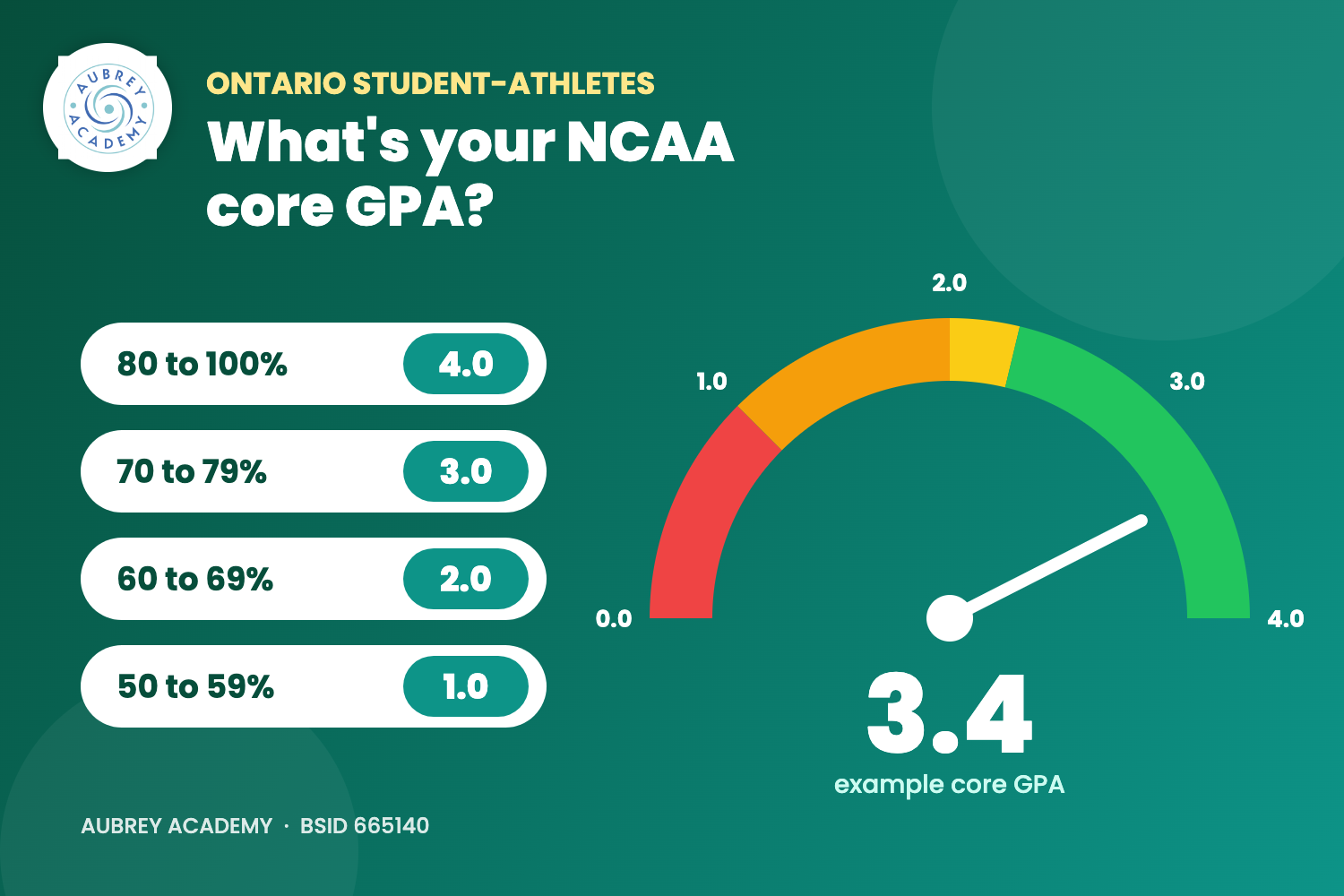
The NCAA converts Ontario percentages to grade points:
80 to 100 = 4.0
70 to 79 = 3.0
60 to 69 = 2.0
50 to 59 = 1.0
Below 50 = 0.0
Notice the big jumps. A 79 and a 70 both count as 3.0, while an 80 counts as 4.0. A few marks can change your core GPA significantly.
A worked example
Imagine a student with 16 core courses: 8 courses with marks of 80 or higher, 5 courses in the 70s and 3 courses in the 60s.
8 courses x 4.0 = 32 points
5 courses x 3.0 = 15 points
3 courses x 2.0 = 6 points
Total = 53 points / 16 courses = 3.31 core GPA
That student comfortably clears the Division I minimum of 2.3 and the Division II minimum of 2.2. Half-credit courses, such as Ontario Civics, count as half a course in the calculation.
Minimums to know
Division I: 2.3 core GPA across 16 core courses, with 10 core courses (7 in English, math or science) completed before your final year
Division II: 2.2 core GPA across 16 core courses
Division III: no NCAA core GPA certification; each school sets its own admission standards
Remember that the minimum is only the starting point. Coaches and admissions offices often look for much stronger academics, especially for scholarships.
How to raise your core GPA
Upgrade key marks. If you repeat a core course, the NCAA generally uses the higher mark. Moving a 78 to an 80 adds a full grade point for that course.
Replace non-core courses. If some of your courses are C or O level, adding U or M courses can fill gaps in your core course list.
Watch the 10/7 deadline. For Division I, the ten courses completed before your final year are locked in, so plan upgrades early.
Common mistakes
Using your overall Ontario average instead of only core courses
Assuming a 79 rounds up to a 4.0
Counting College or Open level courses
Leaving upgrades until the summer before college
Get your core GPA calculated for you
Aubrey Academy's NCAA Eligibility Pathway Planning service (CA$250) calculates your core GPA for Division I and II, reviews your transcript against NCAA core course requirements and builds a course-by-course plan. If you need to upgrade a mark or add a U or M course, our Ministry-inspected online courses start any day and are taught by Ontario Certified Teachers. Your first NCAA consultation is free. The service is open to student-athletes everywhere, not only in Canada, including international and U.S. students.
New to the process? Start with our step-by-step guide to NCAA eligibility in Canada.
The NCAA Eligibility Center makes the final decision on every student's core GPA. Always confirm your status directly with the NCAA.
NCAA Eligibility for Canadian Students: A Step-by-Step Guide
How Ontario and Canadian student-athletes become academically eligible for NCAA Division I and II: core courses, the 10/7 rule, core GPA, which OSSD courses count and how to register with the NCAA Eligibility Center.
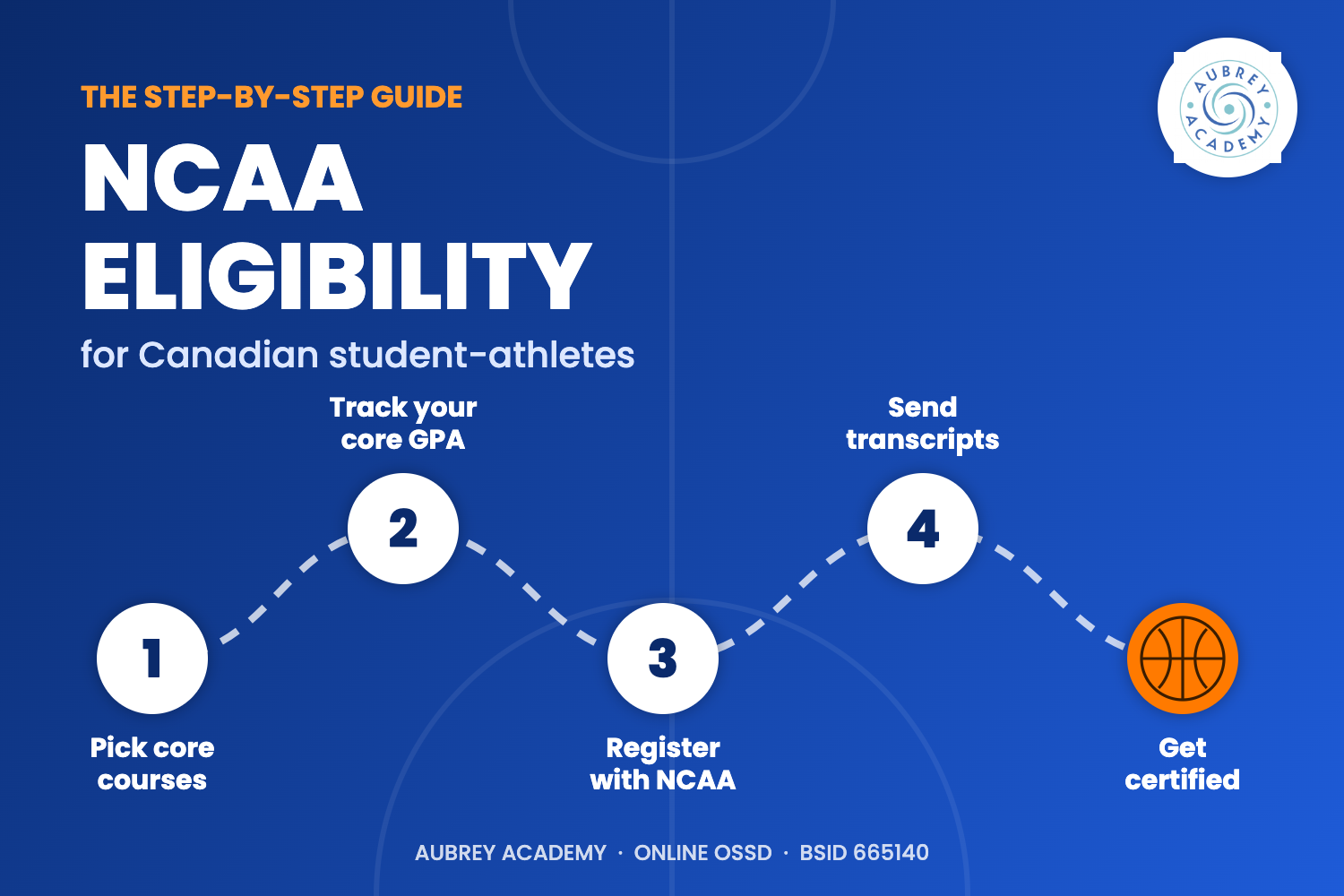
Playing NCAA sports starts in the classroom. Before a Canadian student-athlete can practise, compete or receive an athletic scholarship at a Division I or Division II school, the NCAA Eligibility Center has to certify their high school record. This guide walks Ontario students and parents through each step, from choosing the right courses to registering with the Eligibility Center.
Step 1: Know which division you are aiming for
Division I and Division II have academic eligibility standards that the NCAA Eligibility Center checks. Division III schools do not use NCAA academic certification. Instead, each Division III school applies its own admission requirements. Many athletes keep more than one division open, so it is smart to plan for the Division I standard from Grade 9.
Step 2: Learn the core course requirements
Division I requires 16 NCAA-approved core courses:
4 years of English
3 years of math (Algebra I or higher)
2 years of science
1 additional year of English, math or science
2 years of social science
4 additional core courses
Ten of those 16 courses, including 7 in English, math or science, must be completed before the start of your senior year. This is called the 10/7 rule, and those ten courses are locked in for your core GPA once your final year begins.
Division II also requires 16 core courses: 3 years of English, 2 years of math, 2 years of science, 3 additional years of English, math or science, 2 years of social science and 4 additional core courses.
Step 3: Make sure your Ontario courses count
For Ontario students, the NCAA counts University (U) and University/College (M) courses in English, math, science and social science as core courses. College (C), Open (O), Workplace (E) and Locally Developed courses do not count. The NCAA also expects proof of graduation, which for Ontario students is the Ontario Secondary School Diploma (OSSD), and it looks at courses completed over four years, or eight semesters, starting in Grade 9.
This is where many Canadian athletes run into trouble. A course that is fine for your OSSD may not count for the NCAA, so check every course against these rules before you choose it.
Step 4: Calculate your core course GPA
Division I requires a minimum core course GPA of 2.3, and Division II requires 2.2. The NCAA converts Ontario percentages to a 4.0 scale, so an 80 counts as a 4.0 but a 79 counts as a 3.0. Our guide How to Calculate Your NCAA Core GPA in Ontario shows exactly how it works, with a worked example.
Step 5: Register with the NCAA Eligibility Center
Create your account at the NCAA Eligibility Center, usually in Grade 10 or 11, and keep your course list up to date. After graduation you will need a final official transcript with proof of graduation. SAT and ACT scores are no longer required for Division I or Division II academic eligibility, although some schools may still ask for them for admission.
Step 6: Keep your other pathways open
Many Canadian athletes also consider U SPORTS at Canadian universities or a junior college (JUCO) in the United States. The academic rules are different for each. Read U SPORTS vs NCAA: Academic Requirements for Ontario Student-Athletes to compare them side by side.
How Aubrey Academy helps student-athletes
Aubrey Academy is a Ministry-inspected Ontario private online high school (BSID 665140). Our courses are taught by Ontario Certified Teachers, run 100 percent online and start any day, so athletes can fill core course gaps or upgrade marks around training and travel.
Our NCAA Eligibility Pathway Planning service (CA$250) includes a transcript review against NCAA core course requirements, your core course GPA for Division I and II, your U SPORTS admission average, a course-by-course academic plan and an academic profile you can share with coaches. It covers D1, D2, D3, U SPORTS and JUCO pathways, and your first NCAA consultation is free. The service is open to student-athletes everywhere, not only in Canada, including international and U.S. students. Learn more on our student-athlete page.
NCAA rules can change. Always confirm your status with the NCAA Eligibility Center, which makes the final decision on every student's record.

Can You Switch to Online High School Mid-Year in Ontario? What Parents Need to Know
Considering a mid-year switch to online high school in Ontario? Learn how transferring credits works, what happens to your OSSD requirements, and what students and parents should consider before making the change.

Yes, students can switch to an online high school in Ontario during the school year. Depending on the student’s situation, they may be able to transfer completed credits, continue working toward their OSSD, and begin courses online without waiting for a new school year.
For families considering a mid-year change, the most important steps are understanding which credits the student has already earned, determining which OSSD requirements remain, and choosing a school that can support the transition.
Why Do Students Switch to Online High School Mid-Year?
There are many reasons a student may need a different high school option during the school year.
Some students find that their current school environment is no longer the right fit. Others may need greater flexibility because of athletics, travel, health or family circumstances, or a change in their academic goals.
Online high school can also be an option for students who need to catch up on credits, want to earn additional credits, or need a more flexible schedule.
Aubrey Academy is a flexible, Ministry-inspected online private high school in Ontario offering OSSD credits for students in Grades 9 to 12.
Can I Transfer My High School Credits to an Online School?
In many cases, students can transfer previously earned high school credits when moving to another Ontario high school. The receiving school reviews the student’s academic records to determine which credits can be applied toward their OSSD requirements.
Students should provide their most recent transcript or Ontario Student Transcript (OST) so the school can accurately review their progress.
Will Switching Schools Mid-Year Affect My OSSD?
Switching schools mid-year does not automatically prevent a student from earning an OSSD.
The key is understanding the credits and requirements the student has already completed and creating a plan for the courses still needed. A review of the student’s transcript can help identify any outstanding compulsory or elective credits.
What If I Am Already Taking a Course at Another Ontario High School?
If a student is already enrolled in a course when they decide to switch to an online high school, the next steps will depend on the student’s academic record and the status of the course.
The new school can review the student’s academic records to determine which credits have been completed and what requirements remain toward the OSSD. Families should provide the most up-to-date academic information available so the school can determine the appropriate next steps.
It is helpful to speak with the new school before withdrawing from the current school so the student’s transition can be planned appropriately.
Can I Switch to Online High School After Starting the School Year?
Yes. Students do not necessarily have to wait until September to switch to an online high school in Ontario.
A mid-year transition may be possible depending on the school, course availability, the student’s academic records, and the timing of the request. Families should contact the school directly to discuss the student’s situation and determine the best next steps.
Is Online High School a Good Option for Student Athletes?
Online high school can be particularly helpful for student athletes who need more flexibility in their daily schedules.
Training, competitions, travel, and tournaments can make a traditional school schedule difficult to manage. An online learning environment may allow students to organize their schoolwork around their athletic commitments while continuing to work toward their OSSD.
Is Online High School an Option for Homeschool Families?
Yes. Families who have been homeschooling may also explore Ontario online high school as they plan the student’s transition toward earning an OSSD.
The student’s previous academic work and completed credits should be reviewed so the school can determine what requirements remain and what courses may be appropriate.
Can International Students Study Toward an OSSD Online?
International students may also consider an Ontario online high school when looking for flexibility or an Ontario secondary school credit pathway.
Because individual circumstances and academic histories vary, international families should speak with the school about their previous education, current goals, and the OSSD requirements they need to complete.
What Documents Do I Need to Switch to an Online High School?
The documents required can vary depending on the student and the school. Typically, an academic transcript or Ontario Student Transcript is an important starting point.
Having accurate academic records allows the school to review completed credits and determine what courses the student may need to complete next.
How Do I Know Which OSSD Courses I Still Need?
The best way to determine what a student needs is to review their academic record against the requirements for the Ontario Secondary School Diploma.
This can help identify completed credits, remaining compulsory credits, elective requirements, and other graduation requirements. A school can help families understand the student’s current academic standing and develop a course plan.
What If My Student Wants to Catch Up on Credits?
Online learning can provide an opportunity for students to work toward outstanding credits while having greater flexibility in how they organize their school time.
For some students, the ability to focus on one course at a time or work around other commitments can make it easier to stay on track academically.
What Should Parents Consider Before Switching Mid-Year?
Before making a change, parents should consider:
Which credits has the student already completed?
Which OSSD requirements are still outstanding?
Does the online school offer the courses the student needs?
How flexible is the course schedule?
What support is available to the student?
How will completed credits be documented?
What is the expected timeline for completing the remaining courses?
It is also important to choose a school that is properly authorized to offer the Ontario secondary school credits the student needs.
Aubrey Academy provides flexible online learning for Ontario high school students who are looking for an alternative to a traditional school setting while working toward their OSSD.
Frequently Asked Questions About Switching to Online High School
Can I switch to an online high school in Ontario during the school year?
Yes. Students can explore switching to an online high school during the school year. Their academic records should be reviewed to determine which credits they have completed and what requirements remain.
Can I transfer my Ontario high school credits?
Previously earned credits may be transferred and applied toward the student’s OSSD requirements. The receiving school will review the student’s academic records to determine how the credits fit into their graduation plan.
Do I have to wait until September to start online high school?
No. Some online high schools allow students to begin courses at different points during the school year. Start dates and course availability vary by school.
Is online high school good for student athletes?
It can be. The flexibility of online learning may make it easier for student athletes to balance schoolwork with training, competitions, and travel.
Can homeschool students earn an OSSD through online high school?
Homeschool families can explore online high school as an option for completing Ontario secondary school credits. The student’s previous academic work should be reviewed to determine an appropriate pathway.
What is the first step if I want to switch schools?
The first step is to contact the online high school and provide the student’s current academic records for review. This allows the school to determine what credits have been completed and what courses may still be required.
Thinking About Switching to Online High School?
If you're considering a mid-year transfer, contact Aubrey Academy to discuss your student's academic record and course options.
Contact Aubrey Academy to discuss your student’s academic situation, review their course options, and learn more about working toward an OSSD through flexible online learning in Ontario.
Ready to explore your options? Contact Aubrey Academy today.
Ontario's New 10 Percent Attendance Mark: What It Means for Student Athletes and FlexibleLearners
Ontario’s new 10 percent attendance and participation mark is here. Learn what the changes mean for students, parents, and flexible learners in the 2026–27 school year.
Ontario high school students are starting the 2026–27 school year under significant new assessment rules — and one of the biggest changes is the addition of attendance and participation to the final course mark.
Under the province's new assessment requirements, attendance and participation now account for 15% of the final mark in Grades 9 and 10 and 10% in Grades 11 and 12.
For families of student-athletes, performers, students who travel frequently, and other learners whose schedules don't fit a traditional school day, this raises an important question:
How will time away from school affect my child's grades?
The answer depends on how a school defines and measures attendance and participation and for students with demanding schedules, the learning model matters more than ever.
What Is Bill 101?
The Putting Student Achievement First Act, 2026 (Bill 101) introduced changes to Ontario's education system, including new assessment and evaluation requirements for secondary students.
The legislation received Royal Assent on May 7, 2026, and provisions affecting education have come into force in stages. The new attendance and participation requirements apply beginning with the 2026–27 school year.
The Ontario Ministry of Education now requires final secondary school marks to include attendance and participation.
This means attendance is no longer simply something recorded by a school. For students in Grades 9–12, it can now form part of the final course grade.
How Are Ontario High School Grades Calculated in 2026–27?
The new grading structure divides a student's final course mark into three components.
Grades 9 and 10
65% — Classroom work completed throughout the course
20% — Mandatory final evaluation
15% — Attendance and participation
Grades 11 and 12
65% — Classroom work completed throughout the course
25% — Mandatory final evaluation
10% — Attendance and participation
For a Grade 9 or 10 student, that means attendance and participation can represent 15 marks out of the student's final 100%.
For a Grade 11 or 12 student, it represents 10 marks.
That is a meaningful change from the previous assessment model, where attendance and participation were not directly included as a percentage of the final course mark.
Do Excused Absences Lower a Student's Mark?
No.
This is one of the most important points for parents to understand.
The Ontario Ministry of Education states that excused absences do not negatively affect a student's mark.
Schools may consider a student's attendance, engagement and participation when determining this component of the final grade, but an absence that is properly excused should not result in a reduction to the student's mark.
This distinction is particularly important for students whose schedules include legitimate commitments outside the classroom.
Parents should always follow their school's process for reporting or documenting an absence.
What About Student-Athletes Who Travel?
This is where the new attendance and participation mark becomes especially important for student-athletes.
Competitive athletes may spend significant amounts of time:
Travelling to tournaments
Competing outside Ontario
Attending training camps
Participating in showcases
Training multiple times per week
Travelling internationally
Attending recruitment events
Preparing for provincial, national or international competitions
A traditional school schedule can make this difficult.
A student may be an excellent learner, complete their assignments, communicate with teachers and maintain strong academic performance but still have a schedule that doesn't fit neatly into a conventional classroom timetable.
The question isn't simply: "How often is the student physically in a classroom?"
For today's student-athletes, an increasingly important question is:
How is the school measuring meaningful participation?
That distinction matters.
Why an Asynchronous Online School Can Be a Better Fit
At Aubrey Academy, our online OSSD model is designed around students who need flexibility without giving up academic support.
Our courses are asynchronous, meaning students do not have to be online in a traditional classroom at a fixed time each day.
Students can work around their actual schedules — including training, travel and competition — while continuing to complete their coursework and stay connected with their teachers.
This can be particularly valuable for student-athletes.
Instead of requiring a student to be physically present in a classroom at a specific time, an asynchronous model allows learning to happen around the student's schedule.
Explore Aubrey Academy's Online OSSD Courses
What Does "Participation" Look Like in an Online School?
Participation doesn't have to mean sitting in a classroom from 9 a.m. to 3 p.m.
In an online learning environment, meaningful participation can be demonstrated through engagement with the course and learning process.
At Aubrey Academy, our asynchronous model allows students to demonstrate engagement through their coursework, learning activities, communication and ongoing progress with teacher support.
For an athlete travelling to a tournament in another province, for example, the student isn't necessarily stepping away from school.
They may be completing coursework from a hotel room.
They may be working through a lesson between training sessions.
They may be communicating with their teacher remotely.
They may continue progressing through their course while travelling with their team.
The location may change. The learning doesn't have to stop.
That is one of the major advantages of flexible online education.
A Realistic Example
Imagine a Grade 11 student who plays competitive hockey.
During the season, the student may travel regularly for tournaments and competitions. Some weekends may involve long-distance travel, while weekdays may include several hours of training.
In a traditional school environment, the family may need to carefully coordinate missed classes, absences and make-up work.
With an asynchronous online course, the student can structure their learning around their athletic schedule.
They can continue working through their course while travelling, complete assignments according to their course requirements and maintain communication with their teacher.
For families considering an online school, this flexibility can make a significant difference.
Does This Mean Student-Athletes Don't Have to Participate?
No.
The new rules do not mean students can simply ignore their courses because they attend an online school.
Students still need to demonstrate meaningful engagement and complete their academic responsibilities.
The difference is that an asynchronous model can allow students to demonstrate that engagement without requiring them to follow a traditional classroom timetable.
That's an important distinction.
Flexibility does not mean less accountability.
It means the structure of learning is designed differently.
Written Exams Are Also Part of the New Rules
The attendance change isn't the only major assessment update for 2026–27.
Ontario has also introduced mandatory final evaluations, including written exams for many secondary courses. The Ministry states that most secondary courses will have mandatory written exams, with specific course and subject exemptions.
English, mathematics and science courses have written examinations as part of their final evaluation structure.
Some courses are exempt from the mandatory written exam requirement, including certain locally developed compulsory credit courses, Grades 11 and 12 workplace preparation and open courses, Co-operative Education, Interdisciplinary Studies and specified Guidance and Career Education courses. These courses still require a final evaluation.
For families choosing an online high school, it is important to understand not only how coursework is delivered, but also how final evaluations and exams are administered.
What Should Parents Ask an Online School?
If your child is considering online high school for the 2026–27 school year, don't just ask whether the school is "online."
Ask how the school handles the new assessment requirements.
Here are five questions worth asking:
1. How is attendance measured?
Ask what the school considers attendance and how it contributes to the student's final mark.
2. How is participation measured?
For an asynchronous student, this is especially important.
Ask how the school evaluates meaningful engagement when there isn't a traditional daily classroom.
3. What happens when my child travels?
If your child is an athlete, performer or frequently travelling student, ask how travel affects course participation and deadlines.
4. How are final evaluations and exams completed?
Find out whether exams are written online, in person, remotely proctored or administered another way.
5. Can the school accommodate an athletic schedule?
A school may technically offer online courses while still requiring rigid schedules.
Make sure the learning model actually fits your child's life.
Why This Matters for Families Choosing an OSSD Pathway
The new Ontario grading rules don't mean that traditional school is the wrong choice.
But they do make school structure and assessment practices more important considerations for families.
For some students, a traditional classroom environment is exactly what they need.
For others — particularly student-athletes, performers, working students, frequent travellers and learners who thrive with greater flexibility — an asynchronous online model may be a better fit.
At Aubrey Academy, we believe students shouldn't have to choose between their academic future and the activities, goals and commitments that matter to them.
Our Ministry-inspected Ontario private high school offers flexible online OSSD credit courses supported by Ontario Certified Teachers, with academic pathways designed around each student's goals.
See How Aubrey Academy Supports Student-Athletes
The Bottom Line
Ontario's new attendance and participation mark is now part of the high school grading system.
Starting in the 2026–27 school year:
Grades 9 and 10 include 15% attendance and participation
Grades 11 and 12 include 10% attendance and participation
Excused absences do not negatively affect a student's mark
Mandatory final evaluations have been introduced
Many courses now include written final exams
Schools must follow the province's updated assessment requirements
For student-athletes and other flexible learners, the key question isn't simply how much time a student spends inside a classroom.
It's whether their school environment allows them to stay engaged, keep learning and demonstrate meaningful participation while managing the realities of their schedule.
Looking for Flexible OSSD Credits?
If your child is balancing high-performance athletics, training, travel, work or other commitments, Aubrey Academy can help you explore an OSSD pathway that fits.
Contact Aubrey Academy to discuss flexible online OSSD credits and find out whether our asynchronous learning model is right for your student.
Aubrey Academy
Ontario Ministry-Inspected Private High School
BSID #665140
📧 info@aubreyacademy.ca
📞 (416) 998-3354
NCAA Eligibility in Canada: Your Complete Step-by-Step Guide
The Complete Roadmap for NCAA Eligibility as a Canadian Student
Every year, talented Canadian student-athletes lose their shot at playing NCAA sports — not because they lacked skill, but because they didn’t meet the academic eligibility requirements.
The NCAA eligibility process for Canadians can feel like a maze, especially for Ontario students balancing OSSD credits with U.S. athletic requirements. The good news? With the right planning, you can keep your NCAA dream alive.
Here’s your complete roadmap for NCAA eligibility in Canada.
1. Understand the NCAA Eligibility Center
The NCAA Eligibility Center is where every prospective Division I and II student-athlete must register. It verifies both your academics and amateur status before you can compete.
Division I & II: Academic + amateurism certification required
Division III: Academic eligibility is determined by the individual college
If you’re a Canadian high school athlete, registration is your first step toward competing in the NCAA.
2. Know the Core-Course Requirements
The NCAA requires 16 core courses in specific subject areas:
4 years of English
3 years of Math (Algebra I or higher)
2 years of Natural/Physical Science
1 additional year of English, Math, or Science
2 years of Social Science
4 additional years from the above or foreign language, religion, philosophy
For Ontario high school students, this means carefully mapping your OSSD courses to NCAA-approved subjects. Not every course counts toward NCAA eligibility, and the approved list can vary by school.
See which Aubrey Academy courses count: 35 of our online OSSD courses are on the NCAA list of approved Ontario core courses. Download our free NCAA Course Guide (PDF) or visit our student-athlete page to book a free NCAA consultation.
3. Calculate Your NCAA GPA
Your NCAA GPA is not the same as your Ontario average. Only the 16 core courses count, and grades are converted to a U.S. 4.0 GPA scale.
If you’re aiming for a Division I athletic scholarship, maintaining a high GPA in NCAA-approved courses is critical.
4. Plan Your Timeline Early
Start in Grade 9:
Review NCAA-approved courses for your school
Ensure you’re on track for all 16 core courses
By Grade 11:
Register with the NCAA Eligibility Center
Begin collecting transcripts and standardized test scores (if required)
By Grade 12:
Complete all core courses
Request final amateurism certification
Send your final transcripts immediately after graduation
Following this timeline is key for any Canadian athlete pursuing NCAA scholarships.
5. Send the Right Documents
The NCAA requires official transcripts directly from your school. Ontario students often need:
Transcripts for all Grade 9–12 courses
Proof of graduation (OSSD)
Additional summer courses if needed for eligibility
6. Avoid Common PitfallS
Taking non-approved online courses
Leaving math or science requirements until your final semester
Failing to maintain amateur status (e.g., accepting certain types of payments or endorsements before eligibility)
7. Work With a School That Knows NCAA Rules
Many Canadian schools don’t actively track NCAA requirements. If you fall behind, online OSSD courses can help fill gaps or upgrade grades without delaying graduation.
At Aubrey Academy, we work with Canadian student-athletes to:
Ensure all courses are NCAA-approved
Offer flexible, asynchronous learning for busy training schedules
Help meet core-course requirements before recruitment deadlines
✅ Pro Tip: The earlier you start your NCAA eligibility plan as a Canadian student, the more options you’ll have when recruitment season arrives.
The NCAA pathway for Canadian student-athletes isn’t just about talent on the field — it’s about having the right academic plan off the field. By understanding the requirements early, mapping your courses carefully, and partnering with a school that knows the NCAA process inside and out, you can keep every door to U.S. college athletics open. Your dream is possible — and the roadmap starts here.
If you need help planning your NCAA eligibility pathway, course selection, or timing your online OSSD credits, Aubrey Academy is here to guide you.
Our team works with Canadian student-athletes every day to make sure they stay on track academically while pursuing their athletic goals.
📩 Contact us anytime for personalized planning support.
We’re here to make sure your NCAA dreams stay within reach.

Unlocking Student-Athlete Success: Aubrey Academy x Prep 4 Success Canada
Why Student-Athletes Need Academic Support
For student-athletes, success isn’t just measured on the court, field, or track—it also depends on their academic journey. Meeting NCAA eligibility requirements, maintaining strong GPAs, and completing the right high school courses are all essential for unlocking opportunities in collegiate athletics.
In Canada, navigating these requirements can feel overwhelming for families. That’s why Aubrey Academy and Prep 4 Success Canada have partnered—to simplify the process and guide student-athletes every step of the way.
How Aubrey Academy Supports NCAA Pathways
Aubrey Academy is a Ministry-inspected online private high school in Ontario that provides flexible, NCAA-approved credit courses toward the Ontario Secondary School Diploma (OSSD)


Led by Principal and Founder, Jasmine Nazarali, Aubrey Academy was designed with student-athletes in mind.
The school offers:
Flexible scheduling to balance academics with training, travel, and tournaments.
University-prep and NCAA-approved courses aligned with graduation requirements.
Personalized learning plans that keep student-athletes on track for both academic and athletic success.
Global access for student-athletes across Canada, the U.S., and beyond.
How Prep 4 Success Canada Helps With Eligibility
Prep 4 Success Canada, founded by Shanice McKoy, specializes in NCAA eligibility and academic planning for athletes. Shanice is a former Division I basketball player at the University of Texas whose career was reshaped by injury, sparking her mission to support the next generation of athletes.
Since 2019, Shanice has guided over 250 athletes with:
Transcript evaluations and GPA calculations
Course selection guidance to meet NCAA requirements
Recruitment readiness planning to keep doors open to U Sports, NCAA, NAIA, and JUCO
Her lived experience as both an athlete and mentor makes her a trusted leader in academic consulting for student-athletes.
The Power of Partnership: Academics + Athletics
By working together, Aubrey Academy and Prep 4 Success Canada provide a complete roadmap for student-athletes. Jasmine ensures that academic requirements are met through high-quality, flexible courses, while Shanice provides the expertise to align every credit and GPA with NCAA eligibility rules.
This partnership offers families peace of mind and gives athletes the tools they need to:
Stay academically eligible while training at an elite level.
Understand and meet NCAA eligibility requirements.
Balance academics with demanding athletic schedules.
Access mentorship and support from experienced educators and former athletes.
Your Roadmap to Success
With the combined expertise of Jasmine Nazarali and Shanice McKoy, student-athletes no longer have to choose between academic success and athletic excellence. Together, Aubrey Academy and Prep 4 Success Canada are opening doors to scholarships, collegiate athletics, and future opportunities.
📩 Learn more about our programs and pathways:

Aubrey Academy Spotlight: Evans Barning Jr. Takes His Game to Division I Basketball at WVU
At Aubrey Academy, we believe that student-athletes deserve every opportunity to succeed both on the court and in the classroom. Competing at the next level, especially in Division I basketball, requires more than just talent — it takes discipline, resilience, academic readiness, and a strong support system of coaches, parents, teachers, and mentors working together.
This is what drives our work every day: providing flexible, NCAA-approved online high school courses that allow athletes to balance training, travel, and competition with their academic progress. When these pieces come together, anything is possible.
The Power of Collaboration
We’ve seen firsthand how powerful it can be when a community rallies behind a student-athlete. Coaches who push their players to new heights. Parents who provide encouragement and guidance. Teachers who adapt learning to fit demanding schedules. Mentors who open doors to new opportunities.
A recent success story perfectly captures this spirit. Thanks to an introduction from Dash at D-Lab, Aubrey Academy was able to support a talented young player in his journey to achieve something extraordinary.
Spotlight on Evans Barning Jr.
That player is Evans Barning Jr., a 6-foot-7 forward from Toronto, Ontario, who has officially committed to play Division I basketball at West Virginia University (WVU).
Evans has been making waves across the basketball world. At Archbishop Carroll High School in Washington, D.C., he averaged 10.4 points and 6.3 rebounds per game this past season, with standout performances such as:
13 points and 11 rebounds against DeMatha
20 points and 11 rebounds versus Concordia Prep
17 points and 15 rebounds against Neumann Goretti
He also starred with Team Durant in the Nike EYBL circuit, where he averaged 8.8 points and 4.3 rebounds per game at Peach Jam, highlighted by a 29-point explosion against eventual champions Brad Beal Elite.

“I want to thank God for putting me in this position to exceed. My family for supporting my dreams since day one. My teammates for fighting with me through hardship. That being said, I’m excited to go to WVU.”
A Big Decision: Reclassifying to 2025
Originally a member of the Class of 2026, Evans has chosen to reclassify to 2025 and will join WVU for the 2025-26 season. Taking the final roster spot, he begins his next chapter in the prestigious Big 12 Conference under head coach Ross Hodge, who praised him as “a versatile forward with great length and athleticism.”
Balancing Academics and Athletics
What makes Evans’ story special is not just his athletic accomplishments but the way he managed to stay academically strong while competing at the highest levels. With Aubrey Academy’s flexible online programs, he was able to stay prepared for NCAA eligibility requirements while keeping pace with his athletic commitments.
Our role wasn’t to change Evans’ story — it was to support it. By providing the tools, structure, and flexibility, we helped create the space for his talent, dedication, and character to shine.
From Dream to Reality
Evans summed it up best himself:
“I want to thank God for putting me in this position to exceed. My family for supporting my dreams since day one. My teammates for fighting with me through hardship. That being said, I’m excited to go to WVU.”
His commitment to West Virginia is a proud moment for Evans, his family, his coaches, and for us here at Aubrey Academy. It also serves as inspiration for every student-athlete who dreams of reaching the next level.
At Aubrey Academy, we help student-athletes like Evans balance their academics and athletics while preparing for NCAA eligibility and university pathways.
If you’re a student, parent, or coach looking for the right support system, we’d love to connect.
👉 Learn more about Aubrey Academy’s programs
👉 Contact us today to get started

Supporting Student-Athletes Together: Aubrey Academy x Baller Mom Canada
At Aubrey Academy, we believe that student-athletes deserve more than just flexibility—they deserve a community of support, empowerment, and opportunity. That’s why we’re thrilled to announce our partnership with Baller Mom Canada, a trusted resource hub and growing community dedicated to uplifting sports parents and their young athletes across the country.
Founded by Gifty Kusi Appiah, Baller Mom Canada provides support to parents raising student athletes in basketball from ages 5 to 18. Gifty, a former athlete herself and proud mom of two boys, created this platform to bridge the gap between families and the sports world. Her mission? To build a community that supports, cheers, and unites parents and athletes with essential resources—from local leagues to training programs, academic support, and more.
Why This Partnership Matters
As a Ministry-inspected private high school offering flexible, fully-online OSSD credit courses, Aubrey Academy understands the unique challenges student-athletes face. Balancing a demanding training schedule with academic responsibilities can be overwhelming—and too often, traditional school structures don’t provide the adaptability these students need to succeed.
That’s where this partnership comes in.
Together, Aubrey Academy and Baller Mom Canada will provide:
✅ Flexible academic pathways designed for athletes—complete courses online, at your pace, from anywhere
✅ Access to NCAA-aligned high school credits for those pursuing sports post-secondary in Canada or the U.S.
✅ Community referrals to trusted programs, trainers, and educational support systems
✅ Shared events, speaker series, and parent resources to help families navigate the student-athlete journey
Empowering the Whole Athlete
This collaboration is more than a partnership—it’s a shared mission. We’re working together to empower young athletes not only to reach their goals on the court or field but also in the classroom and beyond. By uniting education and sports in one aligned vision, we aim to make the student-athlete experience more accessible, holistic, and supported.
Stay tuned for upcoming features, resources, and student spotlights celebrating young athletes and the incredible parents behind them.
Let’s rise together.
For more on our programs or to explore partnership opportunities, visit
🌐 www.aubreyacademy.ca
📩 Email us: info@aubreyacademy.ca
🤝 Connect with Baller Mom Canada at ballermom.ca or follow @ballermomcanada on Instagram

Connect with us today!

Where Education Meets Athletic Excellence: Our Ongoing Partnership with D-Lab Basketball
At Aubrey Academy, we believe students shouldn’t have to choose between chasing their dreams and completing their education. That’s why we’re proud to spotlight one of our most impactful partnerships—our founding collaboration with DeShawn “Dash” Montaque, founder of D-Lab Basketball.

Dash Montaque, founder of d-lab basketball
Dash is more than a coach—he’s a visionary. As a high-performance basketball trainer with years of experience working with elite athletes, Dash understands the unique needs of student-athletes who are preparing for NCAA Division 1 and Division 2 opportunities. He was instrumental in helping the launch of Aubrey Academy, ensuring our online private school was designed with NCAA eligibility in mind from day one.
Our very first students were part of the D-Lab family—high-performance athletes who needed a learning experience that could adapt to their demanding training schedules. With Dash’s support, these students enrolled in our Grade 9 Business course, where they weren’t just completing credits—they were developing leadership skills, learning the fundamentals of entrepreneurship, and exploring real-world scenarios that reflected their identities and passions, especially in basketball.
This course was more than a requirement. It was an opportunity for student-athletes to see themselves in the curriculum—to apply the mindset and discipline they learn on the court to the world of business and leadership. Whether managing time like a point guard, leading with confidence like a team captain, or strategizing like a coach, our students found that the skills they build in sport translate powerfully into academic success.
We are now proud to offer NCAA-approved courses that allow student-athletes from D-Lab Basketball and beyond to earn real Ontario Secondary School Diploma (OSSD) credits without compromising on training time or academic quality. Our fully online, teacher-led courses are personalized to help students thrive both in the classroom and on the court.
This is just the beginning of our long-term partnership with Dash and D-Lab. Together, we are creating a future where student-athletes can truly have it all—excellence in sport, excellence in education, and a path to NCAA success.
If you’re a student-athlete looking to maximize your potential, or a parent or coach seeking the right academic support for your player, Aubrey Academy is here to help you level up.