
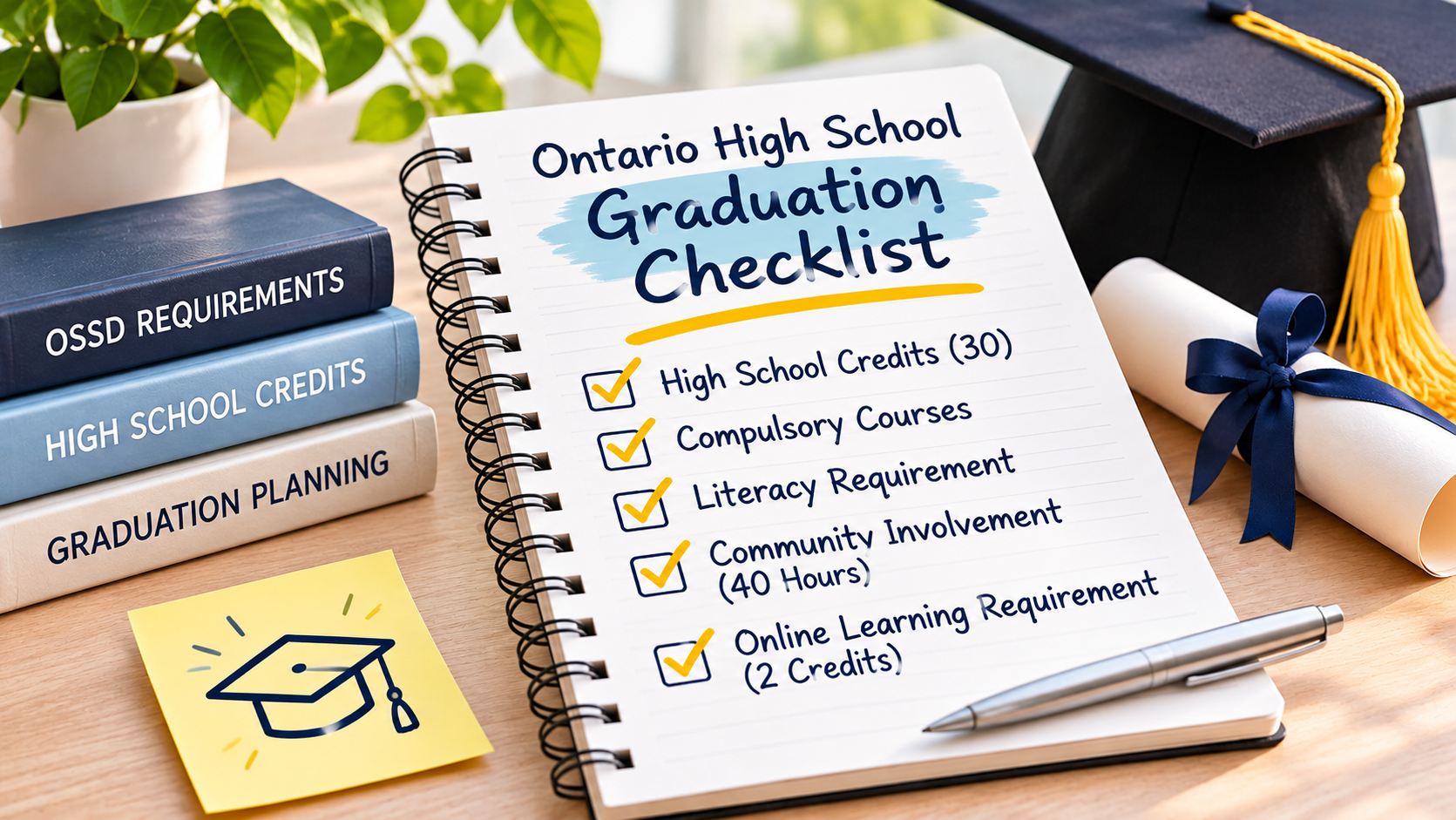
Ontario High School Graduation Checklist
Are you on track to graduate in Ontario? Use this practical OSSD checklist to review your credits, literacy requirement, volunteer hours, online learning and other graduation requirements.
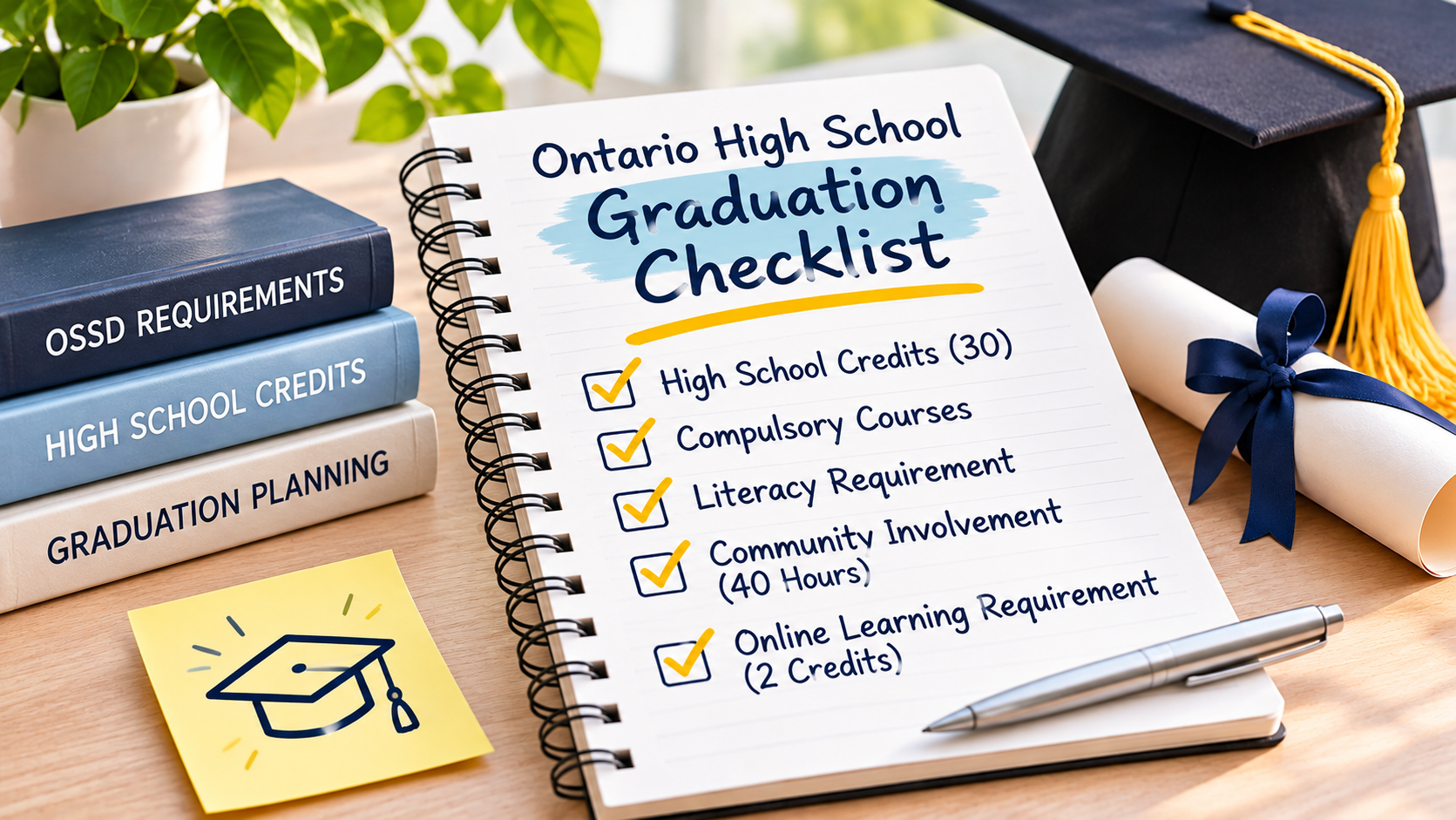
A practical guide to planning your OSSD
Are you on track to graduate from high school in Ontario? To earn an Ontario Secondary School Diploma (OSSD), students must complete the required high school credits and meet the applicable literacy, community involvement, online learning, and financial literacy requirements. Understanding what you have completed and what you still need is the first step toward graduating with confidence.
Whether you are in Grade 9, planning your Grade 12 year, transferring schools, or completing courses online, this Ontario high school graduation checklist can help you organize your next steps.
1. Have You Earned Enough High School Credits?
The first step in your graduation plan is checking your completed credits.
Most Ontario students need a minimum of 30 credits to earn an OSSD. However, the distribution of compulsory and optional credits depends on when you entered Grade 9.
Students who entered Grade 9 in September 2023 or earlier generally need 18 compulsory credits and 12 optional credits.
Students who entered Grade 9 in the 2024–2025 school year or later generally need 17 compulsory credits and 13 optional credits.
Your school can help confirm which requirements apply to your individual academic history.
Your credit checklist:
Review your most recent high school transcript.
Confirm how many credits you have successfully completed.
Identify any compulsory credits you are missing.
Check how many optional credits you still need.
Make a plan for any outstanding courses.
Remember that having 30 credits does not automatically mean you have met every graduation requirement. You must also satisfy the other applicable OSSD requirements.
2. Have You Completed All Your Compulsory Courses?
Compulsory courses are the subjects students must complete to earn their diploma. They provide a foundation in areas such as English, Mathematics, Science, Canadian History, and other required subjects.
For students following the requirements introduced in 2024–2025, compulsory credits include:
Four English credits, one for each grade
Three Mathematics credits, including at least one in Grade 11 or 12
Two Science credits
One Canadian geography credit
One Canadian history credit
One Arts credit
One Health and Physical Education credit
One French as a second language credit
One Technological education credit
Half a credit in Career studies
Half a credit in Civics and Citizenship
Additional compulsory credits specified by Ontario's graduation requirements
The exact list and distribution differ for students following earlier graduation requirements.
Your compulsory credit checklist:
Ask your school to identify any outstanding compulsory courses.
Check that your planned courses meet the correct grade and subject requirements.
Consider whether any missing courses could affect your graduation date.
Confirm that your remaining course plan meets your postsecondary goals, if applicable.
If you are planning to attend college or university, remember that admission prerequisites may differ from the courses required simply to graduate.
3. Have You Met the Ontario Literacy Requirement?
Ontario students must meet the provincial literacy graduation requirement to earn their OSSD.
For many students, this means successfully completing the Ontario Secondary School Literacy Test (OSSLT). Eligible students may meet the requirement through the Ontario Secondary School Literacy Course (OSSLC), depending on their circumstances and the rules that apply to them.
Your literacy checklist:
Confirm whether you have completed the OSSLT successfully.
If you have not met the requirement, ask your school about your available options.
Check whether the OSSLC is an appropriate pathway for your situation.
Make sure your literacy requirement is recorded as completed.
If you have changed schools or completed some of your education outside Ontario, ask your school to review your academic record and determine which requirements apply.
4. Have You Completed Your 40 Community Involvement Hours?
Ontario students generally need at least 40 hours of eligible community involvement activities to graduate.
These hours give students an opportunity to participate in their communities, explore interests, and develop skills outside the classroom.
Examples of possible activities include volunteering with eligible charitable organizations, supporting community events, and participating in approved community initiatives. Activities must meet Ontario's eligibility rules, so confirm that your planned volunteer work qualifies before counting the hours.
Your community involvement checklist:
Confirm how many approved hours you have completed.
Review your school's process for recording volunteer hours.
Submit any outstanding documentation.
Identify eligible opportunities if you still need hours.
Confirm that your completed hours have been recorded.
Do not leave this requirement until your final semester. Tracking your hours throughout high school can make graduation planning much easier.
5. Have You Met the Online Learning Requirement?
Ontario's OSSD requirements include two online learning credits for applicable students, subject to the provincial rules and available exemptions.
The online learning requirement is separate from the total number of credits needed for graduation.
Your online learning checklist:
Confirm whether the online learning requirement applies to you.
Check whether any qualifying online learning credits are already recorded on your transcript.
Determine whether you need additional online courses.
Ask your school about any applicable exemption or opt-out process.
Students who attend traditional in-person high schools may still need to consider this requirement. Families should confirm their individual circumstances with their school rather than assume that attending a regular high school automatically satisfies it.
For students who need a flexible way to complete additional OSSD credits, online learning may be one option to explore.
At Aubrey Academy, students can take online OSSD credit courses while working toward their academic goals. Learn more about our online high school and OSSD course options.
6. Are Your Grade 11 and Grade 12 Courses Aligned With Your Future Plans?
Graduation planning is not only about meeting minimum requirements. It is also about making sure your courses support what you want to do next.
For example, a student planning to attend university may need specific Grade 12 University Preparation courses. A student considering college may have different prerequisites, depending on the program.
Students interested in competitive athletics, performing arts, apprenticeships, or entering the workforce may also have particular academic goals to consider.
Your future planning checklist:
Identify your potential postsecondary or career pathways.
Research the admission requirements for programs that interest you.
Check whether you need specific Grade 11 or Grade 12 courses.
Review your current marks and identify any courses you may need to repeat or upgrade.
Confirm that your graduation plan leaves enough time to complete any required prerequisites.
You do not need to have every detail of your future decided. However, understanding your options early can help you make more informed course choices.
7. What If You Are Missing Credits or Have Changed Schools?
If your transcript shows that you are missing credits, you may still have options.
Students may need additional courses because they changed schools, transferred into Ontario from another education system, did not pass a course, or changed their postsecondary plans.
The right next step is to understand exactly what is outstanding before registering for another course.
Your catch-up checklist:
Obtain your most recent transcript or academic record.
Ask your school to identify outstanding graduation requirements.
Confirm whether previous coursework can be assessed for equivalency or recognition.
Identify the specific courses you need to complete.
Discuss possible course schedules and timelines with your school.
Check whether any outstanding courses are prerequisites for your future plans.
Students transferring from another province or country may have different credit assessment needs. Their graduation plan should be reviewed individually rather than based on the requirements of a student who completed all four years of high school in Ontario.
If you need additional flexibility, an online course may be worth considering.
Aubrey Academy is a Ministry-inspected online private high school in Ontario offering OSSD credit courses for students in Grades 9–12. Students can explore course options that may help them work toward their academic goals while balancing other commitments.
8. Your Final Ontario High School Graduation Checklist
Use this summary to review your progress with your school.
I have reviewed my transcript and completed credits.
I understand which OSSD graduation requirements apply to me.
I have completed, or planned to complete, all required compulsory and optional credits.
I have met the provincial literacy requirement.
I have completed the required community involvement hours.
I have checked my online learning requirement and any applicable exemption.
I have confirmed whether the financial literacy requirement applies to me.
I have checked the Grade 11 and Grade 12 courses needed for my future plans.
I have addressed any missing credits or outstanding documentation.
I have reviewed my expected graduation timeline with my school.
Keep a copy of your checklist and update it whenever you complete a course or another graduation requirement.
Frequently Asked Questions
How many credits do you need to graduate high school in Ontario?
Most students need 30 credits to earn an OSSD. The number of compulsory and optional credits depends on when the student entered Grade 9.
Can you graduate with 30 credits if you have not completed your volunteer hours?
No. Students must also meet the applicable community involvement requirement and the other requirements for their OSSD. Having enough credits alone is not sufficient.
Can online courses help you complete missing OSSD credits?
Online courses may provide an option for completing additional credits. Students should confirm that the course is appropriate for their academic plan and that the school and course meet their educational needs.
What should I do if I am not sure whether I am on track to graduate?
Start by reviewing your transcript and asking your school to confirm which requirements you have completed and which remain outstanding. A clear credit plan can help you identify the next steps.
Start Planning Your Path to Graduation
Graduating from high school is an important milestone, and keeping track of your progress can make the process feel more manageable.
By reviewing your credits, checking your graduation requirements, and planning ahead for any outstanding courses, you can take practical steps toward earning your Ontario Secondary School Diploma.
If you need additional courses or a more flexible learning option, Aubrey Academy can help you explore available online OSSD credit courses.
Interested in exploring your options? Visit Aubrey Academy to learn more about online courses, or contact the school at info@aubreyacademy.ca or (416) 998-3354 to discuss your academic goals.
Graduation requirements can vary by student and may change over time. Always confirm your individual requirements with your school and consult the Ontario Ministry of Education for the most current information.
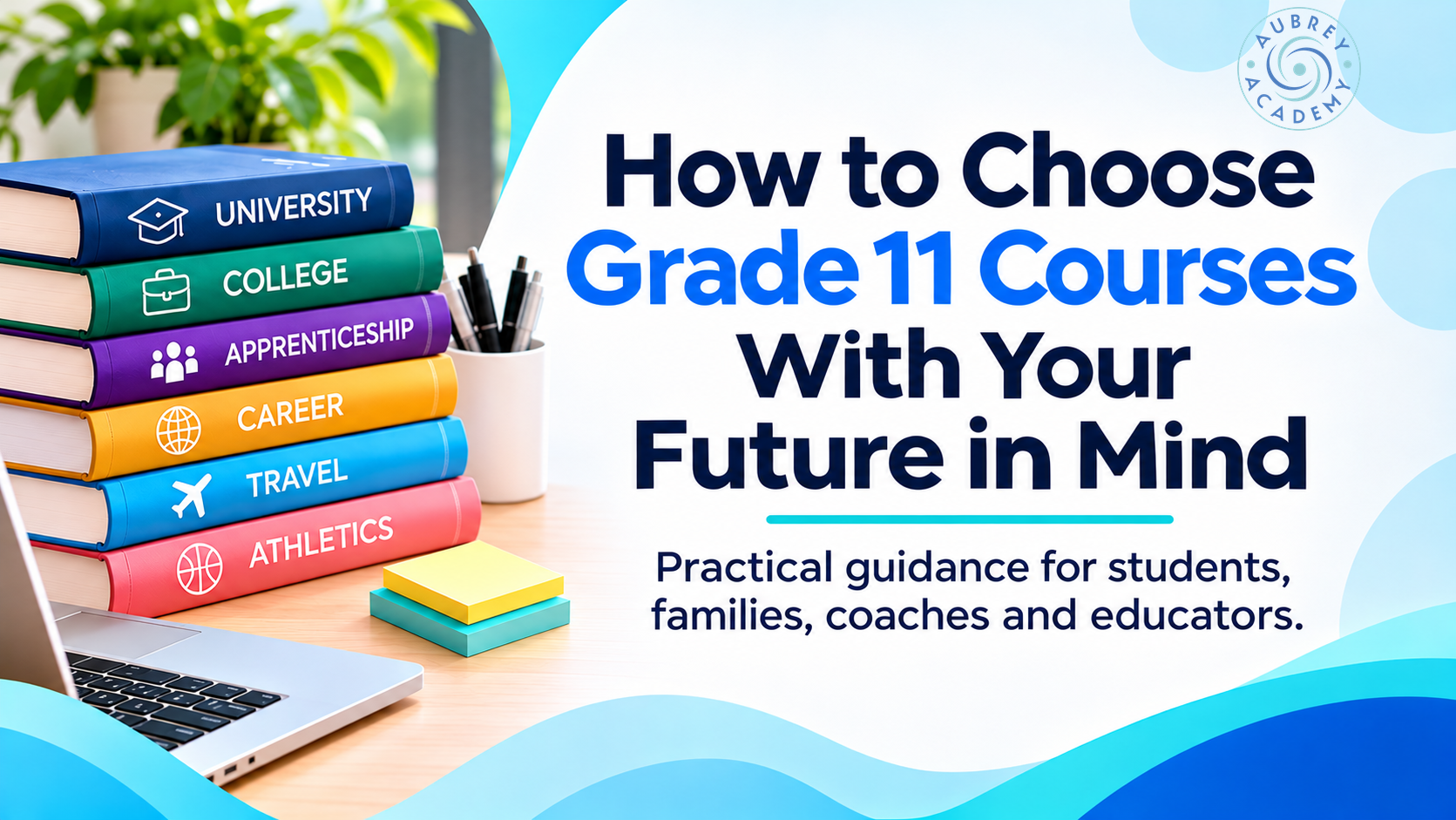
How to Choose Grade 11 Courses With Your Future in Mind
Grade 11 is an important time for Ontario students to plan ahead. Learn how to choose courses that align with your interests, prepare for Grade 12 prerequisites, and keep college, university, and career options open.
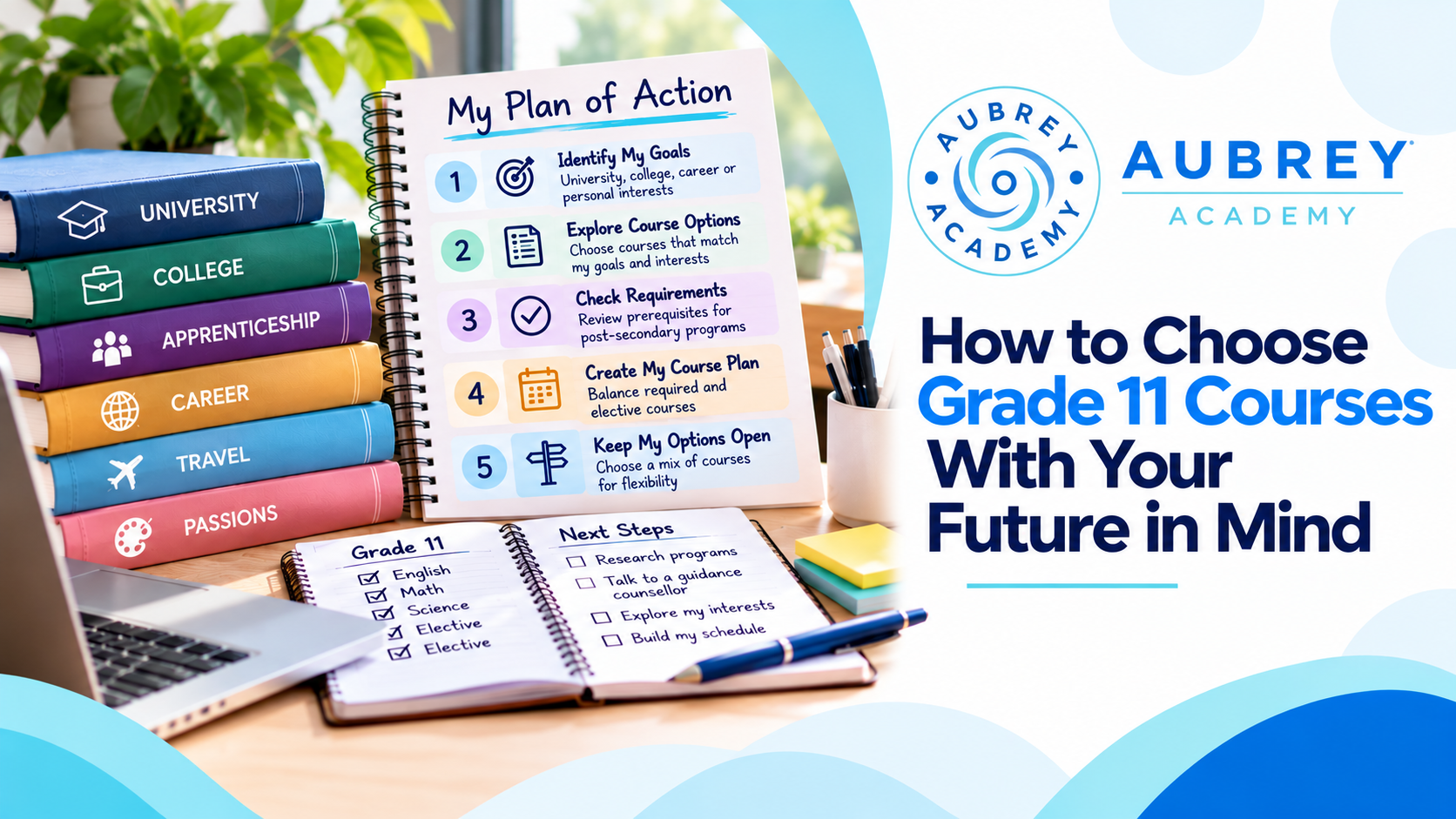
Grade 11 is an important year for Ontario high school students. As students begin thinking more seriously about college, university, apprenticeships, and future careers, the courses they choose can help shape the opportunities available to them after graduation.
If your teen is selecting Grade 11 courses this fall, now is a good time to look beyond next semester's timetable and consider the bigger picture. The right choices can help students prepare for Grade 12 prerequisites, explore their interests, and keep their future options open.
At Aubrey Academy, we understand that every student's path looks different. Whether your teen already has a clear career goal or is still figuring out what they enjoy, thoughtful course planning can make the transition from high school to postsecondary education easier.
Why Grade 11 Course Selection Matters
Grade 11 is more than another year of earning credits toward the Ontario Secondary School Diploma (OSSD). It is also an opportunity to prepare for the courses and requirements students may encounter in Grade 12.
Many college and university programs specify particular Grade 12 courses for admission. Students often need to complete the appropriate Grade 11 prerequisites before they can take those senior-level courses.
For example, a student interested in engineering may need to plan for senior mathematics and physics. Someone considering a health sciences program may need to investigate biology, chemistry, and mathematics requirements. A student interested in business may benefit from exploring mathematics and business-related courses.
The exact requirements depend on the institution and program. Planning ahead gives students more time to identify what they need rather than discovering a missing prerequisite in Grade 12.
Start With Your Interests, Not Just Your Marks
It is tempting to choose courses based only on past grades, friends' choices, or which classes seem easiest. While workload and academic strengths matter, students should also consider what interests them and where they might want to go next.
Encourage your teen to think about three questions:
What subjects do I enjoy? Consider the classes, projects, and activities that keep you interested and motivated.
What am I good at? Think about your strengths, the skills you have developed, and the subjects in which you feel confident.
What would I like to explore? You do not need to have your entire future figured out. You can use Grade 11 to investigate different fields and possibilities.
Students who are undecided about their future can still make thoughtful choices. The goal is to select courses that meet graduation requirements while preserving reasonable options for the next stage of their education.
Understand the Different Course Pathways
Ontario high school courses have different pathways and purposes. Understanding the course codes can help students make informed decisions.
University preparation (U)
University preparation courses are designed to prepare students for university-level study. They are often required for admission to university programs, particularly when a program specifies particular Grade 12 prerequisites.
College preparation (C)
College preparation courses help students develop the knowledge and skills needed for college programs. They may be appropriate for students pursuing a college diploma or other college pathway.
University/college preparation (M)
University/college preparation courses are designed to prepare students for both university and college pathways, depending on the subject and program requirements.
Workplace preparation (E)
Workplace preparation courses focus on knowledge and skills relevant to entering the workplace after high school.
Open courses (O)
Open courses are designed to broaden students' education and may be taken by students with different postsecondary plans.
The appropriate pathway depends on the individual course and the student's goals. A course code alone does not determine whether a student will qualify for a particular college or university program. Always check the admission requirements for the specific program your teen is considering.
Research Grade 12 Prerequisites Before You Choose
One of the most useful things students can do before finalizing Grade 11 courses is research the requirements for a few possible postsecondary programs.
You do not need to choose a university or college today. Instead, use this exercise to identify courses that may be important for your future options.
Start with these steps:
Choose two or three possible programs. They can be in the same field or represent different interests.
Visit the official college or university websites. Look for admission requirements for each program.
Write down the required Grade 12 courses. Note any specific mathematics, science, English, or other prerequisites.
Work backward to Grade 11. Check which courses are required to enter those Grade 12 courses.
Review your plan with your guidance counsellor. Confirm that your selections meet your current graduation requirements and keep your intended pathways open.
Admission requirements can change, so always use the institution's current information rather than relying solely on advice from friends, older students, or online discussions.
What If You Haven't Decided on a Career Yet?
Not every Grade 11 student knows what they want to do after graduation, and that is completely normal.
If your teen is undecided, focus on balancing their interests, strengths, graduation requirements, and potential future pathways.
Consider these strategies:
Keep an eye on prerequisites for fields that interest you, even if you are not ready to commit.
Explore subjects you enjoy and courses that introduce you to new areas of learning.
Ask questions about college, university, apprenticeship, and workplace pathways.
Avoid dropping a course that may be an important prerequisite without checking the consequences first.
Speak with a guidance counsellor if you are unsure which options will keep the most doors open.
The aim is not to predict your entire future in Grade 11. It is to make informed decisions that give you room to grow and change direction as your interests develop.
Balance Academic Goals With Your Other Commitments
Course selection is not only about meeting admission requirements. Students also need a realistic plan for managing their workload.
A demanding timetable combined with extracurricular activities, competitive sports, a part-time job, family responsibilities, or other commitments can become difficult to manage.
Before selecting courses, consider how much time you can realistically devote to assignments, studying, assessments, and exam preparation. Think about which subjects may require extra support and whether your schedule leaves enough room for rest and other responsibilities.
Students who need additional flexibility may also wish to explore individual online OSSD courses. Depending on their circumstances and school arrangements, an online course can be an option for completing a prerequisite or taking a course that does not fit their regular timetable.
A flexible learning arrangement should still include a clear plan for completing coursework and meeting academic expectations.
What If You Need a Course Your School Doesn't Offer?
Sometimes a student discovers that their school does not offer a particular course, that a course conflicts with another required class, or that they need an additional course to prepare for a future program.
Before changing your plans, speak with your guidance counsellor about the available options. Depending on your situation, you may be able to consider another timetable arrangement or an individual course through an eligible online school.
Aubrey Academy offers online OSSD courses for Ontario students in Grades 9–12, including selected Grade 11 courses in English, mathematics, science, business, and other subject areas.
If you are considering an additional course, first confirm that it meets your specific academic goal and that you satisfy its prerequisites.
You can browse the Aubrey Academy course list to explore available options.
A Simple Grade 11 Course-Planning Checklist
Before submitting your course selections, use this checklist to review your plan.
Confirm that your courses support your progress toward the OSSD.
Research the admission requirements for programs that interest you.
Identify the Grade 12 courses you may need.
Check the prerequisites for those Grade 12 courses.
Consider your academic strengths, interests, and current workload.
Discuss any uncertainties with your guidance counsellor.
Investigate alternatives if a required course is unavailable or does not fit your timetable.
Keep a copy of your course plan and revisit it as your goals develop.
A little planning now can help reduce stress later and give you more confidence when Grade 12 course selection arrives.
Frequently Asked Questions
Is Grade 11 important for university admission in Ontario?
Grade 11 can be important for preparing for university admission because students use this year to complete prerequisites for Grade 12 courses. Universities generally base admission decisions on their published requirements, including specified Grade 12 courses and marks. Requirements vary by program and institution.
Can I change my mind about my career after choosing Grade 11 courses?
Yes. Many students change their interests as they learn more about themselves and their options. The key is to review any new plans against the required prerequisites and graduation requirements before changing courses.
Should I take university preparation courses if I'm unsure about university?
That depends on your interests and possible future pathways. If university is one option you want to preserve, investigate the required courses before choosing your timetable. A guidance counsellor can help you understand which choices make sense for your situation.
What if I am missing a prerequisite for Grade 12?
Speak with your guidance counsellor as early as possible. They can help you understand your options and whether an alternative timetable or an additional course may be appropriate.
Can I take a Grade 11 OSSD course online?
Individual online OSSD courses may be an option for eligible students who need a particular credit or prerequisite. Confirm the course's requirements, availability, and suitability for your academic plan before enrolling.
Start Planning Your Next Step
Grade 11 course selection is an opportunity to make decisions that support both your immediate learning needs and your longer-term goals. Students do not need to have everything figured out, but they should understand how their choices may affect the courses and programs available to them later.
At Aubrey Academy, we support students working toward their OSSD through flexible online learning options.
If your teen needs a particular course, wants to explore available Grade 11 options, or is unsure how an online course might fit into their academic plan, we invite you to connect with our team.
Explore your options: Visit our online OSSD course list to see available courses.
Need help finding the right course? Contact Aubrey Academy at info@aubreyacademy.ca or call/text (416) 998-3354 to discuss your student's needs.
Planning ahead today can help students approach Grade 12 with greater confidence and a clearer path toward what comes next.
Aubrey Academy
Ontario Ministry-Inspected Private High School
Flexible online learning for students working toward their OSSD.
Injured During Your Season? An Ontario Student-Athlete’s Academic Plan
An unexpected injury can change a student-athlete’s season, but it doesn't have to derail their education. Discover practical ways to protect your OSSD progress, stay on track with university plans, and explore flexible learning options in Ontario.
When an Injury Changes More Than Your Season
For student-athletes in Ontario, an unexpected injury can affect more than playing time. It can disrupt training schedules, travel plans, recruitment opportunities, and even the way a student approaches school.
When an athlete is focused on reaching the next level, an injury may leave them wondering what happens next. Will they fall behind in school? Can they continue working toward their Ontario Secondary School Diploma (OSSD)? What if they need to change their plans for university or college?
The good news is that an injury does not automatically mean your academic goals have to go on hold. With communication, a review of your academic progress, and a plan that reflects your circumstances, you can continue working toward your future while you recover.
At Aubrey Academy, we understand that student-athletes have goals beyond the classroom. Their education should remain part of the plan, even when the unexpected happens.
1. Start With Your Current Academic Standing
When an injury occurs, schoolwork may be the last thing on your mind. Your first priority should be following your healthcare team's guidance and allowing yourself time to recover.
Once you're ready to review your schoolwork, start by understanding exactly where you stand academically.
Ask yourself:
How many OSSD credits have I completed?
Which courses am I currently taking?
Are there upcoming assignments, assessments, or deadlines I need to address?
Am I meeting the prerequisites for the university or college programs I'm considering?
Could a change to my athletic schedule affect my graduation timeline?
Reviewing your transcript and current courses can help you identify what needs attention before small concerns become bigger problems.
If you are considering university athletics, remember that your academic record matters independently of your athletic performance. Keeping track of your credits, grades, and prerequisites helps you protect future opportunities.
2. Communicate With Your School Early
An injury can make it difficult to keep up with your usual school routine, particularly if you're attending medical appointments, recovering from surgery, or managing a lengthy rehabilitation schedule.
Rather than waiting until you have missed several deadlines, contact your teachers or school administration as early as possible.
Explain your circumstances and ask what options may be available to help you manage your coursework.
Depending on your situation and school policies, you may be able to discuss adjusted timelines, available academic supports, or an appropriate plan for continuing your studies.
Remember that an injury does not automatically change school deadlines or course requirements. Communicating early gives you and your school an opportunity to understand your options and determine the next steps.
3. Consider Whether Your Learning Schedule Needs to Change
Not every athlete experiences the same recovery. Some may return to their regular routine relatively quickly, while others may need months of rehabilitation or a longer period away from competition.
If your previous school schedule no longer fits your circumstances, it may be worth exploring alternative learning arrangements.
For example, an athlete who previously spent hours travelling to practices and competitions may suddenly have more time available for coursework. Another athlete may need greater flexibility because recovery appointments and fatigue make a fixed daily schedule difficult.
An asynchronous online learning model can offer another way to approach education. Students can work through their courses without attending a traditional live online class at a set time each day, while still completing required coursework and receiving teacher support.
At Aubrey Academy, students can explore flexible online OSSD courses that may better accommodate changing schedules.
The key is to find an arrangement that supports your academic progress without creating unnecessary pressure during recovery.
Explore your options: Visit Aubrey Academy to learn more about flexible online high school education in Ontario.
4. Protect Your University and College Options
One of the biggest concerns for a competitive athlete is what an injury might mean for their future.
If you were hoping to earn an athletic scholarship, join a university team, or attend a college with a competitive sports program, it is understandable to worry about losing momentum.
However, an injury does not necessarily eliminate those possibilities.
While you focus on recovery, you can still take practical steps to protect your academic pathway:
Review admission requirements. Check the prerequisites and application deadlines for the programs you are considering.
Keep your transcript organized. Make sure you understand which credits you have earned and which requirements remain outstanding.
Maintain communication with coaches. If you are already in contact with a recruitment coach, ask what information they need and how your circumstances may affect their recruitment timeline.
Review athletic eligibility separately. Rules vary by institution, league, and athletic association. Contact the relevant organization or institution to understand how an injury, a delayed graduation, or a change in enrolment could affect your eligibility.
Build more than one pathway. Consider academic programs and career interests alongside your athletic ambitions.
Your future does not have to depend on a single season or one recruitment opportunity. Keeping your academic options open gives you more choices as your circumstances change.
5. Remember That Your Identity Is Bigger Than Your Sport
For athletes who have trained and competed for years, being sidelined can be difficult emotionally as well as physically.
Sport often provides structure, friendships, confidence, and a sense of purpose. When an injury removes those familiar routines, it can be challenging to know where to focus your energy.
Education can provide a meaningful area of progress during this time.
Working toward a course completion, exploring a future career, or preparing for post-secondary education can help you maintain a sense of direction while your athletic plans are temporarily uncertain.
This does not mean you need to fill every available hour with schoolwork. Recovery takes time, and your academic plan should reflect your needs and circumstances.
Instead, think of education as another part of your long-term development. The discipline, persistence, and ability to adapt that you build through sport can also help you navigate academic challenges.
6. Create a Practical Academic Recovery Plan
You do not need to map out your entire future immediately after an injury. Start with a manageable plan and adjust it as your circumstances evolve.
Here is a simple checklist for student-athletes and their families.
Your academic action plan
Review your current transcript and completed OSSD credits.
List your current courses, upcoming assessments, and deadlines.
Contact your school to discuss your situation and available supports.
Identify any university or college prerequisites that still need to be completed.
Determine whether your current learning schedule remains realistic.
If appropriate, explore flexible online course options.
Revisit your plan regularly as your recovery and schedule change.
Parents can help by supporting communication with the school, keeping track of important dates, and helping their student consider alternatives without making decisions based solely on the uncertainty of the moment.
Coaches can also play a valuable role by encouraging athletes to maintain their academic plans while they work through the challenges of recovery.
The goal is not to rush back into a demanding routine. It is to make sure that the next steps remain manageable and aligned with the student's longer-term goals.
How Aubrey Academy Supports Student-Athletes
An athletic injury can change a student's immediate priorities, but it does not have to mean abandoning their education.
Aubrey Academy is a Ministry-inspected private online high school in Ontario offering courses toward the Ontario Secondary School Diploma (OSSD). Its flexible learning model can help students explore ways to continue their education while navigating demanding or changing schedules.
Whether you are an athlete managing a busy competition calendar, reassessing your plans after an injury, or preparing for post-secondary opportunities, reviewing your academic options can help you make informed decisions.
Every student's situation is different. The right course plan depends on completed credits, graduation requirements, intended post-secondary programs, and any applicable athletic eligibility rules.
Want to understand your options? Visit Aubrey Academy to explore online OSSD courses and learn more about academic support for student-athletes.
Your Season May Change. Your Future Is Still Yours to Shape.
An injury can interrupt your plans, challenge your confidence, and force you to reconsider your next steps. But it can also be an opportunity to reassess your priorities and make sure you are building a future that extends beyond competition.
Your athletic journey may not follow the timeline you originally imagined. That does not mean your education has to stop moving forward.
With a realistic plan, the right communication, and an educational pathway that reflects your circumstances, you can continue working toward your goals on and off the field, court, track, or rink.
Ready to plan your next academic step? Contact Aubrey Academy to explore flexible Ontario high school courses designed to support students with different goals and schedules.
This article provides general educational information, not medical advice or a guarantee of academic or athletic eligibility. Students should confirm individual course, graduation, admission, and athletic requirements with the appropriate school or organization.

U SPORTS vs NCAA: Academic Requirements for Ontario Student-Athletes
Compare the academic requirements for NCAA, U SPORTS and JUCO as an Ontario student-athlete, and learn how to plan your high school courses so every pathway stays open.
Ontario student-athletes often have three realistic paths after high school: NCAA schools in the United States, U SPORTS teams at Canadian universities and junior colleges (JUCO) in the United States. Each one checks your academics differently. Here is a side-by-side look so you can plan your courses once and keep every option open.
The quick comparison
NCAA (D1 and D2)
Who checks your academics: NCAA Eligibility Center
Entry requirement: 16 core courses and a minimum core GPA (2.3 for D1, 2.2 for D2)
What matters most: U and M courses in core subjects, marks converted to a 4.0 scale
Standardized tests: Not required for NCAA eligibility
U SPORTS
Who checks your academics: The university you are admitted to
Entry requirement: Admission to the university and enrollment in degree courses
What matters most: Your admission average and program prerequisites
Standardized tests: Not required by most Ontario universities
JUCO
Who checks your academics: The college you enroll in
Entry requirement: Proof of high school graduation
What matters most: Your diploma, then college grades once enrolled
Standardized tests: Generally not required
NCAA: a course-by-course standard
The NCAA is the most detailed of the three. Division I requires 16 core courses, including 4 years of English and 3 years of math, with 10 core courses completed before your final year and a minimum core GPA of 2.3. Division II requires 16 core courses and a 2.2 core GPA. For Ontario students, only University (U) and University/College (M) courses count as core courses. Learn more in our step-by-step NCAA eligibility guide.
U SPORTS: admission is the key
Since the 2024-25 season, first-year U SPORTS student-athletes can compete and receive athletic scholarships once they are admitted to a university and enrolled in degree courses. There is no separate first-year grade minimum. That means your Ontario admission average and program prerequisites are what really count. Competitive programs often require strong averages across six Grade 12 U and M courses, so upgrading one or two marks can make a real difference.
JUCO: your diploma opens the door
Junior college athletics programs require proof of high school graduation. For Ontario students that is the Ontario Secondary School Diploma (OSSD). Once you are enrolled, you need to keep up your college grades and course load to stay eligible. JUCO can be a strong path for athletes who want to develop and then transfer to a four-year school.
How to plan for all three at once
Choose U and M courses in English, math, science and social science from Grade 9 onward. They satisfy the NCAA and support university admission.
Protect your marks. An 80 counts as a 4.0 for the NCAA and also helps your U SPORTS admission average.
Watch the timeline. Complete 10 NCAA core courses before your final year.
Graduate on time. Your OSSD is required for every path.
Plan your pathway with Aubrey Academy
Aubrey Academy is a Ministry-inspected Ontario private online high school (BSID 665140) built around training and travel schedules. Our NCAA Eligibility Pathway Planning service (CA$250) covers D1, D2, D3, U SPORTS and JUCO. It includes a transcript review, your NCAA core GPA, your U SPORTS admission average, a course-by-course academic plan and an academic profile for coaches. Your first NCAA consultation is free. The service is open to student-athletes everywhere, not only in Canada, including international and U.S. students. Visit our student-athlete page to learn more.
Rules can change. Always confirm requirements with the NCAA Eligibility Center, U SPORTS, the NJCAA and each school.