
Injured During Your Season? An Ontario Student-Athlete’s Academic Plan
An unexpected injury can change a student-athlete’s season, but it doesn't have to derail their education. Discover practical ways to protect your OSSD progress, stay on track with university plans, and explore flexible learning options in Ontario.
When an Injury Changes More Than Your Season
For student-athletes in Ontario, an unexpected injury can affect more than playing time. It can disrupt training schedules, travel plans, recruitment opportunities, and even the way a student approaches school.
When an athlete is focused on reaching the next level, an injury may leave them wondering what happens next. Will they fall behind in school? Can they continue working toward their Ontario Secondary School Diploma (OSSD)? What if they need to change their plans for university or college?
The good news is that an injury does not automatically mean your academic goals have to go on hold. With communication, a review of your academic progress, and a plan that reflects your circumstances, you can continue working toward your future while you recover.
At Aubrey Academy, we understand that student-athletes have goals beyond the classroom. Their education should remain part of the plan, even when the unexpected happens.
1. Start With Your Current Academic Standing
When an injury occurs, schoolwork may be the last thing on your mind. Your first priority should be following your healthcare team's guidance and allowing yourself time to recover.
Once you're ready to review your schoolwork, start by understanding exactly where you stand academically.
Ask yourself:
How many OSSD credits have I completed?
Which courses am I currently taking?
Are there upcoming assignments, assessments, or deadlines I need to address?
Am I meeting the prerequisites for the university or college programs I'm considering?
Could a change to my athletic schedule affect my graduation timeline?
Reviewing your transcript and current courses can help you identify what needs attention before small concerns become bigger problems.
If you are considering university athletics, remember that your academic record matters independently of your athletic performance. Keeping track of your credits, grades, and prerequisites helps you protect future opportunities.
2. Communicate With Your School Early
An injury can make it difficult to keep up with your usual school routine, particularly if you're attending medical appointments, recovering from surgery, or managing a lengthy rehabilitation schedule.
Rather than waiting until you have missed several deadlines, contact your teachers or school administration as early as possible.
Explain your circumstances and ask what options may be available to help you manage your coursework.
Depending on your situation and school policies, you may be able to discuss adjusted timelines, available academic supports, or an appropriate plan for continuing your studies.
Remember that an injury does not automatically change school deadlines or course requirements. Communicating early gives you and your school an opportunity to understand your options and determine the next steps.
3. Consider Whether Your Learning Schedule Needs to Change
Not every athlete experiences the same recovery. Some may return to their regular routine relatively quickly, while others may need months of rehabilitation or a longer period away from competition.
If your previous school schedule no longer fits your circumstances, it may be worth exploring alternative learning arrangements.
For example, an athlete who previously spent hours travelling to practices and competitions may suddenly have more time available for coursework. Another athlete may need greater flexibility because recovery appointments and fatigue make a fixed daily schedule difficult.
An asynchronous online learning model can offer another way to approach education. Students can work through their courses without attending a traditional live online class at a set time each day, while still completing required coursework and receiving teacher support.
At Aubrey Academy, students can explore flexible online OSSD courses that may better accommodate changing schedules.
The key is to find an arrangement that supports your academic progress without creating unnecessary pressure during recovery.
Explore your options: Visit Aubrey Academy to learn more about flexible online high school education in Ontario.
4. Protect Your University and College Options
One of the biggest concerns for a competitive athlete is what an injury might mean for their future.
If you were hoping to earn an athletic scholarship, join a university team, or attend a college with a competitive sports program, it is understandable to worry about losing momentum.
However, an injury does not necessarily eliminate those possibilities.
While you focus on recovery, you can still take practical steps to protect your academic pathway:
Review admission requirements. Check the prerequisites and application deadlines for the programs you are considering.
Keep your transcript organized. Make sure you understand which credits you have earned and which requirements remain outstanding.
Maintain communication with coaches. If you are already in contact with a recruitment coach, ask what information they need and how your circumstances may affect their recruitment timeline.
Review athletic eligibility separately. Rules vary by institution, league, and athletic association. Contact the relevant organization or institution to understand how an injury, a delayed graduation, or a change in enrolment could affect your eligibility.
Build more than one pathway. Consider academic programs and career interests alongside your athletic ambitions.
Your future does not have to depend on a single season or one recruitment opportunity. Keeping your academic options open gives you more choices as your circumstances change.
5. Remember That Your Identity Is Bigger Than Your Sport
For athletes who have trained and competed for years, being sidelined can be difficult emotionally as well as physically.
Sport often provides structure, friendships, confidence, and a sense of purpose. When an injury removes those familiar routines, it can be challenging to know where to focus your energy.
Education can provide a meaningful area of progress during this time.
Working toward a course completion, exploring a future career, or preparing for post-secondary education can help you maintain a sense of direction while your athletic plans are temporarily uncertain.
This does not mean you need to fill every available hour with schoolwork. Recovery takes time, and your academic plan should reflect your needs and circumstances.
Instead, think of education as another part of your long-term development. The discipline, persistence, and ability to adapt that you build through sport can also help you navigate academic challenges.
6. Create a Practical Academic Recovery Plan
You do not need to map out your entire future immediately after an injury. Start with a manageable plan and adjust it as your circumstances evolve.
Here is a simple checklist for student-athletes and their families.
Your academic action plan
Review your current transcript and completed OSSD credits.
List your current courses, upcoming assessments, and deadlines.
Contact your school to discuss your situation and available supports.
Identify any university or college prerequisites that still need to be completed.
Determine whether your current learning schedule remains realistic.
If appropriate, explore flexible online course options.
Revisit your plan regularly as your recovery and schedule change.
Parents can help by supporting communication with the school, keeping track of important dates, and helping their student consider alternatives without making decisions based solely on the uncertainty of the moment.
Coaches can also play a valuable role by encouraging athletes to maintain their academic plans while they work through the challenges of recovery.
The goal is not to rush back into a demanding routine. It is to make sure that the next steps remain manageable and aligned with the student's longer-term goals.
How Aubrey Academy Supports Student-Athletes
An athletic injury can change a student's immediate priorities, but it does not have to mean abandoning their education.
Aubrey Academy is a Ministry-inspected private online high school in Ontario offering courses toward the Ontario Secondary School Diploma (OSSD). Its flexible learning model can help students explore ways to continue their education while navigating demanding or changing schedules.
Whether you are an athlete managing a busy competition calendar, reassessing your plans after an injury, or preparing for post-secondary opportunities, reviewing your academic options can help you make informed decisions.
Every student's situation is different. The right course plan depends on completed credits, graduation requirements, intended post-secondary programs, and any applicable athletic eligibility rules.
Want to understand your options? Visit Aubrey Academy to explore online OSSD courses and learn more about academic support for student-athletes.
Your Season May Change. Your Future Is Still Yours to Shape.
An injury can interrupt your plans, challenge your confidence, and force you to reconsider your next steps. But it can also be an opportunity to reassess your priorities and make sure you are building a future that extends beyond competition.
Your athletic journey may not follow the timeline you originally imagined. That does not mean your education has to stop moving forward.
With a realistic plan, the right communication, and an educational pathway that reflects your circumstances, you can continue working toward your goals on and off the field, court, track, or rink.
Ready to plan your next academic step? Contact Aubrey Academy to explore flexible Ontario high school courses designed to support students with different goals and schedules.
This article provides general educational information, not medical advice or a guarantee of academic or athletic eligibility. Students should confirm individual course, graduation, admission, and athletic requirements with the appropriate school or organization.

Can You Switch to Online High School Mid-Year in Ontario? What Parents Need to Know
Considering a mid-year switch to online high school in Ontario? Learn how transferring credits works, what happens to your OSSD requirements, and what students and parents should consider before making the change.
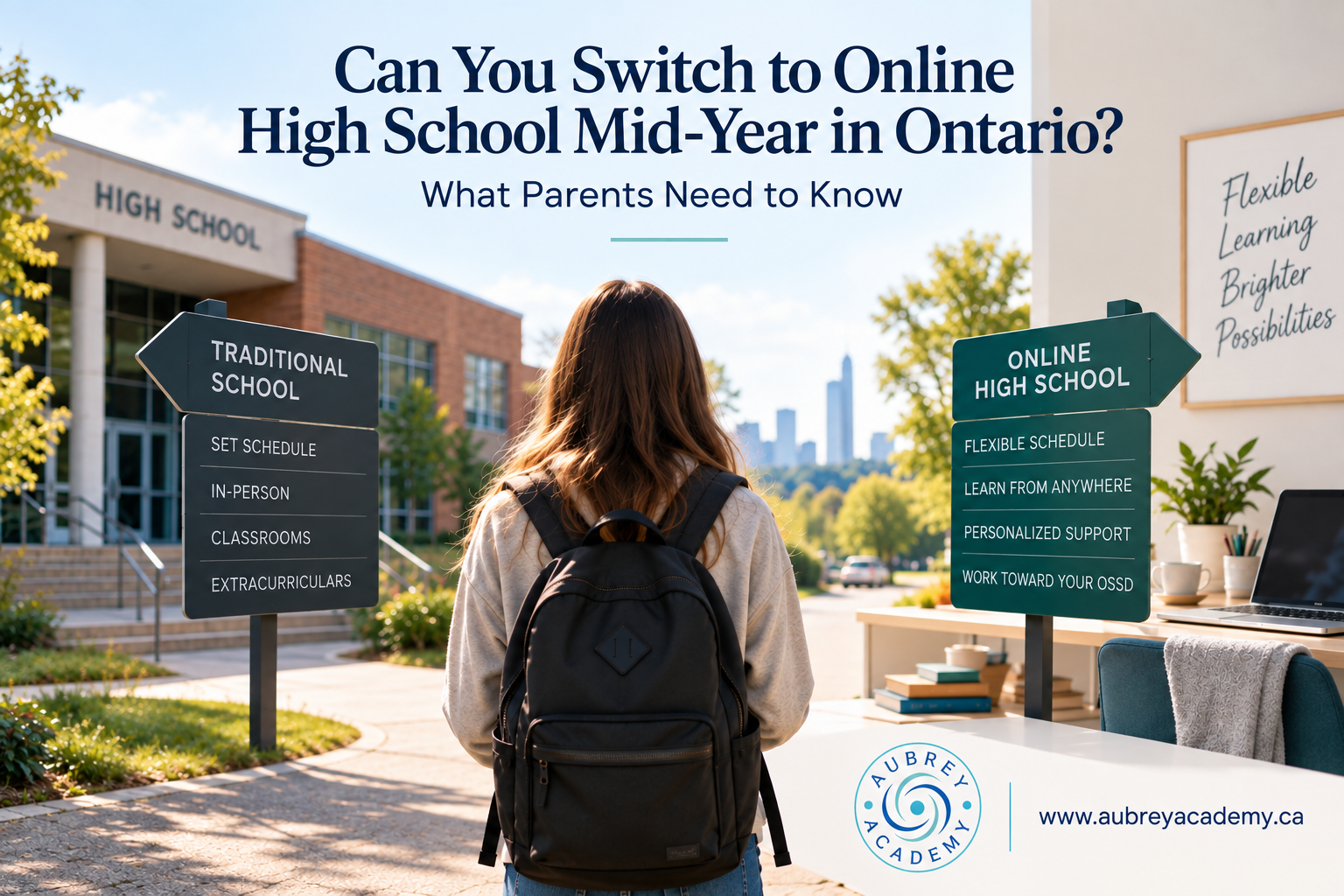
Yes, students can switch to an online high school in Ontario during the school year. Depending on the student’s situation, they may be able to transfer completed credits, continue working toward their OSSD, and begin courses online without waiting for a new school year.
For families considering a mid-year change, the most important steps are understanding which credits the student has already earned, determining which OSSD requirements remain, and choosing a school that can support the transition.
Why Do Students Switch to Online High School Mid-Year?
There are many reasons a student may need a different high school option during the school year.
Some students find that their current school environment is no longer the right fit. Others may need greater flexibility because of athletics, travel, health or family circumstances, or a change in their academic goals.
Online high school can also be an option for students who need to catch up on credits, want to earn additional credits, or need a more flexible schedule.
Aubrey Academy is a flexible, Ministry-inspected online private high school in Ontario offering OSSD credits for students in Grades 9 to 12.
Can I Transfer My High School Credits to an Online School?
In many cases, students can transfer previously earned high school credits when moving to another Ontario high school. The receiving school reviews the student’s academic records to determine which credits can be applied toward their OSSD requirements.
Students should provide their most recent transcript or Ontario Student Transcript (OST) so the school can accurately review their progress.
Will Switching Schools Mid-Year Affect My OSSD?
Switching schools mid-year does not automatically prevent a student from earning an OSSD.
The key is understanding the credits and requirements the student has already completed and creating a plan for the courses still needed. A review of the student’s transcript can help identify any outstanding compulsory or elective credits.
What If I Am Already Taking a Course at Another Ontario High School?
If a student is already enrolled in a course when they decide to switch to an online high school, the next steps will depend on the student’s academic record and the status of the course.
The new school can review the student’s academic records to determine which credits have been completed and what requirements remain toward the OSSD. Families should provide the most up-to-date academic information available so the school can determine the appropriate next steps.
It is helpful to speak with the new school before withdrawing from the current school so the student’s transition can be planned appropriately.
Can I Switch to Online High School After Starting the School Year?
Yes. Students do not necessarily have to wait until September to switch to an online high school in Ontario.
A mid-year transition may be possible depending on the school, course availability, the student’s academic records, and the timing of the request. Families should contact the school directly to discuss the student’s situation and determine the best next steps.
Is Online High School a Good Option for Student Athletes?
Online high school can be particularly helpful for student athletes who need more flexibility in their daily schedules.
Training, competitions, travel, and tournaments can make a traditional school schedule difficult to manage. An online learning environment may allow students to organize their schoolwork around their athletic commitments while continuing to work toward their OSSD.
Is Online High School an Option for Homeschool Families?
Yes. Families who have been homeschooling may also explore Ontario online high school as they plan the student’s transition toward earning an OSSD.
The student’s previous academic work and completed credits should be reviewed so the school can determine what requirements remain and what courses may be appropriate.
Can International Students Study Toward an OSSD Online?
International students may also consider an Ontario online high school when looking for flexibility or an Ontario secondary school credit pathway.
Because individual circumstances and academic histories vary, international families should speak with the school about their previous education, current goals, and the OSSD requirements they need to complete.
What Documents Do I Need to Switch to an Online High School?
The documents required can vary depending on the student and the school. Typically, an academic transcript or Ontario Student Transcript is an important starting point.
Having accurate academic records allows the school to review completed credits and determine what courses the student may need to complete next.
How Do I Know Which OSSD Courses I Still Need?
The best way to determine what a student needs is to review their academic record against the requirements for the Ontario Secondary School Diploma.
This can help identify completed credits, remaining compulsory credits, elective requirements, and other graduation requirements. A school can help families understand the student’s current academic standing and develop a course plan.
What If My Student Wants to Catch Up on Credits?
Online learning can provide an opportunity for students to work toward outstanding credits while having greater flexibility in how they organize their school time.
For some students, the ability to focus on one course at a time or work around other commitments can make it easier to stay on track academically.
What Should Parents Consider Before Switching Mid-Year?
Before making a change, parents should consider:
Which credits has the student already completed?
Which OSSD requirements are still outstanding?
Does the online school offer the courses the student needs?
How flexible is the course schedule?
What support is available to the student?
How will completed credits be documented?
What is the expected timeline for completing the remaining courses?
It is also important to choose a school that is properly authorized to offer the Ontario secondary school credits the student needs.
Aubrey Academy provides flexible online learning for Ontario high school students who are looking for an alternative to a traditional school setting while working toward their OSSD.
Frequently Asked Questions About Switching to Online High School
Can I switch to an online high school in Ontario during the school year?
Yes. Students can explore switching to an online high school during the school year. Their academic records should be reviewed to determine which credits they have completed and what requirements remain.
Can I transfer my Ontario high school credits?
Previously earned credits may be transferred and applied toward the student’s OSSD requirements. The receiving school will review the student’s academic records to determine how the credits fit into their graduation plan.
Do I have to wait until September to start online high school?
No. Some online high schools allow students to begin courses at different points during the school year. Start dates and course availability vary by school.
Is online high school good for student athletes?
It can be. The flexibility of online learning may make it easier for student athletes to balance schoolwork with training, competitions, and travel.
Can homeschool students earn an OSSD through online high school?
Homeschool families can explore online high school as an option for completing Ontario secondary school credits. The student’s previous academic work should be reviewed to determine an appropriate pathway.
What is the first step if I want to switch schools?
The first step is to contact the online high school and provide the student’s current academic records for review. This allows the school to determine what credits have been completed and what courses may still be required.
Thinking About Switching to Online High School?
If you're considering a mid-year transfer, contact Aubrey Academy to discuss your student's academic record and course options.
Contact Aubrey Academy to discuss your student’s academic situation, review their course options, and learn more about working toward an OSSD through flexible online learning in Ontario.
Ready to explore your options? Contact Aubrey Academy today.

10 Signs Your Teen Might Thrive in an Online High School (Ontario Parents’ Guide)
Could your teen benefit from online high school? Discover 10 signs that an online learning environment may be the right fit and learn how Aubrey Academy helps Ontario students earn their Ontario Secondary School Diploma (OSSD) with flexible, personalized education.
At Aubrey Academy, a Ministry-inspected Ontario private school (BSID #665140), we help students earn their Ontario Secondary School Diploma (OSSD) through flexible online learning. Here are ten signs that your teen might thrive in an online high school setting.
For some Ontario teens, an online high school can provide the flexibility, structure, and academic support they need to succeed while working toward their OSSD.
1. They Prefer a Flexible Schedule
If your teen has commitments like sports, dance, music, or part-time work, online learning allows them to balance their responsibilities more effectively. Instead of trying to fit everything into a traditional school day, they can create a schedule that works for them while continuing to earn their OSSD.
Learn more about how we support Student Athletes.
2. They Are Self-Motivated
Students who can manage their time and stay on task independently often excel in an online environment. They enjoy taking ownership of their learning while still receiving support and guidance from their teachers when they need it.
3. They Feel Distracted in Traditional Classrooms
A quieter, more controlled learning space at home can help students focus better. For teens who find busy classrooms overwhelming, online learning can reduce distractions and improve concentration.
4. They Want to Learn at Their Own Pace
Online courses allow students to move quickly through material they understand and spend more time on challenging topics. This flexibility can build confidence and help students achieve better results.
5. They Have Unique Learning Needs
Whether they need extra support or more advanced material, online learning can be tailored to fit individual needs. Personalized learning helps students work toward success in a way that suits them best.
Not sure which courses your teen should start with? Visit our FAQ to learn more about enrollment, credits, pacing, and teacher support at Aubrey Academy.
6. They Experience Anxiety in Social Settings
For some students, reducing the pressures of a traditional school environment can improve confidence and academic performance. Learning in a comfortable environment allows many teens to focus more on their education and less on the stress of everyday school life.
7. They Travel Frequently
Families who travel or relocate often can benefit from the consistency of online education. Whether travelling for sports, work, or family commitments, students can continue earning Ontario high school credits from anywhere with an internet connection.
Learn more about our International Student program.
8. They Are Pursuing Specialized Interests
Teens focused on athletics, dance, music, arts, or other passions can maintain their training while continuing their education. Online learning provides the flexibility to pursue personal goals without putting academics on hold.
9. They Want to Upgrade or Recover Credits
Online learning offers opportunities to retake courses, improve grades, or earn missing OSSD credits in a flexible format. Many Ontario students choose online courses to strengthen their college or university applications.
Browse our complete list of OSSD Courses.
10. They Are Preparing for Post-Secondary Goals
Online learning helps students develop independence, time management, and responsibility—skills that are essential for college and university success. These habits often give students greater confidence as they transition to post-secondary education.
Learn more about our programs and how Aubrey Academy helps students earn their Ontario Secondary School Diploma.
Is Online High School Right for Your Teen?
Every student learns differently, and the best learning environment is one that supports their individual goals, strengths, and lifestyle. For many Ontario families, online education provides the flexibility and personalized support students need to succeed.
At Aubrey Academy, we’re committed to helping students earn their Ontario Secondary School Diploma (OSSD) through engaging online courses, experienced teachers, and personalized academic support.
Ready to see if online learning is the right fit for your teen? Browse our full list of OSSD courses, explore our programs, or call/text us at (416) 998-3354. Our team is happy to answer your questions and help you find the right path forward.
Frequently Asked Questions
Is an online high school diploma in Ontario the same as a regular diploma?
Yes. Students who meet Ontario’s graduation requirements receive the same Ontario Secondary School Diploma (OSSD) as students attending traditional schools.
Can students upgrade marks for college or university?
Yes. Many students take individual online OSSD courses to improve grades or recover credits for post-secondary admissions.
Can students complete online courses from anywhere?
Absolutely. With a reliable internet connection, students can complete their coursework from anywhere while staying on track toward graduation.