
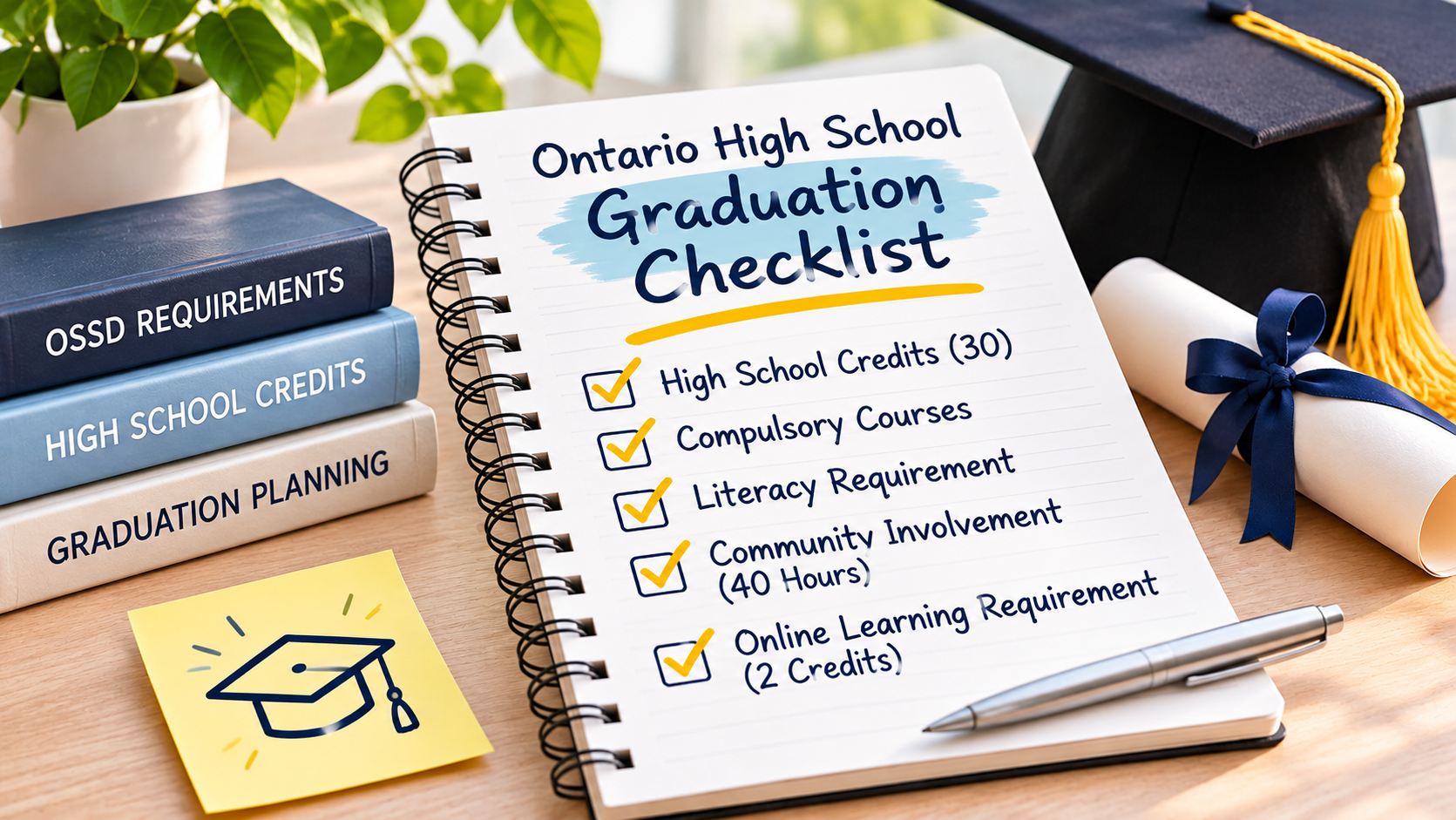
Ontario High School Graduation Checklist
Are you on track to graduate in Ontario? Use this practical OSSD checklist to review your credits, literacy requirement, volunteer hours, online learning and other graduation requirements.
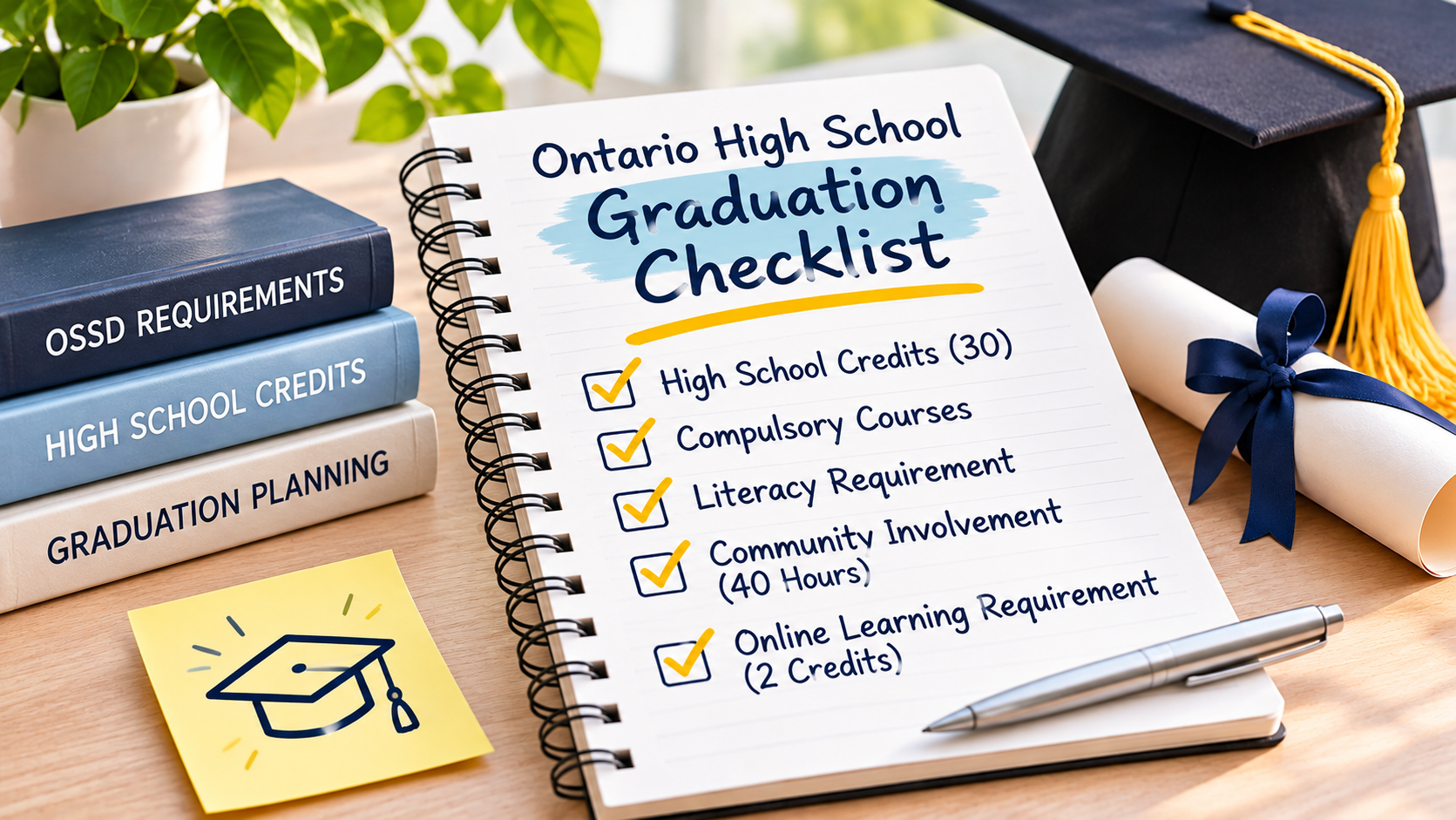
A practical guide to planning your OSSD
Are you on track to graduate from high school in Ontario? To earn an Ontario Secondary School Diploma (OSSD), students must complete the required high school credits and meet the applicable literacy, community involvement, online learning, and financial literacy requirements. Understanding what you have completed and what you still need is the first step toward graduating with confidence.
Whether you are in Grade 9, planning your Grade 12 year, transferring schools, or completing courses online, this Ontario high school graduation checklist can help you organize your next steps.
1. Have You Earned Enough High School Credits?
The first step in your graduation plan is checking your completed credits.
Most Ontario students need a minimum of 30 credits to earn an OSSD. However, the distribution of compulsory and optional credits depends on when you entered Grade 9.
Students who entered Grade 9 in September 2023 or earlier generally need 18 compulsory credits and 12 optional credits.
Students who entered Grade 9 in the 2024–2025 school year or later generally need 17 compulsory credits and 13 optional credits.
Your school can help confirm which requirements apply to your individual academic history.
Your credit checklist:
Review your most recent high school transcript.
Confirm how many credits you have successfully completed.
Identify any compulsory credits you are missing.
Check how many optional credits you still need.
Make a plan for any outstanding courses.
Remember that having 30 credits does not automatically mean you have met every graduation requirement. You must also satisfy the other applicable OSSD requirements.
2. Have You Completed All Your Compulsory Courses?
Compulsory courses are the subjects students must complete to earn their diploma. They provide a foundation in areas such as English, Mathematics, Science, Canadian History, and other required subjects.
For students following the requirements introduced in 2024–2025, compulsory credits include:
Four English credits, one for each grade
Three Mathematics credits, including at least one in Grade 11 or 12
Two Science credits
One Canadian geography credit
One Canadian history credit
One Arts credit
One Health and Physical Education credit
One French as a second language credit
One Technological education credit
Half a credit in Career studies
Half a credit in Civics and Citizenship
Additional compulsory credits specified by Ontario's graduation requirements
The exact list and distribution differ for students following earlier graduation requirements.
Your compulsory credit checklist:
Ask your school to identify any outstanding compulsory courses.
Check that your planned courses meet the correct grade and subject requirements.
Consider whether any missing courses could affect your graduation date.
Confirm that your remaining course plan meets your postsecondary goals, if applicable.
If you are planning to attend college or university, remember that admission prerequisites may differ from the courses required simply to graduate.
3. Have You Met the Ontario Literacy Requirement?
Ontario students must meet the provincial literacy graduation requirement to earn their OSSD.
For many students, this means successfully completing the Ontario Secondary School Literacy Test (OSSLT). Eligible students may meet the requirement through the Ontario Secondary School Literacy Course (OSSLC), depending on their circumstances and the rules that apply to them.
Your literacy checklist:
Confirm whether you have completed the OSSLT successfully.
If you have not met the requirement, ask your school about your available options.
Check whether the OSSLC is an appropriate pathway for your situation.
Make sure your literacy requirement is recorded as completed.
If you have changed schools or completed some of your education outside Ontario, ask your school to review your academic record and determine which requirements apply.
4. Have You Completed Your 40 Community Involvement Hours?
Ontario students generally need at least 40 hours of eligible community involvement activities to graduate.
These hours give students an opportunity to participate in their communities, explore interests, and develop skills outside the classroom.
Examples of possible activities include volunteering with eligible charitable organizations, supporting community events, and participating in approved community initiatives. Activities must meet Ontario's eligibility rules, so confirm that your planned volunteer work qualifies before counting the hours.
Your community involvement checklist:
Confirm how many approved hours you have completed.
Review your school's process for recording volunteer hours.
Submit any outstanding documentation.
Identify eligible opportunities if you still need hours.
Confirm that your completed hours have been recorded.
Do not leave this requirement until your final semester. Tracking your hours throughout high school can make graduation planning much easier.
5. Have You Met the Online Learning Requirement?
Ontario's OSSD requirements include two online learning credits for applicable students, subject to the provincial rules and available exemptions.
The online learning requirement is separate from the total number of credits needed for graduation.
Your online learning checklist:
Confirm whether the online learning requirement applies to you.
Check whether any qualifying online learning credits are already recorded on your transcript.
Determine whether you need additional online courses.
Ask your school about any applicable exemption or opt-out process.
Students who attend traditional in-person high schools may still need to consider this requirement. Families should confirm their individual circumstances with their school rather than assume that attending a regular high school automatically satisfies it.
For students who need a flexible way to complete additional OSSD credits, online learning may be one option to explore.
At Aubrey Academy, students can take online OSSD credit courses while working toward their academic goals. Learn more about our online high school and OSSD course options.
6. Are Your Grade 11 and Grade 12 Courses Aligned With Your Future Plans?
Graduation planning is not only about meeting minimum requirements. It is also about making sure your courses support what you want to do next.
For example, a student planning to attend university may need specific Grade 12 University Preparation courses. A student considering college may have different prerequisites, depending on the program.
Students interested in competitive athletics, performing arts, apprenticeships, or entering the workforce may also have particular academic goals to consider.
Your future planning checklist:
Identify your potential postsecondary or career pathways.
Research the admission requirements for programs that interest you.
Check whether you need specific Grade 11 or Grade 12 courses.
Review your current marks and identify any courses you may need to repeat or upgrade.
Confirm that your graduation plan leaves enough time to complete any required prerequisites.
You do not need to have every detail of your future decided. However, understanding your options early can help you make more informed course choices.
7. What If You Are Missing Credits or Have Changed Schools?
If your transcript shows that you are missing credits, you may still have options.
Students may need additional courses because they changed schools, transferred into Ontario from another education system, did not pass a course, or changed their postsecondary plans.
The right next step is to understand exactly what is outstanding before registering for another course.
Your catch-up checklist:
Obtain your most recent transcript or academic record.
Ask your school to identify outstanding graduation requirements.
Confirm whether previous coursework can be assessed for equivalency or recognition.
Identify the specific courses you need to complete.
Discuss possible course schedules and timelines with your school.
Check whether any outstanding courses are prerequisites for your future plans.
Students transferring from another province or country may have different credit assessment needs. Their graduation plan should be reviewed individually rather than based on the requirements of a student who completed all four years of high school in Ontario.
If you need additional flexibility, an online course may be worth considering.
Aubrey Academy is a Ministry-inspected online private high school in Ontario offering OSSD credit courses for students in Grades 9–12. Students can explore course options that may help them work toward their academic goals while balancing other commitments.
8. Your Final Ontario High School Graduation Checklist
Use this summary to review your progress with your school.
I have reviewed my transcript and completed credits.
I understand which OSSD graduation requirements apply to me.
I have completed, or planned to complete, all required compulsory and optional credits.
I have met the provincial literacy requirement.
I have completed the required community involvement hours.
I have checked my online learning requirement and any applicable exemption.
I have confirmed whether the financial literacy requirement applies to me.
I have checked the Grade 11 and Grade 12 courses needed for my future plans.
I have addressed any missing credits or outstanding documentation.
I have reviewed my expected graduation timeline with my school.
Keep a copy of your checklist and update it whenever you complete a course or another graduation requirement.
Frequently Asked Questions
How many credits do you need to graduate high school in Ontario?
Most students need 30 credits to earn an OSSD. The number of compulsory and optional credits depends on when the student entered Grade 9.
Can you graduate with 30 credits if you have not completed your volunteer hours?
No. Students must also meet the applicable community involvement requirement and the other requirements for their OSSD. Having enough credits alone is not sufficient.
Can online courses help you complete missing OSSD credits?
Online courses may provide an option for completing additional credits. Students should confirm that the course is appropriate for their academic plan and that the school and course meet their educational needs.
What should I do if I am not sure whether I am on track to graduate?
Start by reviewing your transcript and asking your school to confirm which requirements you have completed and which remain outstanding. A clear credit plan can help you identify the next steps.
Start Planning Your Path to Graduation
Graduating from high school is an important milestone, and keeping track of your progress can make the process feel more manageable.
By reviewing your credits, checking your graduation requirements, and planning ahead for any outstanding courses, you can take practical steps toward earning your Ontario Secondary School Diploma.
If you need additional courses or a more flexible learning option, Aubrey Academy can help you explore available online OSSD credit courses.
Interested in exploring your options? Visit Aubrey Academy to learn more about online courses, or contact the school at info@aubreyacademy.ca or (416) 998-3354 to discuss your academic goals.
Graduation requirements can vary by student and may change over time. Always confirm your individual requirements with your school and consult the Ontario Ministry of Education for the most current information.