

What the ILAC Closure Means for International Students and How to Keep Your Canadian Education on Track
Affected by the ILAC closure? Learn what international students can do next, how previous studies may be assessed, and how to keep working toward an Ontario Secondary School Diploma online from home.
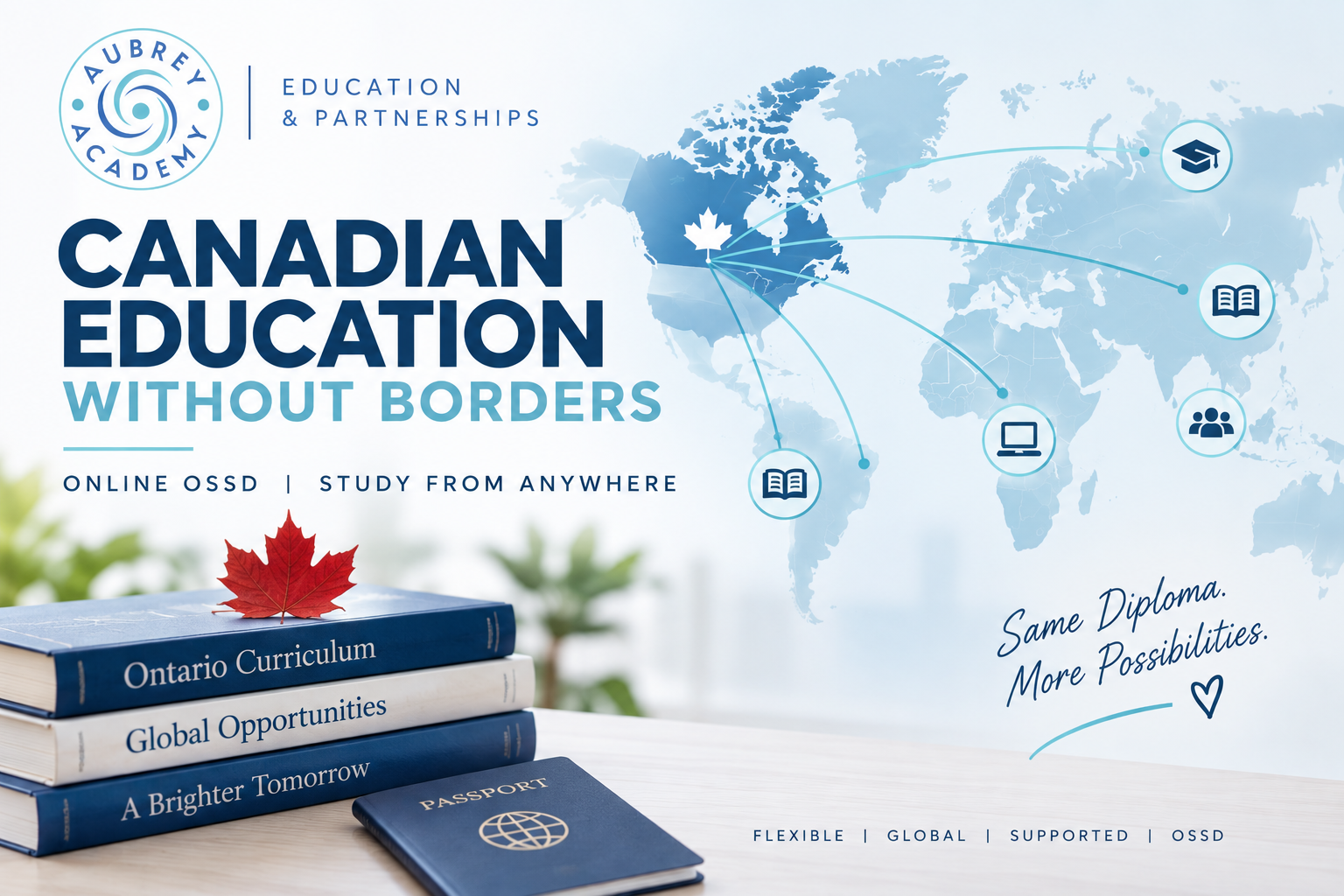
The sudden closure of ILAC on September 18, 2026, has left students, families, education agents, and international partners facing difficult questions about what comes next.
ILAC announced that it had filed for bankruptcy protection and ceased operations immediately, with classes and programming cancelled at its Toronto and Vancouver locations. The announcement came shortly after EC English closed its Canadian schools, adding to uncertainty for international students who had planned their education around studying in Canada.
For students whose plans have been disrupted, the most important question now is:
How can I continue my education without starting over?
The good news is that there are alternative pathways available — including options that allow students to study the Ontario curriculum from their home country.
What Should Students Do After an Unexpected School Closure?
If your school or academic program has closed, there are several important steps to take before choosing your next program.
1. Gather your academic records
Keep copies of your transcripts, report cards, course records, receipts, and any documentation showing the courses or credits you have completed.
If you are transferring to another school, these records can help determine what education you have already completed and what you may still need.
2. Check whether the school is authorized to grant OSSD credits
If your goal is an Ontario Secondary School Diploma, it is important to verify that the school you choose is an Ontario Ministry-inspected private high school authorized to grant credits toward the OSSD.
The Ontario Ministry of Education recommends that families ask whether a private school is inspected, whether it can issue OSSD credits, and whether it follows the Ontario curriculum.
3. Ask how your previous education will be assessed
You may not need to start from the beginning.
Depending on your academic history, previous coursework may be assessed through Ontario equivalency or Prior Learning Assessment and Recognition (PLAR) processes. The purpose is to determine which requirements you have already met and which credits you still need.
A Flexible Alternative: Study the Ontario Curriculum From Home
For some international students, relocating to Canada is not the only way to access an Ontario education.
Aubrey Academy is an Ontario Ministry-inspected private high school (BSID #665140) offering asynchronous OSSD credit courses online. Students can study the Ontario curriculum from anywhere in the world while working toward their Ontario Secondary School Diploma.
Students can:
Study online from their home country
Learn through a flexible, asynchronous schedule
Work with Ontario-certified teachers
Begin courses throughout the year
Have previous academic records assessed
Complete OSSD credits toward their graduation requirements
Continue working toward university and college pathways
For students who are unable or no longer planning to relocate to Canada, this can provide another way to continue their Canadian education without waiting for a traditional semester to begin.
Looking for an ILAC Alternative?
If you were affected by the ILAC closure and are looking for an ILAC alternative, the right choice will depend on your academic goals and what you have already completed.
Aubrey Academy can review your academic history and help determine whether an online OSSD pathway may be appropriate for you.
Our team can look at your previous coursework and help identify:
Which credits you may already have
Which OSSD requirements remain
Which courses you may need to complete
How an online pathway could fit your timeline
What steps are needed to continue toward graduation
The goal is simple: help you understand your options before you make your next decision.
For International Students: You Don't Have to Put Your Education on Hold
Changing schools unexpectedly can be stressful, particularly when travel, immigration, accommodation, tuition, and university plans are involved.
An online Canadian high school pathway can remove some of those logistical challenges by allowing students to study the Ontario curriculum from home.
For families specifically searching for OSSD online for international students or looking for a way to study Canadian curriculum from home, Aubrey Academy offers a flexible option designed for students studying from outside Canada.
For Education Agents and International Schools
We also welcome conversations with education agents, international schools, and organizations looking for an Ontario academic partner.
Aubrey Academy works with international families and partners to provide flexible OSSD pathways for students around the world.
If you are supporting students affected by a school closure, we would be happy to discuss whether an online OSSD pathway could be appropriate for them.
Take the Next Step
If your education plans have been disrupted, you don't have to figure everything out on your own.
Contact Aubrey Academy for a pathway assessment.
Send us your transcript or available academic records, and our team can help you understand where you currently stand and what your next steps toward the OSSD could look like.
Explore Online OSSD Options for International Students →
Aubrey Academy
Ontario Ministry-Inspected Private High School
BSID #665140
(416) 998-3354
info@aubreyacademy.ca

Understanding Equivalency and PLAR in Ontario: How Students Can Earn Up to 26 High School Credits from Previous Schooling
Moved to Ontario, studied internationally, or returning to school? Learn how PLAR and equivalency can help eligible students receive up to 26 Ontario Secondary School Diploma (OSSD) credits for previous learning.
Students who transfer schools, move to Ontario, or return to education often ask:
“Will my previous schooling count toward my Ontario Secondary School Diploma (OSSD)?”
According to Ontario Ministry of Education policy, students are entitled to have their prior learning evaluated through Equivalency and Prior Learning Assessment and Recognition (PLAR).
These pathways allow students to receive official Ontario credits for learning they have already completed—reducing the number of courses they must take and accelerating their path to graduation.
At Aubrey Academy, we specialize in both processes and help students maximize eligible credits while staying fully compliant with Ministry requirements.
What Is Equivalency in Ontario?
Equivalency applies primarily to Grades 9 and 10.
The Ontario Ministry of Education allows schools to grant equivalency credits when students have completed comparable learning outside Ontario, including:
International school systems
Other Canadian provinces
Private or online schools
Recognized alternative programs
Instead of repeating coursework, schools analyze transcripts and map completed learning to Ontario curriculum expectations.
How Many Equivalency Credits Are Possible?
Under Ministry policy:
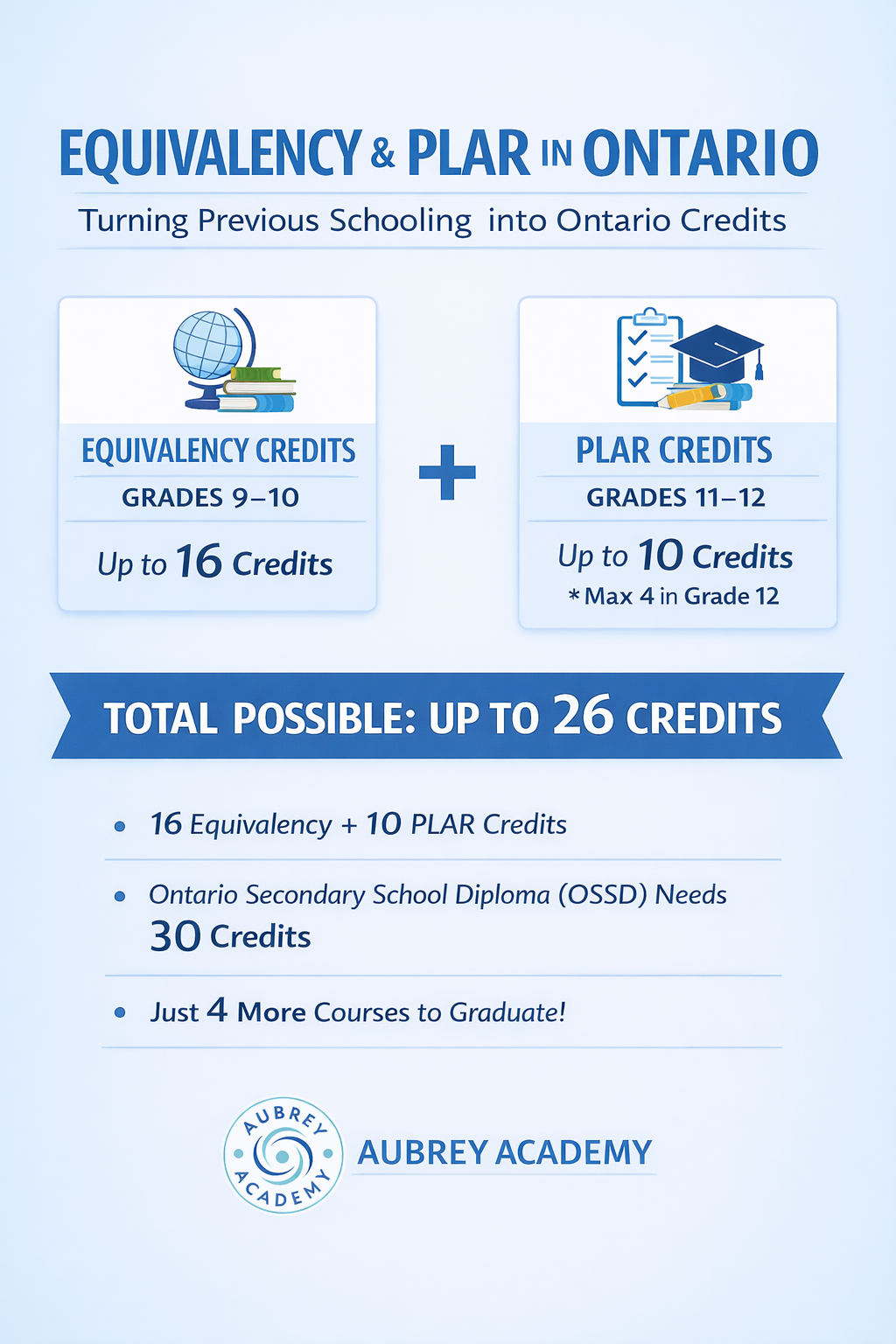
Students may earn up to 16 equivalency credits for Grade 9–10 learning
This typically covers all compulsory Grade 9 and 10 credits
These credits are granted through transcript review and do not require the student to write a course exam again.
Result: Students enter senior high school (Grades 11–12) with a strong credit base.
What Is PLAR (Prior Learning Assessment and Recognition)?
PLAR applies primarily to Grades 11 and 12.
PLAR recognizes that students may already possess the knowledge and skills of an Ontario course through:
Previous high school courses
International curricula
Private school programs
Online learning
Homeschooling
Work or life experience (where applicable)
Instead of repeating the entire course, students demonstrate learning through:
Diagnostic assessments
Assignments or projects
Unit tests
Final exams
Portfolios
If expectations are met, the school grants the credit.
How Many PLAR Credits Are Allowed in Ontario?
According to Ontario Ministry policy:
Students may earn up to 10 PLAR credits toward the OSSD
Of these, no more than 4 PLAR credits may be at the Grade 12 level
The remaining PLAR credits are usually at the Grade 11 level
These credits appear on the Ontario transcript exactly like traditional course credits.
Maximum Credit Scenario
When Equivalency and PLAR are combined:
Up to 16 Grade 9–10 equivalency credits
Up to 10 Grade 11–12 PLAR credits
Total possible: up to 26 credits
Since an OSSD requires 30 total credits, some students may only need to complete 4 additional Ontario courses to graduate. (Exact numbers vary based on individual transcripts and graduation requirements.)
Compulsory Credits Still Matter
Even when using Equivalency and PLAR, students must still meet Ontario’s compulsory credit requirements, including:
English (4 credits)
Mathematics (3 credits)
Science (2 credits)
Canadian Geography
Canadian History
Civics
Career Studies
Health & Physical Education
Arts
French as a Second Language
A Ministry-inspected school ensures that awarded credits properly satisfy these categories.
How the PLAR & Equivalency Process Works at Aubrey Academy
Submit transcripts and academic records
Academic team completes Ministry-aligned review
Eligible equivalency credits are granted
PLAR assessments are assigned (if applicable)
Credits are recorded on Ontario transcript
Graduation plan is created
All documentation is maintained according to Ministry inspection standards.
Are Universities and Colleges OK with PLAR and Equivalency?
Yes! Ontario universities and colleges accept OSSD credits regardless of whether they were earned through:
Traditional coursework
Equivalency
PLAR
What matters is that the credits are issued by a Ministry-inspected Ontario private school following policy.
Why Families Choose Aubrey Academy for PLAR and Equivalency
Ministry-aligned evaluation process
Experienced PLAR assessors
Clear graduation planning
Faster pathway to OSSD
Support for international and newcomer students
Official Ontario report cards and transcripts
At Aubrey Academy, we believe students should never lose years of progress because they changed schools or countries. Ontario’s Equivalency and PLAR policies exist to honour prior learning and create fair access to graduation. With the right school and proper evaluation, students may already be much closer to their OSSD than they realize.
Want to know how many credits you may be eligible for?
Contact Aubrey Academy today for a transcript review and personalized graduation pathway.