
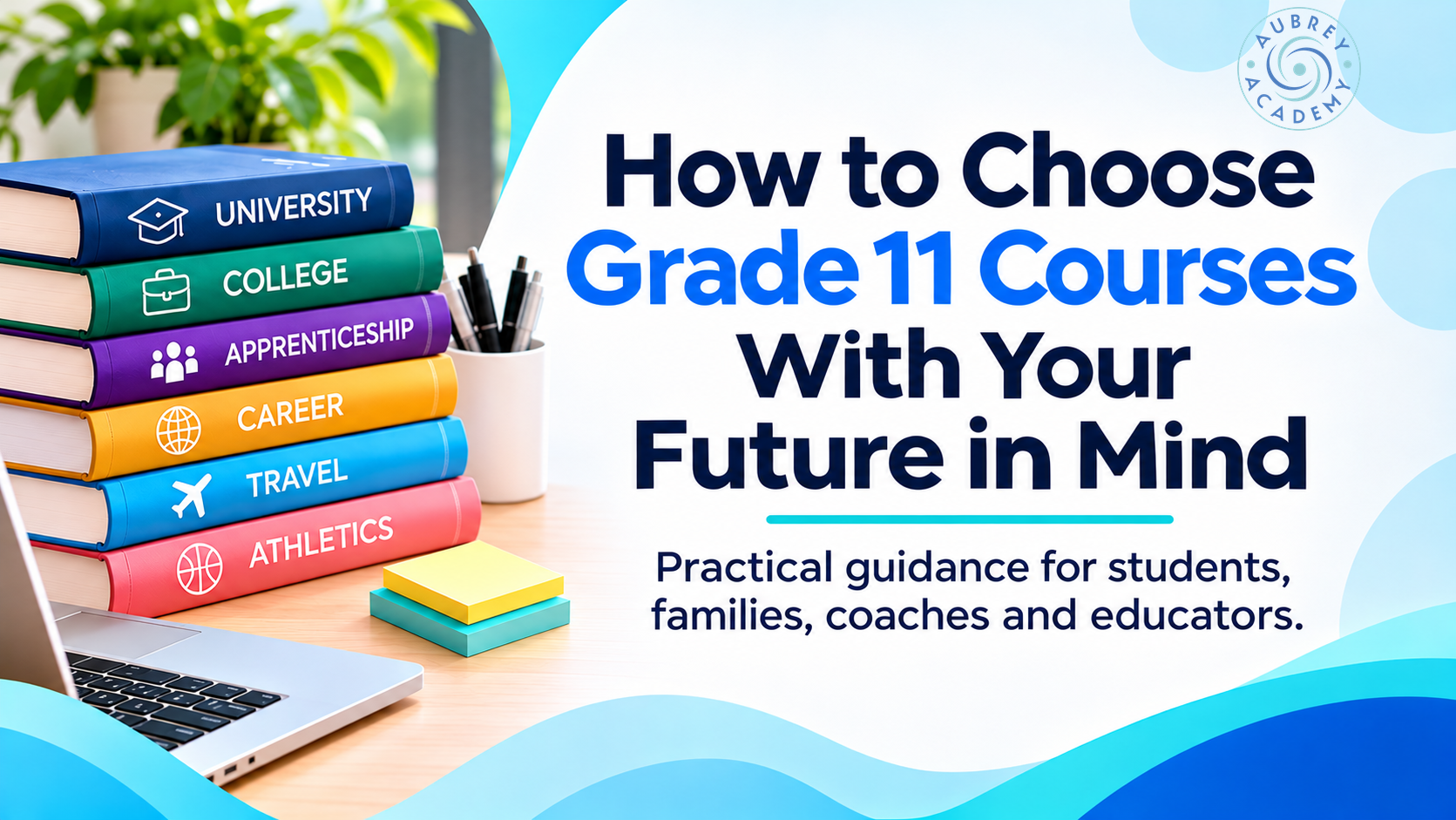
How to Choose Grade 11 Courses With Your Future in Mind
Grade 11 is an important time for Ontario students to plan ahead. Learn how to choose courses that align with your interests, prepare for Grade 12 prerequisites, and keep college, university, and career options open.
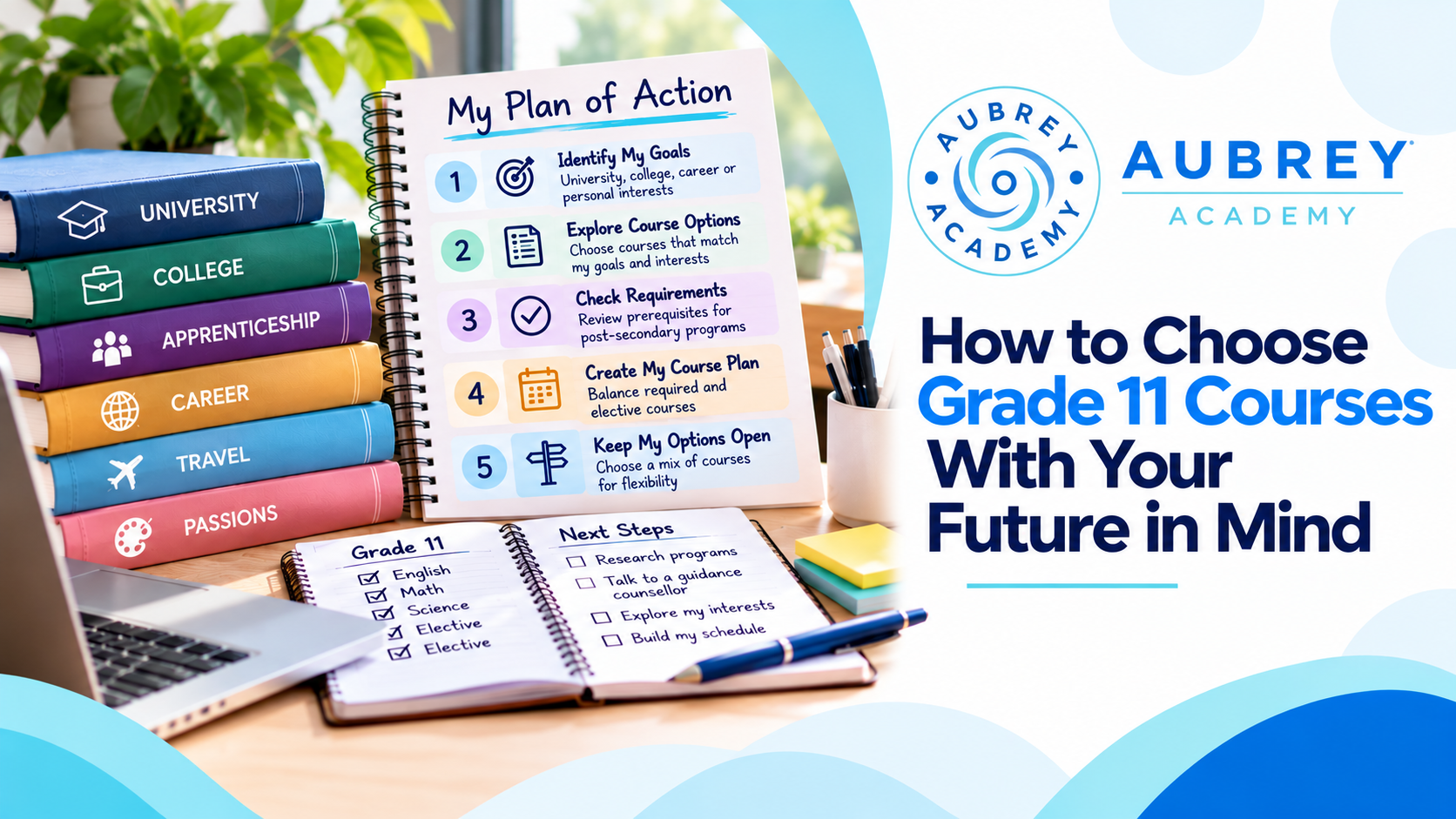
Grade 11 is an important year for Ontario high school students. As students begin thinking more seriously about college, university, apprenticeships, and future careers, the courses they choose can help shape the opportunities available to them after graduation.
If your teen is selecting Grade 11 courses this fall, now is a good time to look beyond next semester's timetable and consider the bigger picture. The right choices can help students prepare for Grade 12 prerequisites, explore their interests, and keep their future options open.
At Aubrey Academy, we understand that every student's path looks different. Whether your teen already has a clear career goal or is still figuring out what they enjoy, thoughtful course planning can make the transition from high school to postsecondary education easier.
Why Grade 11 Course Selection Matters
Grade 11 is more than another year of earning credits toward the Ontario Secondary School Diploma (OSSD). It is also an opportunity to prepare for the courses and requirements students may encounter in Grade 12.
Many college and university programs specify particular Grade 12 courses for admission. Students often need to complete the appropriate Grade 11 prerequisites before they can take those senior-level courses.
For example, a student interested in engineering may need to plan for senior mathematics and physics. Someone considering a health sciences program may need to investigate biology, chemistry, and mathematics requirements. A student interested in business may benefit from exploring mathematics and business-related courses.
The exact requirements depend on the institution and program. Planning ahead gives students more time to identify what they need rather than discovering a missing prerequisite in Grade 12.
Start With Your Interests, Not Just Your Marks
It is tempting to choose courses based only on past grades, friends' choices, or which classes seem easiest. While workload and academic strengths matter, students should also consider what interests them and where they might want to go next.
Encourage your teen to think about three questions:
What subjects do I enjoy? Consider the classes, projects, and activities that keep you interested and motivated.
What am I good at? Think about your strengths, the skills you have developed, and the subjects in which you feel confident.
What would I like to explore? You do not need to have your entire future figured out. You can use Grade 11 to investigate different fields and possibilities.
Students who are undecided about their future can still make thoughtful choices. The goal is to select courses that meet graduation requirements while preserving reasonable options for the next stage of their education.
Understand the Different Course Pathways
Ontario high school courses have different pathways and purposes. Understanding the course codes can help students make informed decisions.
University preparation (U)
University preparation courses are designed to prepare students for university-level study. They are often required for admission to university programs, particularly when a program specifies particular Grade 12 prerequisites.
College preparation (C)
College preparation courses help students develop the knowledge and skills needed for college programs. They may be appropriate for students pursuing a college diploma or other college pathway.
University/college preparation (M)
University/college preparation courses are designed to prepare students for both university and college pathways, depending on the subject and program requirements.
Workplace preparation (E)
Workplace preparation courses focus on knowledge and skills relevant to entering the workplace after high school.
Open courses (O)
Open courses are designed to broaden students' education and may be taken by students with different postsecondary plans.
The appropriate pathway depends on the individual course and the student's goals. A course code alone does not determine whether a student will qualify for a particular college or university program. Always check the admission requirements for the specific program your teen is considering.
Research Grade 12 Prerequisites Before You Choose
One of the most useful things students can do before finalizing Grade 11 courses is research the requirements for a few possible postsecondary programs.
You do not need to choose a university or college today. Instead, use this exercise to identify courses that may be important for your future options.
Start with these steps:
Choose two or three possible programs. They can be in the same field or represent different interests.
Visit the official college or university websites. Look for admission requirements for each program.
Write down the required Grade 12 courses. Note any specific mathematics, science, English, or other prerequisites.
Work backward to Grade 11. Check which courses are required to enter those Grade 12 courses.
Review your plan with your guidance counsellor. Confirm that your selections meet your current graduation requirements and keep your intended pathways open.
Admission requirements can change, so always use the institution's current information rather than relying solely on advice from friends, older students, or online discussions.
What If You Haven't Decided on a Career Yet?
Not every Grade 11 student knows what they want to do after graduation, and that is completely normal.
If your teen is undecided, focus on balancing their interests, strengths, graduation requirements, and potential future pathways.
Consider these strategies:
Keep an eye on prerequisites for fields that interest you, even if you are not ready to commit.
Explore subjects you enjoy and courses that introduce you to new areas of learning.
Ask questions about college, university, apprenticeship, and workplace pathways.
Avoid dropping a course that may be an important prerequisite without checking the consequences first.
Speak with a guidance counsellor if you are unsure which options will keep the most doors open.
The aim is not to predict your entire future in Grade 11. It is to make informed decisions that give you room to grow and change direction as your interests develop.
Balance Academic Goals With Your Other Commitments
Course selection is not only about meeting admission requirements. Students also need a realistic plan for managing their workload.
A demanding timetable combined with extracurricular activities, competitive sports, a part-time job, family responsibilities, or other commitments can become difficult to manage.
Before selecting courses, consider how much time you can realistically devote to assignments, studying, assessments, and exam preparation. Think about which subjects may require extra support and whether your schedule leaves enough room for rest and other responsibilities.
Students who need additional flexibility may also wish to explore individual online OSSD courses. Depending on their circumstances and school arrangements, an online course can be an option for completing a prerequisite or taking a course that does not fit their regular timetable.
A flexible learning arrangement should still include a clear plan for completing coursework and meeting academic expectations.
What If You Need a Course Your School Doesn't Offer?
Sometimes a student discovers that their school does not offer a particular course, that a course conflicts with another required class, or that they need an additional course to prepare for a future program.
Before changing your plans, speak with your guidance counsellor about the available options. Depending on your situation, you may be able to consider another timetable arrangement or an individual course through an eligible online school.
Aubrey Academy offers online OSSD courses for Ontario students in Grades 9–12, including selected Grade 11 courses in English, mathematics, science, business, and other subject areas.
If you are considering an additional course, first confirm that it meets your specific academic goal and that you satisfy its prerequisites.
You can browse the Aubrey Academy course list to explore available options.
A Simple Grade 11 Course-Planning Checklist
Before submitting your course selections, use this checklist to review your plan.
Confirm that your courses support your progress toward the OSSD.
Research the admission requirements for programs that interest you.
Identify the Grade 12 courses you may need.
Check the prerequisites for those Grade 12 courses.
Consider your academic strengths, interests, and current workload.
Discuss any uncertainties with your guidance counsellor.
Investigate alternatives if a required course is unavailable or does not fit your timetable.
Keep a copy of your course plan and revisit it as your goals develop.
A little planning now can help reduce stress later and give you more confidence when Grade 12 course selection arrives.
Frequently Asked Questions
Is Grade 11 important for university admission in Ontario?
Grade 11 can be important for preparing for university admission because students use this year to complete prerequisites for Grade 12 courses. Universities generally base admission decisions on their published requirements, including specified Grade 12 courses and marks. Requirements vary by program and institution.
Can I change my mind about my career after choosing Grade 11 courses?
Yes. Many students change their interests as they learn more about themselves and their options. The key is to review any new plans against the required prerequisites and graduation requirements before changing courses.
Should I take university preparation courses if I'm unsure about university?
That depends on your interests and possible future pathways. If university is one option you want to preserve, investigate the required courses before choosing your timetable. A guidance counsellor can help you understand which choices make sense for your situation.
What if I am missing a prerequisite for Grade 12?
Speak with your guidance counsellor as early as possible. They can help you understand your options and whether an alternative timetable or an additional course may be appropriate.
Can I take a Grade 11 OSSD course online?
Individual online OSSD courses may be an option for eligible students who need a particular credit or prerequisite. Confirm the course's requirements, availability, and suitability for your academic plan before enrolling.
Start Planning Your Next Step
Grade 11 course selection is an opportunity to make decisions that support both your immediate learning needs and your longer-term goals. Students do not need to have everything figured out, but they should understand how their choices may affect the courses and programs available to them later.
At Aubrey Academy, we support students working toward their OSSD through flexible online learning options.
If your teen needs a particular course, wants to explore available Grade 11 options, or is unsure how an online course might fit into their academic plan, we invite you to connect with our team.
Explore your options: Visit our online OSSD course list to see available courses.
Need help finding the right course? Contact Aubrey Academy at info@aubreyacademy.ca or call/text (416) 998-3354 to discuss your student's needs.
Planning ahead today can help students approach Grade 12 with greater confidence and a clearer path toward what comes next.
Aubrey Academy
Ontario Ministry-Inspected Private High School
Flexible online learning for students working toward their OSSD.
Injured During Your Season? An Ontario Student-Athlete’s Academic Plan
An unexpected injury can change a student-athlete’s season, but it doesn't have to derail their education. Discover practical ways to protect your OSSD progress, stay on track with university plans, and explore flexible learning options in Ontario.
When an Injury Changes More Than Your Season
For student-athletes in Ontario, an unexpected injury can affect more than playing time. It can disrupt training schedules, travel plans, recruitment opportunities, and even the way a student approaches school.
When an athlete is focused on reaching the next level, an injury may leave them wondering what happens next. Will they fall behind in school? Can they continue working toward their Ontario Secondary School Diploma (OSSD)? What if they need to change their plans for university or college?
The good news is that an injury does not automatically mean your academic goals have to go on hold. With communication, a review of your academic progress, and a plan that reflects your circumstances, you can continue working toward your future while you recover.
At Aubrey Academy, we understand that student-athletes have goals beyond the classroom. Their education should remain part of the plan, even when the unexpected happens.
1. Start With Your Current Academic Standing
When an injury occurs, schoolwork may be the last thing on your mind. Your first priority should be following your healthcare team's guidance and allowing yourself time to recover.
Once you're ready to review your schoolwork, start by understanding exactly where you stand academically.
Ask yourself:
How many OSSD credits have I completed?
Which courses am I currently taking?
Are there upcoming assignments, assessments, or deadlines I need to address?
Am I meeting the prerequisites for the university or college programs I'm considering?
Could a change to my athletic schedule affect my graduation timeline?
Reviewing your transcript and current courses can help you identify what needs attention before small concerns become bigger problems.
If you are considering university athletics, remember that your academic record matters independently of your athletic performance. Keeping track of your credits, grades, and prerequisites helps you protect future opportunities.
2. Communicate With Your School Early
An injury can make it difficult to keep up with your usual school routine, particularly if you're attending medical appointments, recovering from surgery, or managing a lengthy rehabilitation schedule.
Rather than waiting until you have missed several deadlines, contact your teachers or school administration as early as possible.
Explain your circumstances and ask what options may be available to help you manage your coursework.
Depending on your situation and school policies, you may be able to discuss adjusted timelines, available academic supports, or an appropriate plan for continuing your studies.
Remember that an injury does not automatically change school deadlines or course requirements. Communicating early gives you and your school an opportunity to understand your options and determine the next steps.
3. Consider Whether Your Learning Schedule Needs to Change
Not every athlete experiences the same recovery. Some may return to their regular routine relatively quickly, while others may need months of rehabilitation or a longer period away from competition.
If your previous school schedule no longer fits your circumstances, it may be worth exploring alternative learning arrangements.
For example, an athlete who previously spent hours travelling to practices and competitions may suddenly have more time available for coursework. Another athlete may need greater flexibility because recovery appointments and fatigue make a fixed daily schedule difficult.
An asynchronous online learning model can offer another way to approach education. Students can work through their courses without attending a traditional live online class at a set time each day, while still completing required coursework and receiving teacher support.
At Aubrey Academy, students can explore flexible online OSSD courses that may better accommodate changing schedules.
The key is to find an arrangement that supports your academic progress without creating unnecessary pressure during recovery.
Explore your options: Visit Aubrey Academy to learn more about flexible online high school education in Ontario.
4. Protect Your University and College Options
One of the biggest concerns for a competitive athlete is what an injury might mean for their future.
If you were hoping to earn an athletic scholarship, join a university team, or attend a college with a competitive sports program, it is understandable to worry about losing momentum.
However, an injury does not necessarily eliminate those possibilities.
While you focus on recovery, you can still take practical steps to protect your academic pathway:
Review admission requirements. Check the prerequisites and application deadlines for the programs you are considering.
Keep your transcript organized. Make sure you understand which credits you have earned and which requirements remain outstanding.
Maintain communication with coaches. If you are already in contact with a recruitment coach, ask what information they need and how your circumstances may affect their recruitment timeline.
Review athletic eligibility separately. Rules vary by institution, league, and athletic association. Contact the relevant organization or institution to understand how an injury, a delayed graduation, or a change in enrolment could affect your eligibility.
Build more than one pathway. Consider academic programs and career interests alongside your athletic ambitions.
Your future does not have to depend on a single season or one recruitment opportunity. Keeping your academic options open gives you more choices as your circumstances change.
5. Remember That Your Identity Is Bigger Than Your Sport
For athletes who have trained and competed for years, being sidelined can be difficult emotionally as well as physically.
Sport often provides structure, friendships, confidence, and a sense of purpose. When an injury removes those familiar routines, it can be challenging to know where to focus your energy.
Education can provide a meaningful area of progress during this time.
Working toward a course completion, exploring a future career, or preparing for post-secondary education can help you maintain a sense of direction while your athletic plans are temporarily uncertain.
This does not mean you need to fill every available hour with schoolwork. Recovery takes time, and your academic plan should reflect your needs and circumstances.
Instead, think of education as another part of your long-term development. The discipline, persistence, and ability to adapt that you build through sport can also help you navigate academic challenges.
6. Create a Practical Academic Recovery Plan
You do not need to map out your entire future immediately after an injury. Start with a manageable plan and adjust it as your circumstances evolve.
Here is a simple checklist for student-athletes and their families.
Your academic action plan
Review your current transcript and completed OSSD credits.
List your current courses, upcoming assessments, and deadlines.
Contact your school to discuss your situation and available supports.
Identify any university or college prerequisites that still need to be completed.
Determine whether your current learning schedule remains realistic.
If appropriate, explore flexible online course options.
Revisit your plan regularly as your recovery and schedule change.
Parents can help by supporting communication with the school, keeping track of important dates, and helping their student consider alternatives without making decisions based solely on the uncertainty of the moment.
Coaches can also play a valuable role by encouraging athletes to maintain their academic plans while they work through the challenges of recovery.
The goal is not to rush back into a demanding routine. It is to make sure that the next steps remain manageable and aligned with the student's longer-term goals.
How Aubrey Academy Supports Student-Athletes
An athletic injury can change a student's immediate priorities, but it does not have to mean abandoning their education.
Aubrey Academy is a Ministry-inspected private online high school in Ontario offering courses toward the Ontario Secondary School Diploma (OSSD). Its flexible learning model can help students explore ways to continue their education while navigating demanding or changing schedules.
Whether you are an athlete managing a busy competition calendar, reassessing your plans after an injury, or preparing for post-secondary opportunities, reviewing your academic options can help you make informed decisions.
Every student's situation is different. The right course plan depends on completed credits, graduation requirements, intended post-secondary programs, and any applicable athletic eligibility rules.
Want to understand your options? Visit Aubrey Academy to explore online OSSD courses and learn more about academic support for student-athletes.
Your Season May Change. Your Future Is Still Yours to Shape.
An injury can interrupt your plans, challenge your confidence, and force you to reconsider your next steps. But it can also be an opportunity to reassess your priorities and make sure you are building a future that extends beyond competition.
Your athletic journey may not follow the timeline you originally imagined. That does not mean your education has to stop moving forward.
With a realistic plan, the right communication, and an educational pathway that reflects your circumstances, you can continue working toward your goals on and off the field, court, track, or rink.
Ready to plan your next academic step? Contact Aubrey Academy to explore flexible Ontario high school courses designed to support students with different goals and schedules.
This article provides general educational information, not medical advice or a guarantee of academic or athletic eligibility. Students should confirm individual course, graduation, admission, and athletic requirements with the appropriate school or organization.

Ontario Grade 12: Your College and University Application Checklist
Applying to college or university in Ontario? This Grade 12 checklist covers admission requirements, application deadlines, grades, applicant portals, financial planning, and the steps students should take before starting post-secondary education.
Applying to college or university in Ontario while working toward your Ontario Secondary School Diploma (OSSD) can feel overwhelming, especially when you are balancing classes, assignments, tests, and upcoming deadlines. The good news is that with a clear plan, you can stay organized, complete your applications, and keep your post-secondary goals on track.
If you are a Grade 12 student planning to start college or university in fall 2027, now is the time to research your options, review admission requirements, and make sure you know what needs to be done.
Here is your step-by-step checklist for navigating the Ontario college and university application process.
1. Decide Which Programs Interest You
Before submitting applications, take time to explore the programs that match your interests, strengths, and future career goals.
Ask yourself:
What subjects do I enjoy most?
What career paths am I considering?
Do I need a university degree, a college diploma, or a specific professional qualification?
Would a co-op program, apprenticeship pathway, or hands-on learning environment suit me?
Do I want to study close to home or somewhere new?
You do not need to have your entire future figured out before applying. However, identifying a few potential career paths can help you narrow your choices and select programs worth exploring.
Action step: Create a shortlist of programs at different institutions. Compare admission requirements, program length, tuition, location, and career opportunities before deciding where to apply.
2. Check the Admission Requirements for Every Program
One of the most important steps is confirming that you are taking the right courses for your chosen programs.
Admission requirements vary by institution and program. Some programs require specific Grade 12 courses, while others may consider additional factors such as portfolios, interviews, auditions, or supplementary applications.
For university programs, check whether the program requires particular University Preparation (4U) or University/College Preparation (4M) courses.
For college programs, review the required Ontario high school courses and any additional admission criteria.
Do not assume that meeting the general admission requirements for an institution means you qualify for every program it offers.
Action step: Visit each program's official admissions page and record its required courses, minimum grades, supplementary requirements, and deadlines.
3. Know Your Application Deadlines
Application deadlines are important, but the dates can differ depending on where you apply and which program you choose.
For students applying for fall 2027 entry, two important dates to keep in mind are:
January 15, 2027: The deadline for Ontario high school students in Group A to submit completed undergraduate applications through the Ontario Universities' Application Centre (OUAC).
February 1, 2027: The equal-consideration deadline for applications to highly competitive Ontario college programs through Ontario Colleges.
The February 1 college deadline means applications received and paid for by that date receive equal consideration for highly competitive programs. Students are encouraged to apply earlier where possible.
These dates do not apply universally to every applicant or program. Some programs have different requirements or deadlines, so always confirm the dates that apply to your situation.
Action step: Add every application deadline, supplementary application deadline, portfolio deadline, and document deadline to your calendar. Set reminders well in advance.
4. Complete Your Applications Carefully
Once you have chosen your programs, set aside time to complete your applications accurately.
For Ontario universities, eligible applicants generally apply through OUAC. For Ontario colleges, applications are submitted through Ontario Colleges.
Before submitting, double-check:
Your legal name and contact information.
Your school and academic history.
Your program selections and campus choices.
Your personal information and application details.
Any required supplementary forms or supporting documents.
Application fees and payment confirmation.
Review your selections before submitting. Choosing the wrong program or campus can create unnecessary complications later.
Keep a record of your submitted applications, confirmation emails, and payment receipts.
5. Understand How Your Grades Affect Admission
Your Grade 12 marks can play an important role in admission decisions, particularly for programs with competitive entry requirements.
Universities may consider completed Grade 11 and Grade 12 courses, along with available midterm and final marks from Grade 12 courses. College programs have their own admission and grade-assessment procedures.
If your current marks are lower than you hoped, do not automatically assume that your post-secondary plans are out of reach.
Instead, focus on what you can do now:
Identify the courses that need the most attention.
Speak with your teachers about areas where you can improve.
Develop a realistic study schedule.
Complete outstanding assignments and prepare for upcoming assessments.
Confirm whether you are meeting the prerequisites for your chosen programs.
Remember that admission averages and requirements differ between programs. Research the requirements for your specific choices rather than relying on a general average you have heard from someone else.
6. Monitor Your Application Status
Submitting your application is an important milestone, but it is not necessarily the final step.
After applying, check your email regularly and monitor the applicant portals for your chosen institutions.
You may need to:
Activate an applicant account.
Review your application information.
Submit supplementary applications or documents.
Respond to requests for additional information.
Check whether your academic information has been received.
Review admission decisions and any conditions attached to an offer.
Keep your login information secure and check your accounts regularly so you do not miss important updates.
Action step: Create a simple tracking spreadsheet with columns for the institution, program, application date, deadline, portal details, outstanding requirements, and application status.
7. Plan for More Than Just Tuition
Choosing a college or university also means considering the practical and financial side of post-secondary education.
Research the costs associated with each option, including:
Tuition and compulsory fees.
Textbooks, supplies, and equipment.
Transportation or parking.
Residence or off-campus housing.
Food and personal expenses.
Explore scholarships, bursaries, and financial assistance early. Some awards require separate applications, essays, references, or supporting documents, and their deadlines may differ from admission deadlines.
If you plan to live away from home, investigate residence application dates and costs as well.
Planning ahead can help you compare your options realistically and avoid unexpected expenses.
8. Have a Backup Plan
It is perfectly reasonable to have a first-choice program, but it is also wise to explore alternatives.
Consider applying to a combination of programs that interest you and offer different admission pathways. You might investigate related programs, different campuses, or alternative routes into your intended career.
A backup plan does not mean giving up on your goal. It means giving yourself more options.
If you receive an offer, read it carefully. Check the response deadline and any academic conditions you must meet before enrolling.
For Ontario university applicants, June 1, 2027, is the earliest date that universities may require current Ontario high school students to respond to an offer and make a financial commitment. Individual offer details still matter, so follow the instructions provided by your institution.
Your Ontario Grade 12 Application Checklist
Before moving on to your next task, use this checklist to see where you stand.
Research programs and institutions that interest me.
Confirm the admission requirements for every program.
Check prerequisites against my current and planned courses.
Record application and supplementary deadlines.
Complete and submit my applications.
Save confirmation emails and payment receipts.
Activate and check my applicant portals.
Monitor my grades and work on areas that need improvement.
Research scholarships and financial assistance.
Plan for tuition, transportation, housing, and other expenses.
Review admission offers, conditions, and response deadlines.
Keep a backup option in mind.
You do not have to complete everything in one day. Work through the list one step at a time and prioritize the deadlines that are coming up first.
How Aubrey Academy Can Support Your Academic Goals
Preparing for college or university begins with understanding your academic requirements and staying on track toward graduation.
At Aubrey Academy, students can access flexible online high school learning while working toward their Ontario Secondary School Diploma. Whether you are completing required courses, planning your academic pathway, or working toward your future goals, having a clear plan can make a difference.
If you need support with your Ontario high school education, visit Aubrey Academy to learn more about our online learning options.
Start Planning Your Next Step Today
Your post-secondary journey does not need to feel overwhelming. Start by researching programs, confirming your admission requirements, organizing your deadlines, and keeping up with your current courses.
The earlier you understand what is expected, the more time you have to address questions and complete outstanding requirements.
Your next step: Choose one program that interests you, review its admission requirements, and add its important deadlines to your calendar.
A little planning today can help you move toward graduation and the next chapter of your education with greater confidence.
Official Resources
For current application information and deadlines, consult these official resources:

Courses You Need for College Trades Programs in Ontario
Planning a career in skilled trades or technology? Discover the high school English, math and science courses Ontario colleges may require, plus online upgrading and OSSD pathways for mature students.

What high school courses do you need to get into a college trades or technology program in Ontario?
Most Ontario college trades and technology programs require an Ontario Secondary School Diploma (OSSD) or an accepted equivalent, along with specific prerequisite courses. Grade 12 English at the college or university preparation level is a common requirement, and many technician and technology programs also require Grade 11 or Grade 12 mathematics. Some programs have additional science requirements. If you are an adult returning to school, you may have options for applying as a mature student or completing the high school credits you still need. Aubrey Academy, a Ministry-inspected online private high school in Ontario, helps students earn OSSD credits, upgrade marks and plan their next steps with Ontario Certified Teachers. Built Around Your Life.
Why Ontario Is Adding College Seats in Trades and Technology
Ontario is investing in post-secondary education to help more students prepare for careers in skilled trades, technology, health care and other in-demand fields.
In an October 16, 2026 announcement, the Ontario government announced $15 million to support 1,312 additional post-secondary seats at Lakehead University and Confederation College in Thunder Bay. The announcement included expanded capacity in trades and STEM programs and forms part of a broader $1.7 billion investment supporting more than 70,000 additional college and university seats.
For students considering a hands-on career, this investment highlights the importance of planning for post-secondary education and understanding admission requirements before applying.
You might be interested in electrical work, aviation, construction, industrial maintenance, manufacturing or a technology-related career. Whatever direction you choose, knowing which high school courses you need can help you prepare for the right program.
You do not necessarily need to complete every course before beginning your research. However, identifying your prerequisites early gives you time to earn missing credits, improve your marks and prepare a stronger application.
Common Prerequisites: Grade 12 English and Grade 11 or 12 Math
One of the first steps in researching an Ontario college trades or technology program is checking its academic admission requirements.
Many programs require Grade 12 English, while mathematics requirements vary according to the program and the type of work students will be preparing to do.
English requirements
Grade 12 English is a common prerequisite for college programs. The required course may be at the college or university preparation level, depending on the program.
Aubrey Academy offers the following Grade 11 and Grade 12 English courses online:
Grade 11 English
Grade 12 English
These courses do not automatically substitute for one another. If a college program specifies ENG4C, for example, confirm whether it accepts any alternative English course before registering.
Mathematics requirements
Mathematics can be particularly important for students entering electrical, mechanical, engineering technology, aviation maintenance and other technical programs.
Depending on the program, a college may require Grade 11 college preparation mathematics, Grade 11 university/college preparation mathematics, Grade 12 college mathematics or a more advanced university preparation course.
Aubrey Academy offers the following Grade 11 and Grade 12 mathematics courses online:
Grade 11 Mathematics
Grade 12 Mathematics
MAP4C — Foundations for College Mathematics, College Preparation
MDM4U — Mathematics of Data Management, University Preparation
The correct course depends on the program you want to enter. Do not assume that every Grade 11 or Grade 12 math credit meets the same admission requirement.
Some Programs Also Require Science
English and mathematics are common prerequisites, but some trades and technology programs require additional courses.
Depending on the program, these may include Grade 11 or Grade 12 physics, chemistry or another science credit.
For example, technical programs involving electrical systems, mechanical systems or applied engineering may place greater emphasis on mathematics and physics than other programs. Requirements differ by institution and program, so these examples are a starting point for your research, not a universal admission rule.
Before registering for a course, follow these steps:
Find the exact college program you want to enter.
Open its official admission requirements page.
Record every required course, including the grade level and preparation type.
Check whether minimum grades apply to individual prerequisites or the overall admission average.
Note any additional requirements, such as testing, assessments or supplementary documentation.
Contact the college if you are unsure whether a course you have already completed will be accepted.
Your next step: Make a list of your target programs before choosing courses. This helps ensure that the credits you complete support your actual career goals.
Mature Students: Finishing Your OSSD as an Adult
Returning to high school as an adult can feel like a major undertaking, especially if you have been away from school for years or have work and family responsibilities.
However, you may be closer to earning your Ontario Secondary School Diploma than you think.
Ontario has processes that allow eligible mature students to receive recognition for previous schooling and learning through equivalency and Prior Learning Assessment and Recognition (PLAR). Depending on your circumstances, these processes may reduce the number of credits you need to complete.
At Aubrey Academy, we help mature students review their educational history and determine a pathway toward graduation.
Your next steps may include:
Reviewing previous high school transcripts and report cards.
Assessing eligibility for mature-student equivalency and PLAR.
Identifying compulsory credits and outstanding OSSD graduation requirements.
Determining which courses must still be completed.
Planning the English, mathematics or other prerequisites needed for your intended college program.
It is important to understand that earning an OSSD and qualifying for a particular college program are two separate goals. You may complete your diploma but still need a specific prerequisite or a higher course mark for admission.
That is why planning for graduation and your intended college program together can save time and help you avoid completing credits that do not support your next step.
Learn more about finishing your OSSD as a mature student.
Missing a Course or Need a Higher Mark? How Online Upgrading Works
You do not necessarily need to return to a traditional classroom to complete a missing high school prerequisite.
Online high school courses can give students more flexibility to work toward their goals while balancing employment, family responsibilities, apprenticeship preparation or other commitments.
Aubrey Academy offers online OSSD credits for students in Grades 9 to 12, with Ontario Certified Teachers supporting their coursework.
There are two common situations where upgrading may help.
You have your OSSD but are missing a prerequisite
Perhaps you graduated several years ago but now want to enter a college technology program that requires a particular Grade 12 math course.
You can review the program requirements and determine which additional credit you need. Completing that prerequisite online may help you meet the academic requirements for your intended program.
You have the prerequisite but need a higher mark
Some college programs are competitive or specify minimum grades for particular courses. If your existing mark does not meet the requirement, upgrading may be an option.
Before enrolling, confirm the required course, minimum grade and application deadline with the college. Also check whether the program considers repeated courses differently when assessing applicants.
Once you know what you need, Aubrey Academy can help you identify the appropriate course or upgrade and plan your next steps.
For students already working in the trades or preparing to enter an apprenticeship, online study can provide a way to complete academic requirements without putting every other responsibility on hold.
Explore Aubrey Academy's online courses to see which credits are currently available.
Applying Through OCAS: Dates and Academic Advising
Most applicants to Ontario colleges apply through the Ontario Colleges Application Service (OCAS). The application process allows students to research programs, select their choices and submit applications.
For fall 2027 applicants, applications are open now. The February 1, 2027 equal consideration date is an important planning milestone: applications received and paid for by this date receive equal consideration, subject to the applicable admissions process. Applications may still be accepted afterward, but competitive programs can fill.
Always check the official Ontario Colleges website for current dates, program availability and admission requirements.
Before you apply
Use this checklist to prepare:
Identify the college programs that interest you.
Confirm each program's OSSD or mature-student admission requirements.
Check the required English, mathematics and science course codes.
Review your transcript to identify missing credits or marks that need upgrading.
Arrange a transcript review if you are an adult returning to school or have attended multiple schools.
Check application deadlines and any additional program requirements.
Prepare your application information and supporting documents.
If you are considering both college and university, you may also need to understand the difference between OCAS and the Ontario Universities' Application Centre (OUAC). Read our existing guide, OUAC vs. OCAS: Applying in Ontario, for an overview of the two application systems.
Get help planning your pathway
You do not have to figure out your next steps alone.
Aubrey Academy offers academic advising to help students understand prerequisites, plan their remaining OSSD credits, explore upgrading options and prepare for post-secondary applications.
For mature students, that may mean starting with a transcript review to see which graduation requirements remain. For students heading into the trades, it may mean identifying the right English and mathematics courses before applying to college.
A clear plan can help you focus on the credits that matter for your goals.
Ready to Take the Next Step?
Whether you are finishing high school, returning to education as an adult or preparing for a career in skilled trades or technology, the right courses can help you move forward.
You may need only one missing prerequisite, a higher mark in an important course or a more complete plan for earning your OSSD. The first step is understanding where you are now and what your intended college program requires.
Book a free transcript review or academic advising call with Aubrey Academy to discuss your goals and map out your next steps.
Visit Aubrey Academy to get started.
Aubrey Academy — Built Around Your Life.

The Power of Community Partnerships in OSSD Education
Community partnerships can open doors for Ontario students working toward their OSSD. Discover how collaboration between educators and community organizations can connect students with meaningful experiences, flexible learning, and future opportunities.
Community partnerships can help Ontario students connect their education with real-world experiences, new interests, and future opportunities while working toward their Ontario Secondary School Diploma (OSSD). When schools and community organizations work together, students can benefit from support that extends beyond the classroom.
At Aubrey Academy, we believe every student's educational journey should leave room for exploration, growth, and individual goals. As an Ontario Ministry-inspected online private high school, we recognize that students develop skills and discover their interests in many different environments — not just at school.
Learning Doesn't Happen Only in the Classroom
Students learn valuable lessons through sports, the arts, volunteering, leadership programs, mentorship, and participation in their communities.
These experiences can help young people develop communication, teamwork, problem-solving, time management, and confidence. They can also introduce students to interests and career possibilities they may not otherwise have considered.
Academic learning remains essential, but students benefit when they can connect what they learn in school with the world around them.
Why Community Partnerships Matter
Community organizations often have specialized knowledge, established networks, and opportunities that complement what schools provide. By working together, educational institutions and community partners can create more connected support systems for young people.
Meaningful partnerships can help:
Connect learning with real-world experiences. Students can explore how academic skills apply to activities, interests, and potential careers.
Encourage personal growth. Mentorship and participation in community programs can help students build confidence, independence, and resilience.
Expose students to new possibilities. Access to different programs, professionals, and experiences can help students discover interests and consider future pathways.
Support individual needs. Collaboration can help organizations better understand the different goals, schedules, and circumstances of the students they serve.
Strengthen the community. When organizations share knowledge and resources, they can create opportunities that may be difficult to provide independently.
The goal is not to replace the role of schools, families, or community organizations. It is to bring their strengths together in ways that benefit students.
Connecting Education With Individual Goals
Every student has a different combination of interests, responsibilities, strengths, and ambitions. Some are dedicated athletes. Others are passionate about performing arts, entrepreneurship, community involvement, or developing a particular skill.
For these students, a traditional school schedule may not always align easily with their other commitments.
Flexible online learning can offer another way to work toward academic goals while making room for activities outside school. At Aubrey Academy, students can work toward their OSSD through online courses while receiving support from Ontario-certified teachers.
The right academic plan depends on each student's circumstances, course requirements, and future goals. With appropriate planning, students can pursue their interests without losing sight of their education.
What Effective Educational Partnerships Look Like
Successful partnerships begin with a shared commitment to student development. They also require clear communication, realistic expectations, and an understanding of what each organization brings to the relationship.
For example, a community organization might identify students who need additional academic flexibility, while an education provider helps those students explore suitable learning options. A mentorship program might introduce students to professionals in an industry they are curious about. A youth organization could work with an educational institution to help participants balance program commitments with their academic responsibilities.
These examples illustrate the possibilities. Each partnership should be shaped around the needs of the students involved rather than following a one-size-fits-all model.
It is also important to measure success by more than participation numbers. Student confidence, progress toward academic goals, engagement, and access to future opportunities can all help demonstrate whether a partnership is making a meaningful difference.
Building Stronger Connections for Students in Ontario
At Aubrey Academy, our partnership with North Pole Hoops reflects our commitment to connecting education with the needs of students pursuing goals beyond the traditional classroom. By bringing academic support together with the basketball community, the collaboration helps address the importance of planning for both athletic and educational futures.
We believe the same spirit of collaboration can extend across many areas of student life. Schools, sports organizations, arts programs, youth groups, mentors, and other community organizations all have valuable roles to play in supporting young people.
When these groups share a commitment to student success, they can help create more opportunities for students to explore their potential and prepare for what comes next.
Let's Create More Opportunities Together
Meaningful educational partnerships start with a conversation about shared goals and the students an organization wants to support.
Aubrey Academy welcomes conversations with schools, sports organizations, youth programs, and other community groups interested in exploring ways to connect students with flexible academic pathways.
If your organization shares our commitment to helping students grow academically and personally, we invite you to explore our partnership opportunities.
Together, we can help more Ontario students pursue their education while making room for the interests, experiences, and ambitions that shape their futures.
Aubrey Academy
Ontario Ministry-Inspected Private High School
Working toward an OSSD, with a learning pathway designed around the student.

A Different Path to the OSSD
Not every student follows the traditional high school path. Discover how flexible learning options can help Ontario students balance academics with athletics, performing arts, work, travel, and other commitments while working toward their Ontario Secondary School Diploma (OSSD).

There is more than one way to work toward an Ontario Secondary School Diploma (OSSD). While many students follow the traditional high school pathway, others may need a different approach because of their schedule, learning needs, personal circumstances, or future goals.
For some Ontario students, a flexible education pathway can make it possible to continue working toward an OSSD while creating more room for the things that matter in their lives.
What Does a “Different Path” Look Like?
The traditional high school experience follows a fairly predictable structure: students attend classes during the school day, follow a semester schedule, and complete their courses alongside a group of classmates.
But not every student's circumstances fit that model.
A different pathway might involve:
Completing some courses online
Taking individual courses outside of a student's regular school
Learning through a flexible or asynchronous program
Taking courses during the summer
Completing courses while travelling
Balancing high school with intensive athletics or performing arts
Catching up or getting ahead with additional courses
Changing schools during high school
Working toward an OSSD through a private school
The goal isn't necessarily to take a completely different route. Sometimes a student simply needs one part of their education to work differently.
The OSSD Remains the Goal
Choosing a different learning environment does not mean choosing a different standard.
Students working toward an Ontario Secondary School Diploma still need to meet the applicable Ontario graduation requirements. This includes completing the required number of credits and other graduation requirements established by the Ontario Ministry of Education.
That's why understanding a student's existing credits and remaining requirements is so important before making changes to their education plan.
Considering a different path for your student? Explore Aubrey Academy's Online High School and OSSD Programs.
Why Do Students Choose a Different Path?
There isn't one type of student who benefits from a more flexible pathway.
A student might need a different approach because they are:
Balancing Athletics
Competitive athletes may spend significant time training, travelling and competing. A traditional school schedule may not always fit around those commitments.
Pursuing Performing Arts
Dancers, musicians, actors and other performers may have rehearsals, competitions, auditions and performances that take place during traditional school hours.
Travelling Frequently
Some students travel regularly with their families or for athletic, artistic or other commitments. Online learning can allow them to continue their coursework while away from home.
Working Part-Time
Older high school students may have employment responsibilities alongside their education. A flexible schedule can make it easier to balance work and school.
Looking for a Different Learning Environment
Some students simply learn better when they have greater control over their environment, schedule and pace.
Catching Up or Getting Ahead
A student may need to recover a credit, improve a mark, complete a prerequisite, or earn an additional credit without changing their entire high school program.
Does a Different Path Mean Learning Alone?
Not at all.
One of the biggest misconceptions about flexible or online education is that students are simply left to teach themselves.
A quality online learning environment can provide students with access to teachers, instruction, feedback, assessments and academic support.
At Aubrey Academy, students complete Ontario curriculum courses online while receiving support from Ontario Certified Teachers. The school's asynchronous model allows students to work without fixed class times while still having teacher guidance throughout their courses.
The flexibility is in how students learn — not in whether they receive academic support.
Can Students Combine Different Learning Options?
In some situations, students don't need to choose between a traditional school and an alternative pathway.
A student may remain enrolled in their current school while taking an individual OSSD course online, depending on their circumstances and the policies of the schools involved.
For example, a student might take an additional course because they:
Need a prerequisite for a future program
Want to improve a course mark
Need to recover a credit
Want to get ahead
Cannot fit a particular course into their regular timetable
This can provide flexibility without requiring a student to completely change their high school experience.
[Learn more about Aubrey Academy's individual OSSD courses.]
What About University or College Plans?
Taking a different path through high school does not mean giving up postsecondary goals.
In fact, students who have a specific university or college program in mind may benefit from careful academic planning.
Course selections can matter when a student is working toward a particular postsecondary program. Students should look ahead at admission requirements and make sure their high school course plan supports their future goals.
This is particularly important when students are:
Considering competitive university programs
Planning for college
Exploring specialized programs
Missing a prerequisite
Changing their career direction
Trying to improve marks before applying
A different pathway can still be a well-planned pathway.
Flexibility Does Not Mean Less Structure
Flexible learning is sometimes misunderstood as being easier or requiring less effort.
In reality, students need strong organizational and time-management skills to succeed in a flexible environment.
They may need to learn how to:
Create a realistic study schedule
Set their own deadlines
Stay on top of assignments
Communicate with teachers
Ask questions when they need help
Monitor their academic progress
Balance school with other commitments
These are skills students will continue to use in college, university, employment and everyday life.
Finding the Right Path for the Student
There is no single high school experience that works perfectly for every student.
For some, a traditional school is the right choice. For others, a combination of learning options may work better. And for some students, a fully flexible online program may provide the environment they need to succeed.
The important question isn't:
“What is the traditional path?”
It's:
“What learning environment allows this student to reach their academic goals?”
Before making a change, students and families should consider their current credits, graduation requirements, future plans, learning style, schedule and the level of academic support they need.
A Different Path Can Still Lead to the Same Destination
Working toward an OSSD doesn't have to look exactly the same for every student.
A different pathway can give students the flexibility to accommodate athletics, performing arts, work, travel, changing circumstances or individual learning needs while continuing to work toward their academic goals.
At Aubrey Academy, we believe that students should have options when the traditional school model doesn't fit their circumstances.
As a Ministry-inspected Ontario private high school, Aubrey Academy offers flexible online OSSD credit courses for students in Grades 9–12, with Ontario Certified Teacher support and the ability to begin courses throughout the year.
Whether a student needs one course, additional flexibility, or a different approach to completing high school, the first step is understanding their options.
Ready to explore a different path to the OSSD?
Contact Aubrey Academy to discuss your student's academic goals, existing credits and possible pathway forward.
A different path doesn't mean a different destination. It means finding the route that works for the student.

Why More Students Are Choosing Flexible Learning in Ontario
Discover why more students in Ontario are choosing flexible learning. From student-athletes and performers to teens balancing busy schedules, explore how online high school can help students work toward their Ontario Secondary School Diploma (OSSD) while pursuing their goals.

More Ontario students are choosing flexible learning because they want an education that can fit their lives—not a schedule that forces their lives to fit around school. For students balancing athletics, performing arts, work, travel, family commitments, or different learning needs, flexible online high school can provide another way to work toward an Ontario Secondary School Diploma (OSSD).
Traditional school can be a great fit for many students. But it is not the only way to complete high school.
Today, students have more options when it comes to how, when, and where they learn. Flexible learning allows students to complete their coursework in a way that can better accommodate their individual schedules and goals.
What Is Flexible Learning?
Flexible learning is an approach to education that gives students greater flexibility in how they complete their coursework.
For Ontario high school students, this can include online courses that allow students to access lessons and complete assignments without having to attend a traditional classroom on a fixed daily schedule.
At an online high school, students can work through their courses according to the school's requirements while having more control over when they complete their daily coursework.
This can be particularly valuable for students whose schedules do not fit neatly into a traditional school day.
Why Are Students Looking for More Flexibility?
There isn't one reason why a student may choose flexible learning. Often, it comes down to finding an educational environment that better matches their individual circumstances.
1. Their Schedule Doesn't Look Like Everyone Else's
Not every student has a typical 8:30 a.m. to 3:00 p.m. schedule.
A student-athlete may have early-morning practices, afternoon training, tournaments, or travel. A competitive dancer may spend evenings and weekends rehearsing or travelling to competitions.
Other students may have part-time jobs, family responsibilities, or other commitments that make a traditional school schedule challenging.
Flexible learning can give these students more room to manage school alongside the other important parts of their lives.
2. They Want to Learn at Their Own Pace
Students do not all learn in exactly the same way or at the same speed.
Some students may want additional time to understand a challenging concept. Others may be ready to move through familiar material more quickly.
Flexible learning can allow students to take greater responsibility for managing their coursework and organizing their time.
That does not mean learning without expectations. Students still need to complete the required work and meet course expectations. The difference is that the learning environment can provide greater flexibility around when that work is completed.
3. They're Balancing School With Athletics or Performing Arts
For serious student-athletes and performers, flexibility can make a significant difference.
Training schedules, competitions, rehearsals, performances, auditions, and travel can create commitments during the same hours that students would traditionally be expected to be in class.
An online high school option can provide students with a way to continue working toward their OSSD while accommodating a demanding extracurricular schedule.
For students pursuing high-level athletics or the performing arts, having an education option that can adapt to their schedule can be especially valuable.
Could Flexible Learning Be Right for You?
If you are an Ontario student considering online high school, the first question isn't simply whether online learning is "better" than traditional school.
The better question is:
Which learning environment allows you to be successful?
Flexible learning may be worth considering if you:
Have a demanding athletic or performance schedule
Travel frequently
Need to catch up on credits
Want to take additional OSSD courses
Prefer working independently
Need more flexibility in your daily schedule
Have responsibilities outside of school
Want an alternative to a traditional classroom environment
Of course, flexible learning also requires responsibility. Students need to be organized, manage deadlines, communicate when they need support, and stay engaged with their coursework.
Flexible Doesn't Mean Less Structured
One common misconception about online high school is that flexible learning means students can simply complete their work whenever they want with no structure.
That's not necessarily the case.
A quality online learning environment still has course expectations, assignments, assessments, deadlines, teacher support, and academic requirements.
The flexibility comes from having more control over when and where students complete their learning within those expectations.
For many students, this combination of structure and flexibility can provide the balance they need.
What About the OSSD?
For Ontario students, choosing an online high school does not mean giving up on the goal of earning an Ontario Secondary School Diploma.
Students should always make sure that the school and courses they choose meet the requirements necessary for their educational goals.
The OSSD has specific graduation requirements, including required credits, elective credits, literacy requirements, community involvement hours, and other requirements.
Planning ahead is particularly important for students who are changing schools, catching up on credits, planning for university or college, or trying to fit additional courses into their schedule.
Looking for help understanding your OSSD requirements?
Aubrey Academy offers academic advising to help students understand their course options and plan their high school pathway.
Flexible Learning Can Look Different for Every Student
There is no single "right" reason to choose flexible learning.
For one student, it might mean being able to train for a sport during the day.
For another, it could mean completing a course while travelling.
For another student, it may simply mean having a learning environment that feels more manageable and better suited to how they work.
And for some students, flexible learning may be temporary. They may use an online course to earn a missing credit, take a course that isn't available at their current school, get ahead, or complete a course during the summer.
The important thing is finding an option that supports the student's individual academic goals.
Why Flexible Learning Is Becoming an Important Option for Ontario Students
Education continues to evolve, and students' lives are changing too.
Today's students may be balancing academics with competitive sports, performing arts, employment, travel, family responsibilities, and plans for post-secondary education.
For some students, a traditional school schedule works perfectly. For others, having more flexibility can make it easier to stay on track academically while pursuing their other goals.
That is why flexible learning is becoming an increasingly important option for Ontario students and families exploring different ways to complete high school.
Is Flexible Learning Right for Your Student?
Choosing a high school is an important decision, and there is no one-size-fits-all answer.
If your student needs a more flexible approach to completing their OSSD, an online high school may be worth exploring.
At Aubrey Academy, we provide flexible online high school courses for Ontario students who are looking for an alternative learning environment. Whether a student is working toward graduation, catching up on credits, getting ahead, or balancing academics with other commitments, our team can help families explore their options.
Ready to explore flexible learning?
Learn more about Aubrey Academy's online high school programs and discover whether flexible learning could be the right fit for your student's goals.

U SPORTS vs NCAA: Academic Requirements for Ontario Student-Athletes
Compare the academic requirements for NCAA, U SPORTS and JUCO as an Ontario student-athlete, and learn how to plan your high school courses so every pathway stays open.
Ontario student-athletes often have three realistic paths after high school: NCAA schools in the United States, U SPORTS teams at Canadian universities and junior colleges (JUCO) in the United States. Each one checks your academics differently. Here is a side-by-side look so you can plan your courses once and keep every option open.
The quick comparison
NCAA (D1 and D2)
Who checks your academics: NCAA Eligibility Center
Entry requirement: 16 core courses and a minimum core GPA (2.3 for D1, 2.2 for D2)
What matters most: U and M courses in core subjects, marks converted to a 4.0 scale
Standardized tests: Not required for NCAA eligibility
U SPORTS
Who checks your academics: The university you are admitted to
Entry requirement: Admission to the university and enrollment in degree courses
What matters most: Your admission average and program prerequisites
Standardized tests: Not required by most Ontario universities
JUCO
Who checks your academics: The college you enroll in
Entry requirement: Proof of high school graduation
What matters most: Your diploma, then college grades once enrolled
Standardized tests: Generally not required
NCAA: a course-by-course standard
The NCAA is the most detailed of the three. Division I requires 16 core courses, including 4 years of English and 3 years of math, with 10 core courses completed before your final year and a minimum core GPA of 2.3. Division II requires 16 core courses and a 2.2 core GPA. For Ontario students, only University (U) and University/College (M) courses count as core courses. Learn more in our step-by-step NCAA eligibility guide.
U SPORTS: admission is the key
Since the 2024-25 season, first-year U SPORTS student-athletes can compete and receive athletic scholarships once they are admitted to a university and enrolled in degree courses. There is no separate first-year grade minimum. That means your Ontario admission average and program prerequisites are what really count. Competitive programs often require strong averages across six Grade 12 U and M courses, so upgrading one or two marks can make a real difference.
JUCO: your diploma opens the door
Junior college athletics programs require proof of high school graduation. For Ontario students that is the Ontario Secondary School Diploma (OSSD). Once you are enrolled, you need to keep up your college grades and course load to stay eligible. JUCO can be a strong path for athletes who want to develop and then transfer to a four-year school.
How to plan for all three at once
Choose U and M courses in English, math, science and social science from Grade 9 onward. They satisfy the NCAA and support university admission.
Protect your marks. An 80 counts as a 4.0 for the NCAA and also helps your U SPORTS admission average.
Watch the timeline. Complete 10 NCAA core courses before your final year.
Graduate on time. Your OSSD is required for every path.
Plan your pathway with Aubrey Academy
Aubrey Academy is a Ministry-inspected Ontario private online high school (BSID 665140) built around training and travel schedules. Our NCAA Eligibility Pathway Planning service (CA$250) covers D1, D2, D3, U SPORTS and JUCO. It includes a transcript review, your NCAA core GPA, your U SPORTS admission average, a course-by-course academic plan and an academic profile for coaches. Your first NCAA consultation is free. The service is open to student-athletes everywhere, not only in Canada, including international and U.S. students. Visit our student-athlete page to learn more.
Rules can change. Always confirm requirements with the NCAA Eligibility Center, U SPORTS, the NJCAA and each school.

How to Calculate Your NCAA Core GPA in Ontario
A simple guide for Ontario student-athletes: which courses count toward your NCAA core GPA, how Ontario percentages convert to a 4.0 scale, a worked example and how to raise your core GPA.
Your NCAA core course GPA is one of the two numbers that decide whether you can compete in your first year at a Division I or Division II school. It is not the same as your Ontario average, and many students are surprised by the difference. Here is how it works for Ontario students.
Which courses count
Only NCAA core courses are included. For Ontario students these are University (U) and University/College (M) courses in English, math, science and social science, plus approved additional core courses. College (C), Open (O), Workplace (E) and Locally Developed courses are left out of the calculation completely, even if your marks in them are high.
How Ontario marks convert
The NCAA converts Ontario percentages to grade points:
80 to 100 = 4.0
70 to 79 = 3.0
60 to 69 = 2.0
50 to 59 = 1.0
Below 50 = 0.0
Notice the big jumps. A 79 and a 70 both count as 3.0, while an 80 counts as 4.0. A few marks can change your core GPA significantly.
A worked example
Imagine a student with 16 core courses: 8 courses with marks of 80 or higher, 5 courses in the 70s and 3 courses in the 60s.
8 courses x 4.0 = 32 points
5 courses x 3.0 = 15 points
3 courses x 2.0 = 6 points
Total = 53 points / 16 courses = 3.31 core GPA
That student comfortably clears the Division I minimum of 2.3 and the Division II minimum of 2.2. Half-credit courses, such as Ontario Civics, count as half a course in the calculation.
Minimums to know
Division I: 2.3 core GPA across 16 core courses, with 10 core courses (7 in English, math or science) completed before your final year
Division II: 2.2 core GPA across 16 core courses
Division III: no NCAA core GPA certification; each school sets its own admission standards
Remember that the minimum is only the starting point. Coaches and admissions offices often look for much stronger academics, especially for scholarships.
How to raise your core GPA
Upgrade key marks. If you repeat a core course, the NCAA generally uses the higher mark. Moving a 78 to an 80 adds a full grade point for that course.
Replace non-core courses. If some of your courses are C or O level, adding U or M courses can fill gaps in your core course list.
Watch the 10/7 deadline. For Division I, the ten courses completed before your final year are locked in, so plan upgrades early.
Common mistakes
Using your overall Ontario average instead of only core courses
Assuming a 79 rounds up to a 4.0
Counting College or Open level courses
Leaving upgrades until the summer before college
Get your core GPA calculated for you
Aubrey Academy's NCAA Eligibility Pathway Planning service (CA$250) calculates your core GPA for Division I and II, reviews your transcript against NCAA core course requirements and builds a course-by-course plan. If you need to upgrade a mark or add a U or M course, our Ministry-inspected online courses start any day and are taught by Ontario Certified Teachers. Your first NCAA consultation is free. The service is open to student-athletes everywhere, not only in Canada, including international and U.S. students.
New to the process? Start with our step-by-step guide to NCAA eligibility in Canada.
The NCAA Eligibility Center makes the final decision on every student's core GPA. Always confirm your status directly with the NCAA.

NCAA Eligibility for Canadian Students: A Step-by-Step Guide
How Ontario and Canadian student-athletes become academically eligible for NCAA Division I and II: core courses, the 10/7 rule, core GPA, which OSSD courses count and how to register with the NCAA Eligibility Center.
Playing NCAA sports starts in the classroom. Before a Canadian student-athlete can practise, compete or receive an athletic scholarship at a Division I or Division II school, the NCAA Eligibility Center has to certify their high school record. This guide walks Ontario students and parents through each step, from choosing the right courses to registering with the Eligibility Center.
Step 1: Know which division you are aiming for
Division I and Division II have academic eligibility standards that the NCAA Eligibility Center checks. Division III schools do not use NCAA academic certification. Instead, each Division III school applies its own admission requirements. Many athletes keep more than one division open, so it is smart to plan for the Division I standard from Grade 9.
Step 2: Learn the core course requirements
Division I requires 16 NCAA-approved core courses:
4 years of English
3 years of math (Algebra I or higher)
2 years of science
1 additional year of English, math or science
2 years of social science
4 additional core courses
Ten of those 16 courses, including 7 in English, math or science, must be completed before the start of your senior year. This is called the 10/7 rule, and those ten courses are locked in for your core GPA once your final year begins.
Division II also requires 16 core courses: 3 years of English, 2 years of math, 2 years of science, 3 additional years of English, math or science, 2 years of social science and 4 additional core courses.
Step 3: Make sure your Ontario courses count
For Ontario students, the NCAA counts University (U) and University/College (M) courses in English, math, science and social science as core courses. College (C), Open (O), Workplace (E) and Locally Developed courses do not count. The NCAA also expects proof of graduation, which for Ontario students is the Ontario Secondary School Diploma (OSSD), and it looks at courses completed over four years, or eight semesters, starting in Grade 9.
This is where many Canadian athletes run into trouble. A course that is fine for your OSSD may not count for the NCAA, so check every course against these rules before you choose it.
Step 4: Calculate your core course GPA
Division I requires a minimum core course GPA of 2.3, and Division II requires 2.2. The NCAA converts Ontario percentages to a 4.0 scale, so an 80 counts as a 4.0 but a 79 counts as a 3.0. Our guide How to Calculate Your NCAA Core GPA in Ontario shows exactly how it works, with a worked example.
Step 5: Register with the NCAA Eligibility Center
Create your account at the NCAA Eligibility Center, usually in Grade 10 or 11, and keep your course list up to date. After graduation you will need a final official transcript with proof of graduation. SAT and ACT scores are no longer required for Division I or Division II academic eligibility, although some schools may still ask for them for admission.
Step 6: Keep your other pathways open
Many Canadian athletes also consider U SPORTS at Canadian universities or a junior college (JUCO) in the United States. The academic rules are different for each. Read U SPORTS vs NCAA: Academic Requirements for Ontario Student-Athletes to compare them side by side.
How Aubrey Academy helps student-athletes
Aubrey Academy is a Ministry-inspected Ontario private online high school (BSID 665140). Our courses are taught by Ontario Certified Teachers, run 100 percent online and start any day, so athletes can fill core course gaps or upgrade marks around training and travel.
Our NCAA Eligibility Pathway Planning service (CA$250) includes a transcript review against NCAA core course requirements, your core course GPA for Division I and II, your U SPORTS admission average, a course-by-course academic plan and an academic profile you can share with coaches. It covers D1, D2, D3, U SPORTS and JUCO pathways, and your first NCAA consultation is free. The service is open to student-athletes everywhere, not only in Canada, including international and U.S. students. Learn more on our student-athlete page.
NCAA rules can change. Always confirm your status with the NCAA Eligibility Center, which makes the final decision on every student's record.

OUAC vs. OCAS: Applying in Ontario
Applying to university or college in Ontario? Learn the difference between OUAC and OCAS, whether you can apply through both, and what to have ready before you start your fall 2027 application.
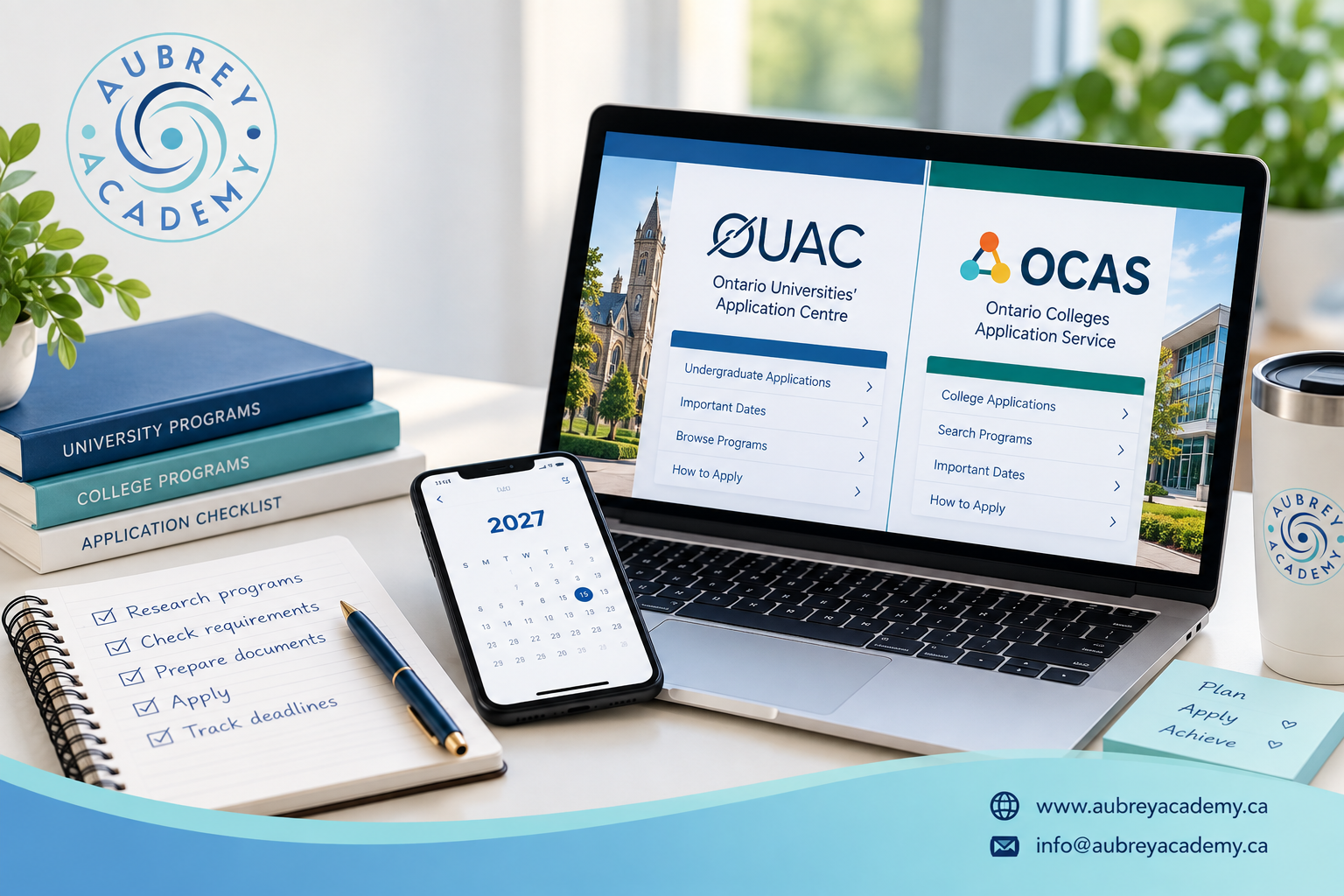
If you're planning to attend a college or university in Ontario, you'll apply through a centralized application service. Students applying to Ontario universities use the Ontario Universities' Application Centre (OUAC), while students applying to Ontario colleges use the Ontario Colleges Application Service (OCAS). Some students apply through both, depending on their post-secondary plans.
For Ontario students beginning their applications for fall 2027, now is the time to start researching programs, requirements and application timelines.
OUAC vs. OCAS: What's the Difference?
The two services are used for different types of Ontario post-secondary applications.
OUAC
The Ontario Universities' Application Centre (OUAC) is the application service used by students applying to undergraduate programs at Ontario universities. Students use OUAC to submit their university program choices and manage their Ontario university application.
OCAS
The Ontario Colleges Application Service (OCAS) is used by students applying to Ontario colleges. Students can use OCAS to research college programs and submit applications to the Ontario colleges they're interested in.
The application service you use depends on the program you're applying to. If you're considering both college and university, you may use both OUAC and OCAS.
Can You Apply Through Both?
Yes. Students can apply to both Ontario colleges and universities if they are considering programs in both systems.
For example, a student might apply to a university business program through OUAC and a college business program through OCAS. The applications are separate, so it's important to keep track of the requirements and deadlines for each.
When Do Ontario University Applications Open?
The OUAC 2027 undergraduate application is now available for students applying to Ontario universities for fall 2027 admission. For Group A applicants, the completed application deadline is January 15, 2027.
Some universities and programs have additional requirements or different deadlines, so students should always check the specific university program they are applying to.
When Should You Start a College Application?
Ontario college applications for the following academic year are also part of the fall application cycle.
Rather than waiting until a deadline approaches, students can use this time to research programs, compare admission requirements and prepare the information they'll need for their application.
Aubrey Academy encourages students to begin the application process early and provides support with both OUAC and Ontario Colleges applications.
What Do You Need Before Applying?
Having your information ready can make the application process much easier.
Students should have:
Their Ontario Education Number (OEN), if available
A list of programs they're interested in
Information about all high schools they've attended
Their course and grade information
A valid email address
Any required supporting documents
Students should also review the admission requirements for their specific programs before submitting their choices.
Tips for a Stronger Post-Secondary Application
Once you've decided where you want to apply, taking a little time to prepare can make the application process easier. Whether you're applying through OUAC for Ontario universities or OCAS for Ontario colleges, make sure you understand the requirements for each program before submitting your application.
A few things to keep in mind:
Research your programs: Review admission requirements, prerequisites and any additional application requirements.
Keep your information organized: Have your course history, grades and school information ready before starting your application.
Check for supplementary applications: Some university programs may require additional information, such as written responses, portfolios, interviews or other supplemental materials.
Watch your deadlines: Application deadlines can vary by institution and program, so don't assume they are all the same.
Ask for help when you need it: Academic advising can help you understand your course pathway, application options and post-secondary requirements.
Aubrey Academy offers academic advising and post-secondary application support to help students navigate their OUAC and OCAS applications and prepare for their next step.
What If You've Attended More Than One High School?
This is important for students who have transferred schools or completed courses at more than one school.
All high schools attended should be included in the application.
For Aubrey Academy students, Aubrey should be added to their education history along with any other secondary schools they've attended. Aubrey's Guidance Office submits students' Aubrey Academy grades directly to OUAC when they become available.
For Ontario college applications, students should also include Aubrey Academy in their high school education history.
Does Aubrey Academy Help With OUAC and OCAS?
Yes. Aubrey Academy provides academic advising and support with OUAC and OCAS applications, course selection and post-secondary planning.
This can be especially helpful for students completing courses online, attending more than one high school, or trying to make sure their OSSD courses align with their post-secondary plans.
What Happens After You Apply?
Submitting an application isn't the final step.
Students should continue checking their application account and email for updates, requests and offers.
For OUAC applicants, students can log back into their account to review their application information and respond to offers.
For college applicants, students should similarly monitor their Ontario Colleges account and communications from the colleges they've selected.
Frequently Asked Questions
Is OUAC for university or college?
OUAC is used for undergraduate applications to Ontario universities.
Is OCAS for university or college?
OCAS is used for applications to Ontario colleges. Aubrey Academy provides instructions for students applying through Ontario Colleges.
Can I apply to both?
Yes. Students considering both college and university can submit applications through both services.
Do I need an OSSD to apply?
Admission requirements depend on the program and applicant. Students should check the requirements for each program they're considering.
Planning Your Next Step
College and university applications can feel complicated when you're trying to keep track of different programs, requirements and deadlines. Understanding the difference between OUAC and OCAS is a simple first step.
Whether you're planning for university, exploring college programs, or considering both, having your OSSD courses and application information organized early can make the process easier.
Aubrey Academy supports Ontario students with OSSD planning, course selection and OUAC and OCAS application assistance.
Need support with your post-secondary planning?

What OSSD Courses Do You Need for University?
Which OSSD courses do you need for university in Ontario? Learn how to check program prerequisites, what 4U courses are, and how to take a missing prerequisite online before applications are due.
If you're planning to attend university in Ontario, choosing the right OSSD courses is an important part of your high school plan. University programs have specific admission requirements and prerequisites, so students should check what courses they need before choosing their Grade 12 schedule.
For students thinking about university, September is a good time to review those requirements and make sure their courses line up with their post-secondary goals.
Which Courses Are Required for University?
The courses you need depend on the university program you want to apply to. Many Ontario university programs require specific Grade 12 University Preparation (4U) courses, while others have additional prerequisites.
For example, a student interested in engineering may need specific Grade 12 math, physics, or chemistry courses, while another program may have completely different requirements.
The best place to start is by researching the programs you're interested in and making a list of their required courses.
What Does 4U Mean?
A 4U course is a Grade 12 University Preparation course in Ontario.
Students planning to attend university will often need several 4U courses as part of their OSSD and university admission plan. However, the exact courses required depend on the program.
Don't choose your Grade 12 courses based only on what you think you'll need. Check the admission requirements for your intended program first.
How Do You Know Which Courses You Need?
Start by looking at the admission requirements for the university programs you're considering.
Pay attention to:
Required Grade 12 courses
Specific prerequisites
Required 4U or 4M courses
Minimum admission averages
Additional program requirements
It's also important to check the university's website for the most current information, since admission requirements can change.
What If You're Missing a University Prerequisite?
Finding out that you're missing a required course doesn't necessarily mean your plans have to change.
Depending on your situation, you may be able to take an individual OSSD course to meet a prerequisite, upgrade a mark, or complete a course that isn't available through your current school.
Aubrey Academy is a Ministry-inspected online private high school in Ontario offering individual OSSD courses for students in Grades 9–12.
Online courses can be particularly useful for students who need flexibility or want to complete a specific course without changing their entire high school program.
Can You Take an OSSD Course Online?
Yes. Students can take individual OSSD courses online through an Ontario private high school.
Aubrey Academy offers a range of university-preparation courses, including ENG4U, MHF4U, MCV4U, MDM4U, SBI4U, SCH4U and SPH4U, among others.
This can be an option for students who need a prerequisite, want to upgrade a course, or need a more flexible learning schedule.
Planning Ahead for University
Students don't need to wait until Grade 12 to start thinking about university. If you have an idea of the programs or fields you're interested in, reviewing admission requirements early can help you choose courses that keep your options open.
This can be especially helpful for students who are considering competitive programs or courses with specific prerequisites.
Getting Ready for Applications
If you're applying to university this year, September is the right time to review your course plan, confirm your prerequisites, and make sure you're on track to complete the courses required for your programs.
The 2027 Ontario university application cycle is now underway, with the OUAC application deadline on January 15, 2027.
Getting organized early can help you avoid discovering a missing prerequisite when an application deadline is approaching.
What About Student Athletes?
Student athletes may need to plan their courses around training, competitions, travel, and other commitments.
Online OSSD courses can provide additional flexibility for students who need to balance academics with athletics while continuing to work toward their university goals.
Frequently Asked Questions
Can I take just one university prerequisite online?
Depending on your circumstances, yes. An individual online OSSD course may be an option if you need to complete a specific prerequisite.
Can I upgrade a Grade 12 course?
Students may be able to retake or upgrade a course to improve their mark. Always check the requirements of the university program you're applying to.
Does Aubrey Academy help students choose courses?
Yes. Aubrey Academy provides academic guidance to help students understand their OSSD requirements, course options, and post-secondary pathways.
Start Planning Your Next Steps
Choosing the right courses starts with understanding where you want to go next. Whether you're planning ahead for university, preparing for applications, balancing academics with athletics, or missing a prerequisite, having a clear course plan can help you stay on track.
Aubrey Academy offers flexible online OSSD courses for Ontario students who need to complete a prerequisite, upgrade a course, or take a course that fits their individual schedule.
Ready to find the right course for your university pathway?

What to Expect When Starting Online High School in Ontario
Thinking about online high school in Ontario? Learn how online courses, teacher support, OSSD credits and assessments work, and what students and parents can expect when they make the switch.
Starting online high school in Ontario can give students more flexibility while still allowing them to work toward their Ontario Secondary School Diploma (OSSD). Students can complete their coursework online with teacher support, manage their schedules more independently, and build a learning routine that fits their individual needs.
For students and parents considering the transition, understanding how online high school works can make the process feel much less overwhelming. Here’s what to expect when starting an online high school program in Ontario.
How Does Online High School Work in Ontario?
Online high school allows students to complete their courses through an online learning environment rather than attending a traditional school building every day. Students access their coursework online, complete assignments and assessments, communicate with their teachers, and work toward earning their required OSSD credits.
The exact structure can vary between schools, so families should understand how courses, teacher support, assessments, and scheduling work before enrolling.
Do Online High School Students Have Teachers?
Yes. Online learning does not mean students are learning completely on their own.
Students have access to teachers who provide instruction, feedback, clarification, and support throughout their courses. Students should also understand how and when they can communicate with their teachers before beginning their courses.
Can Students Work at Their Own Pace?
One of the reasons families consider online high school is flexibility.
Depending on the school's program and course structure, students may have more control over when and where they complete their coursework. This can be particularly helpful for student athletes, performers, students with demanding schedules, or students who need a learning environment that accommodates their individual circumstances.
Flexibility still requires responsibility. Students need to keep track of their assignments, deadlines, tests, and overall progress.
How Do Students Earn OSSD Credits Online?
Students earn OSSD credits by successfully completing approved secondary school courses and meeting the requirements that apply to their Ontario Secondary School Diploma pathway.
Before choosing courses, students should consider both their graduation requirements and their future plans. Students planning to attend college or university should also look carefully at the prerequisites required for their intended programs.
What Happens With Assignments, Tests and Exams?
Online courses still include assessments. Students may complete assignments, projects, tests, and exams as required by their course and school.
Parents and students should review the school's assessment and examination procedures before beginning a course so they understand what is expected.
Is Online High School a Good Option for Student Athletes?
It can be. Student athletes often have schedules that include practices, tournaments, travel, and competitions.
An online learning environment may give these students additional flexibility to manage their academic responsibilities around their athletic commitments while continuing to work toward their OSSD.
Can Homeschool Students Attend an Online High School?
Yes, an online high school can be an option for families looking for a structured Ontario high school program.
For a homeschool student considering an OSSD pathway, it's important to understand how previous learning and credits will be assessed and which courses are still required.
What About Students Coming From Another School?
Students do not necessarily have to start their high school education from the beginning when they move to an online school.
Their previous coursework and credits can be reviewed to determine what they have already completed and what they may still need to meet their academic goals.
This can be particularly relevant for students transferring from another Ontario high school or students changing schools during high school.
What Should Parents Expect When Their Teen Starts Online High School?
Parents can expect their student to have more independence, but that doesn't mean parents have to manage the learning process themselves.
A successful transition often involves establishing a regular study routine, understanding course expectations, keeping track of progress, and communicating with the school when questions arise.
For some students, this independence is one of the biggest adjustments when moving from a traditional classroom to online learning.
Frequently Asked Questions
Is online high school in Ontario recognized?
Students should confirm that the school they choose is authorized to offer the courses and credentials they are seeking. Families should also understand the school's Ministry status and how its courses contribute toward the OSSD.
Can I start online high school in the middle of the school year?
In many situations, students can transition to an online high school during the school year. The school will need to review the student's academic history, current courses, and remaining requirements.
Can student athletes attend online high school?
Yes. The flexibility of online learning can make it an option for students balancing academics with demanding athletic schedules.
Can I take only certain courses online?
Depending on the school and the student's circumstances, it may be possible to complete individual courses online rather than moving an entire high school program online.
Is online high school completely self-directed?
Not necessarily. Online students are expected to take responsibility for their learning, but they can still have teacher instruction, communication, feedback, and academic support.
Starting Online High School: What Comes Next?
Starting an online high school program doesn't have to be complicated. The first step is understanding your current credits, your OSSD requirements, your future academic goals, and the type of learning environment that works best for you.
Aubrey Academy provides flexible online learning for Ontario students working toward their OSSD, with courses designed to support students with different academic goals, schedules, and learning needs.
If you're considering online high school for yourself or your teen, contact Aubrey Academy to discuss your options and determine which courses may be right for you.

What the ILAC Closure Means for International Students and How to Keep Your Canadian Education on Track
Affected by the ILAC closure? Learn what international students can do next, how previous studies may be assessed, and how to keep working toward an Ontario Secondary School Diploma online from home.
The sudden closure of ILAC on September 18, 2026, has left students, families, education agents, and international partners facing difficult questions about what comes next.
ILAC announced that it had filed for bankruptcy protection and ceased operations immediately, with classes and programming cancelled at its Toronto and Vancouver locations. The announcement came shortly after EC English closed its Canadian schools, adding to uncertainty for international students who had planned their education around studying in Canada.
For students whose plans have been disrupted, the most important question now is:
How can I continue my education without starting over?
The good news is that there are alternative pathways available — including options that allow students to study the Ontario curriculum from their home country.
What Should Students Do After an Unexpected School Closure?
If your school or academic program has closed, there are several important steps to take before choosing your next program.
1. Gather your academic records
Keep copies of your transcripts, report cards, course records, receipts, and any documentation showing the courses or credits you have completed.
If you are transferring to another school, these records can help determine what education you have already completed and what you may still need.
2. Check whether the school is authorized to grant OSSD credits
If your goal is an Ontario Secondary School Diploma, it is important to verify that the school you choose is an Ontario Ministry-inspected private high school authorized to grant credits toward the OSSD.
The Ontario Ministry of Education recommends that families ask whether a private school is inspected, whether it can issue OSSD credits, and whether it follows the Ontario curriculum.
3. Ask how your previous education will be assessed
You may not need to start from the beginning.
Depending on your academic history, previous coursework may be assessed through Ontario equivalency or Prior Learning Assessment and Recognition (PLAR) processes. The purpose is to determine which requirements you have already met and which credits you still need.
A Flexible Alternative: Study the Ontario Curriculum From Home
For some international students, relocating to Canada is not the only way to access an Ontario education.
Aubrey Academy is an Ontario Ministry-inspected private high school (BSID #665140) offering asynchronous OSSD credit courses online. Students can study the Ontario curriculum from anywhere in the world while working toward their Ontario Secondary School Diploma.
Students can:
Study online from their home country
Learn through a flexible, asynchronous schedule
Work with Ontario-certified teachers
Begin courses throughout the year
Have previous academic records assessed
Complete OSSD credits toward their graduation requirements
Continue working toward university and college pathways
For students who are unable or no longer planning to relocate to Canada, this can provide another way to continue their Canadian education without waiting for a traditional semester to begin.
Looking for an ILAC Alternative?
If you were affected by the ILAC closure and are looking for an ILAC alternative, the right choice will depend on your academic goals and what you have already completed.
Aubrey Academy can review your academic history and help determine whether an online OSSD pathway may be appropriate for you.
Our team can look at your previous coursework and help identify:
Which credits you may already have
Which OSSD requirements remain
Which courses you may need to complete
How an online pathway could fit your timeline
What steps are needed to continue toward graduation
The goal is simple: help you understand your options before you make your next decision.
For International Students: You Don't Have to Put Your Education on Hold
Changing schools unexpectedly can be stressful, particularly when travel, immigration, accommodation, tuition, and university plans are involved.
An online Canadian high school pathway can remove some of those logistical challenges by allowing students to study the Ontario curriculum from home.
For families specifically searching for OSSD online for international students or looking for a way to study Canadian curriculum from home, Aubrey Academy offers a flexible option designed for students studying from outside Canada.
For Education Agents and International Schools
We also welcome conversations with education agents, international schools, and organizations looking for an Ontario academic partner.
Aubrey Academy works with international families and partners to provide flexible OSSD pathways for students around the world.
If you are supporting students affected by a school closure, we would be happy to discuss whether an online OSSD pathway could be appropriate for them.
Take the Next Step
If your education plans have been disrupted, you don't have to figure everything out on your own.
Contact Aubrey Academy for a pathway assessment.
Send us your transcript or available academic records, and our team can help you understand where you currently stand and what your next steps toward the OSSD could look like.
Explore Online OSSD Options for International Students →
Aubrey Academy
Ontario Ministry-Inspected Private High School
BSID #665140
(416) 998-3354
info@aubreyacademy.ca

Can You Switch to Online High School Mid-Year in Ontario? What Parents Need to Know
Considering a mid-year switch to online high school in Ontario? Learn how transferring credits works, what happens to your OSSD requirements, and what students and parents should consider before making the change.
Yes, students can switch to an online high school in Ontario during the school year. Depending on the student’s situation, they may be able to transfer completed credits, continue working toward their OSSD, and begin courses online without waiting for a new school year.
For families considering a mid-year change, the most important steps are understanding which credits the student has already earned, determining which OSSD requirements remain, and choosing a school that can support the transition.
Why Do Students Switch to Online High School Mid-Year?
There are many reasons a student may need a different high school option during the school year.
Some students find that their current school environment is no longer the right fit. Others may need greater flexibility because of athletics, travel, health or family circumstances, or a change in their academic goals.
Online high school can also be an option for students who need to catch up on credits, want to earn additional credits, or need a more flexible schedule.
Aubrey Academy is a flexible, Ministry-inspected online private high school in Ontario offering OSSD credits for students in Grades 9 to 12.
Can I Transfer My High School Credits to an Online School?
In many cases, students can transfer previously earned high school credits when moving to another Ontario high school. The receiving school reviews the student’s academic records to determine which credits can be applied toward their OSSD requirements.
Students should provide their most recent transcript or Ontario Student Transcript (OST) so the school can accurately review their progress.
Will Switching Schools Mid-Year Affect My OSSD?
Switching schools mid-year does not automatically prevent a student from earning an OSSD.
The key is understanding the credits and requirements the student has already completed and creating a plan for the courses still needed. A review of the student’s transcript can help identify any outstanding compulsory or elective credits.
What If I Am Already Taking a Course at Another Ontario High School?
If a student is already enrolled in a course when they decide to switch to an online high school, the next steps will depend on the student’s academic record and the status of the course.
The new school can review the student’s academic records to determine which credits have been completed and what requirements remain toward the OSSD. Families should provide the most up-to-date academic information available so the school can determine the appropriate next steps.
It is helpful to speak with the new school before withdrawing from the current school so the student’s transition can be planned appropriately.
Can I Switch to Online High School After Starting the School Year?
Yes. Students do not necessarily have to wait until September to switch to an online high school in Ontario.
A mid-year transition may be possible depending on the school, course availability, the student’s academic records, and the timing of the request. Families should contact the school directly to discuss the student’s situation and determine the best next steps.
Is Online High School a Good Option for Student Athletes?
Online high school can be particularly helpful for student athletes who need more flexibility in their daily schedules.
Training, competitions, travel, and tournaments can make a traditional school schedule difficult to manage. An online learning environment may allow students to organize their schoolwork around their athletic commitments while continuing to work toward their OSSD.
Is Online High School an Option for Homeschool Families?
Yes. Families who have been homeschooling may also explore Ontario online high school as they plan the student’s transition toward earning an OSSD.
The student’s previous academic work and completed credits should be reviewed so the school can determine what requirements remain and what courses may be appropriate.
Can International Students Study Toward an OSSD Online?
International students may also consider an Ontario online high school when looking for flexibility or an Ontario secondary school credit pathway.
Because individual circumstances and academic histories vary, international families should speak with the school about their previous education, current goals, and the OSSD requirements they need to complete.
What Documents Do I Need to Switch to an Online High School?
The documents required can vary depending on the student and the school. Typically, an academic transcript or Ontario Student Transcript is an important starting point.
Having accurate academic records allows the school to review completed credits and determine what courses the student may need to complete next.
How Do I Know Which OSSD Courses I Still Need?
The best way to determine what a student needs is to review their academic record against the requirements for the Ontario Secondary School Diploma.
This can help identify completed credits, remaining compulsory credits, elective requirements, and other graduation requirements. A school can help families understand the student’s current academic standing and develop a course plan.
What If My Student Wants to Catch Up on Credits?
Online learning can provide an opportunity for students to work toward outstanding credits while having greater flexibility in how they organize their school time.
For some students, the ability to focus on one course at a time or work around other commitments can make it easier to stay on track academically.
What Should Parents Consider Before Switching Mid-Year?
Before making a change, parents should consider:
Which credits has the student already completed?
Which OSSD requirements are still outstanding?
Does the online school offer the courses the student needs?
How flexible is the course schedule?
What support is available to the student?
How will completed credits be documented?
What is the expected timeline for completing the remaining courses?
It is also important to choose a school that is properly authorized to offer the Ontario secondary school credits the student needs.
Aubrey Academy provides flexible online learning for Ontario high school students who are looking for an alternative to a traditional school setting while working toward their OSSD.
Frequently Asked Questions About Switching to Online High School
Can I switch to an online high school in Ontario during the school year?
Yes. Students can explore switching to an online high school during the school year. Their academic records should be reviewed to determine which credits they have completed and what requirements remain.
Can I transfer my Ontario high school credits?
Previously earned credits may be transferred and applied toward the student’s OSSD requirements. The receiving school will review the student’s academic records to determine how the credits fit into their graduation plan.
Do I have to wait until September to start online high school?
No. Some online high schools allow students to begin courses at different points during the school year. Start dates and course availability vary by school.
Is online high school good for student athletes?
It can be. The flexibility of online learning may make it easier for student athletes to balance schoolwork with training, competitions, and travel.
Can homeschool students earn an OSSD through online high school?
Homeschool families can explore online high school as an option for completing Ontario secondary school credits. The student’s previous academic work should be reviewed to determine an appropriate pathway.
What is the first step if I want to switch schools?
The first step is to contact the online high school and provide the student’s current academic records for review. This allows the school to determine what credits have been completed and what courses may still be required.
Thinking About Switching to Online High School?
If you're considering a mid-year transfer, contact Aubrey Academy to discuss your student's academic record and course options.
Contact Aubrey Academy to discuss your student’s academic situation, review their course options, and learn more about working toward an OSSD through flexible online learning in Ontario.
Ready to explore your options? Contact Aubrey Academy today.

Can You Take Just One High School Course Online?
Need just one high school course? Learn how Ontario students can take an individual online OSSD course for prerequisites, credit recovery, mark improvement, or getting ahead.
Sometimes, a student doesn't need to change schools. They just need one course.
Maybe your teen is missing a prerequisite for a college or university program. Maybe they want to improve a mark, recover a credit, or take a course that doesn't fit into their regular school schedule.
For Ontario students, taking one high school course online can provide a flexible way to meet an academic goal without changing their entire education plan.
With an online OSSD course, students can continue working toward their Ontario Secondary School Diploma while learning from home and managing their other commitments.
Why Would a Student Take One Online Course?
There are many reasons a student may need just one additional high school course.
For example, a Grade 12 student may discover that a university program requires a specific Grade 12 course they did not take. Rather than changing their entire timetable, they may be able to complete that course online.
Another student may have failed a course and need to recover the credit before graduation. Someone else may want to improve a mark to strengthen their application for a competitive college or university program.
Individual online courses can also be useful for students whose schedules don't fit neatly into a traditional school day.
A student athlete may have practices and competitions during regular school hours. A dancer may spend several evenings each week at the studio. A student who travels with family may need a learning option that can move with them.
In these situations, one online course can make a big difference.
What Can You Use One Online Course For?
An individual course can serve different academic purposes depending on the student's needs.
Completing a Prerequisite
Some post-secondary programs require specific high school courses.
For example, a student planning to apply to a program that requires a particular Grade 12 course may discover that the course isn't part of their current timetable. Taking it online may provide another option for completing the requirement.
Students should always check the admission requirements for their specific college or university program before choosing a course.
Recovering a Missing Credit
Students sometimes need to recover a credit because they were unsuccessful in a course or were unable to complete it.
An online course can give them another opportunity to complete the required work and continue toward their graduation goals.
Improving a Mark
A student may have completed a course but want to improve their grade.
For example, a student planning to apply to a competitive university program may decide they want to strengthen a particular mark. Taking an individual course online may give them an opportunity to work toward a stronger result.
Getting Ahead
Not every student takes an extra course because something went wrong.
Some students simply want to get ahead.
A Grade 10 student, for example, may want to complete an additional course before the following school year. Taking a course online can provide an opportunity to work toward another OSSD credit outside their regular school schedule.
Can You Take an Online Course While Attending Another School?
Students attending a publicly funded school may be able to take an individual course through an inspected private school at the same time. This can be helpful when a student's current school doesn't offer the course they need or when they need additional flexibility.
For example, a student might continue attending their regular high school while completing one additional OSSD course online. Before enrolling, families should speak with their current school and the online school to make sure the course fits the student's academic plan and understand how the credit will be recorded.
How Does an Individual Online Course Work?
Taking one online course doesn't mean your teen has to manage everything on their own.
An online course typically includes course materials, assignments, assessments, and academic support from a teacher.
At Aubrey Academy, students can take individual OSSD courses online with the flexibility to fit their coursework around school, work, athletics, family commitments, or other responsibilities. This gives students the flexibility to fit a course around school, work, athletics, family commitments, or other responsibilities.
For example, a student who needs one additional Grade 12 course may be able to work on that course around their existing school schedule rather than trying to rearrange their entire year.
You can browse Aubrey Academy's OSSD courses to see the courses available.
Can Online Courses Help Students Earn an OSSD?
Yes, students can earn OSSD credits through eligible courses offered by a Ministry-inspected private school authorized to grant OSSD credits.
The Ontario Secondary School Diploma has specific graduation requirements, so students should look at their existing credits and remaining requirements before choosing an additional course.
For a student who is missing one credit, the right course may help them move closer to completing those requirements.
For a student who is already on track to graduate, an additional course may instead be useful for a prerequisite or another academic goal.
If you're unsure what your teen needs, Aubrey Academy's OSSD and online high school services provide more information about the options available.
Who Might Benefit From One Online Course?
An individual online course can be a good option for many different students.
Students Who Need More Flexibility
A student may have a busy schedule because of competitive sports, dance, music, work, or other commitments.
For example, a competitive dancer may spend several hours each week training and performing. An online course can provide more flexibility around those commitments.
Aubrey Academy also supports students who need flexibility around athletics through its Student Athlete program.
Students Who Travel
Some families travel frequently or spend part of the year outside Ontario.
An online course can allow students to continue their studies while away, provided they have reliable internet access and meet the course requirements.
Students living outside Canada can also learn more about Aubrey Academy's options for international students.
Students Who Want to Improve Their Academic Options
Sometimes one course can open another door.
A student may discover that a program they want to apply to has a prerequisite they haven't completed. Instead of giving up on that option, they can look at whether completing the required course online is possible.
What Should Parents Check Before Enrolling?
Before choosing an individual online course, it's worth asking a few questions.
Does the course meet the student's academic goal?
Make sure the course matches the prerequisite, credit, or mark-upgrading goal the student has in mind.
Will the course provide an OSSD credit?
If the goal is an Ontario high school credit, confirm that the school is authorized to grant the credit.
Does the course fit the student's schedule?
Consider how much time your teen can realistically dedicate to the course alongside their other responsibilities.
What academic support is available?
Ask how students communicate with teachers and what support is available if they have questions or need help with their coursework.
If you have questions about enrollment, course options, or how online learning works, Aubrey Academy's FAQ is a helpful place to start.
One Course Can Make a Difference
Your teen doesn't always need to change their entire education plan to get the academic support they need.
Sometimes they need one course.
Whether they're completing a prerequisite, recovering a missing credit, upgrading a mark, or getting ahead, an individual online OSSD course can provide another option.
The key is finding a course that fits their academic goals, schedule, and future plans.
Ready to Find the Right Course?
If your teen needs just one high school course, Aubrey Academy offers flexible online OSSD courses that students can take from anywhere and complete at their own pace.
Browse Aubrey Academy's OSSD courses to find the course your student needs, or call/text (416) 998-3354 to speak with the team.
Frequently Asked Questions
Can I take just one high school course online?
Yes. Students can take an individual online OSSD course without completing their entire high school education online. An individual course can be used for a prerequisite, credit recovery, mark improvement, or another academic goal.
Can I take an online course to upgrade my high school mark?
An individual online course may be an option for students who want to improve a mark. Students should discuss their specific academic situation and goals with the school before enrolling.
Can I take an online course to meet a college or university prerequisite?
Yes, an online OSSD course may be an option for completing a prerequisite. Students should always confirm the specific admission requirements of the college or university program they plan to apply to.

Ontario's New Financial Literacy Graduation Requirement: A Parent's Guide
Ontario is introducing a new Financial Literacy Graduation Requirement for eligible Grade 10 students beginning in 2026–2027. Learn what parents need to know about the 70% requirement, two attempts, and how it fits into Grade 10 Career Studies and the OSSD.
Ontario’s new Financial Literacy Graduation Requirement begins in the 2026–2027 school year for eligible Grade 10 students. Learn what parents need to know about the 70% requirement, two attempts, and how it affects the Career Studies course.
Starting in September 2026, a new financial literacy requirement will become part of earning an Ontario Secondary School Diploma (OSSD) for eligible students.
For parents, this raises some important questions: What is the new financial literacy graduation requirement? Does my teen have to take a test? What mark do they need? What happens if they don't pass? And how does this work for students taking Grade 10 Career Studies online?
The good news is that the requirement is completed as part of the compulsory Grade 10 Career Studies course (GLC2O). Students will have opportunities to prepare, receive support, and try again if they are unsuccessful on their first attempt.
Here is what Ontario parents need to know about the new financial literacy graduation requirement for 2026.
What Is the New Ontario Financial Literacy Graduation Requirement?
Beginning in the 2026–2027 school year, eligible Ontario high school students must successfully complete a Financial Literacy Graduation Requirement to earn their OSSD.
The requirement is completed within the compulsory Grade 10 Career Studies course, GLC2O.
The Ministry of Education has introduced the requirement to make sure students leave high school with practical financial knowledge they can use in everyday life. The assessment focuses on financial literacy concepts that students have encountered through the Grades 1 to 9 curriculum and their Grade 10 Career Studies learning.
The requirement consists of learning modules and assessment questions developed by TVO and provided to schools. Students must earn a minimum mark of 70% to successfully complete the requirement.
Once successfully completed, the requirement is recorded on the student's Ontario Student Transcript.
Who needs to complete the financial literacy requirement?
The requirement applies to students who began Grade 9 in the 2025–2026 school year or later.
In practical terms, students entering Grade 10 in the 2026–2027 school year who are taking GLC2O will generally need to complete the requirement as part of that course.
The financial literacy requirement is now one of the requirements students must meet to earn an OSSD, alongside their credits, literacy requirement, community involvement hours and other applicable graduation requirements.
What Is the Grade 10 Career Studies Financial Literacy Test?
Parents may hear this requirement referred to as the Grade 10 financial literacy test, financial literacy exam, or 70% financial literacy test.
Officially, Ontario refers to it as the Financial Literacy Graduation Requirement.
Students complete TVO-developed learning modules and assessment questions during their Grade 10 Career Studies course. The assessment is designed to measure whether students understand important financial concepts rather than simply testing whether they can memorize information.
Students have two attempts during the Career Studies course to meet the requirement. They need to achieve at least 70%.
The results also have a small impact on the student's GLC2O course grade. The financial literacy results count for 5% of the student's final Career Studies mark, with the highest attempt mark used if the student makes more than one attempt.
What Does the Ontario Financial Literacy Requirement Cover?
The goal is to give students practical knowledge they can use when they begin managing their own money.
The financial literacy requirement covers topics including:
Budgeting
Interest rates
Earning and saving money
Taxes
Credit and debt
Consumer awareness
Financial fraud and protecting personal information
These are skills students will encounter in real life, whether they are getting their first job, opening a bank account, applying for a credit card, paying bills, saving for post-secondary education or eventually taking on larger financial responsibilities.
TVO's financial literacy resources are designed to help students understand these concepts and make informed financial decisions.
What Happens If a Student Doesn't Get 70%?
This is one of the biggest questions parents have — and there is no need to panic if a student does not achieve 70% on the first attempt.
Students have two attempts during their Grade 10 Career Studies course.
If a student is unsuccessful on the first attempt, they can review additional resources and receive support before completing a second attempt. The school will provide information about the next steps.
If a student is still unsuccessful after two attempts, Ontario provides additional pathways to complete the requirement. These can include another supervised attempt, additional instructional support before attempting the modules again, or completing alternative financial literacy learning activities developed by TVO.
These options can remain available until the student successfully completes the requirement.
In other words, not passing the first attempt does not automatically mean a student cannot graduate.
Does the Financial Literacy Requirement Count Toward the GLC2O Grade?
Yes.
The results from the financial literacy modules count for 5% of the student's final Grade 10 Career Studies mark.
If a student completes more than one attempt, the highest attempt mark is used as part of the final Career Studies grade. Once the student successfully meets the graduation requirement, it is recorded on their Ontario Student Transcript.
This means students should take the requirement seriously, but it is only one component of their overall GLC2O course.
Who Is Exempt From the Ontario Financial Literacy Graduation Requirement?
There are some exceptions.
Students who completed their Grade 10 Career Studies course before the beginning of the 2026–2027 school year do not have to complete the new financial literacy graduation requirement.
There are also special rules for some students who transfer into Ontario from outside the province.
For example, students who enrol in an Ontario school in Grade 11 or Grade 12 from outside Ontario may not have to complete the requirement if they receive Grade 9 and 10 credits through the equivalency process, including the Grade 10 Career Studies credit.
There is also a transition rule affecting students who take a locally developed Grade 9 Mathematics course instead of MTH1W before September 2027. Beginning in September 2028, all students will be required to complete the financial literacy graduation requirement.
Because individual student pathways can vary, families who are unsure about whether the requirement applies to their teen should speak with their school or academic advisor.
How Does the Financial Literacy Requirement Work for Online Students?
This is especially important for families considering online high school.
Ontario has specific rules for administering the Financial Literacy Graduation Requirement in online and remote learning environments.
For publicly funded school boards, students taking an online or remote Career Studies course may be required to complete the requirement in person unless the course includes approved online proctoring and security measures.
Ontario also states that inspected private schools may administer the requirement through online proctoring.
At Aubrey Academy, students can complete GLC2O through a flexible online learning environment while receiving teacher support throughout the course.
Explore GLC2O – Grade 10 Careers at Aubrey Academy
How Aubrey Academy Supports Students With GLC2O
Aubrey Academy offers GLC2O – Grade 10 Careers as an Ontario OSSD credit course.
The course already includes important financial management learning, including personal financial management, saving and borrowing tools, and creating a budget for a student's first year after secondary school.
Because Aubrey Academy uses a flexible, asynchronous learning model, students can work through their coursework at a pace that fits their individual circumstances, while still having access to Ontario-certified teacher support.
This can be particularly helpful for students who:
Need a more flexible school schedule
Are balancing academics with athletics or other commitments
Need to catch up on an OSSD credit
Prefer working independently
Are completing high school courses online
Need additional time to review concepts before an assessment
Want to fast-track a course when appropriate
Aubrey Academy offers Ontario OSSD courses for students in Grades 9–12, with flexible start dates and pacing options.
View All Aubrey Academy OSSD Courses
Why Financial Literacy Matters Beyond the Graduation Requirement
Although the new requirement is connected to graduation, the skills students learn have value well beyond Grade 10.
Many teenagers will soon be making financial decisions independently for the first time.
They may need to understand how much money they actually take home from a part-time job, how interest affects borrowing, why minimum credit-card payments can become expensive, how to create a realistic monthly budget, or how to recognize a financial scam.
These are not just school topics. They are everyday life skills.
Learning about financial literacy before students leave high school can give them a stronger foundation as they move into university, college, apprenticeships, employment or other post-secondary pathways.
Frequently Asked Questions About Ontario's Financial Literacy Graduation Requirement
What is the financial literacy graduation requirement in Ontario?
The Financial Literacy Graduation Requirement is a new OSSD graduation requirement beginning in the 2026–2027 school year. Eligible students complete it as part of compulsory Grade 10 Career Studies (GLC2O) and must achieve at least 70% to successfully meet the requirement.
Is there a Grade 10 financial literacy test in Ontario?
Yes, although the official name is the Financial Literacy Graduation Requirement. It consists of learning modules and assessment questions developed by TVO. Students complete it as part of their Grade 10 Career Studies course and have two attempts during the course to achieve the required 70%.
What happens if my child fails the Ontario financial literacy test?
Students who do not achieve 70% on their first attempt can receive additional support and have a second attempt. If they are unsuccessful after two attempts, Ontario provides additional options for completing the requirement, including further instructional support and alternative learning activities.
Does GLC2O include financial literacy?
Yes. Grade 10 Career Studies includes personal financial management as part of the course. Students learn about saving and borrowing tools and develop a budget as part of preparing for life after secondary school. The new Financial Literacy Graduation Requirement is completed within GLC2O.
Can I take GLC2O online in Ontario?
Yes. Aubrey Academy offers GLC2O – Grade 10 Careers as an online OSSD credit course. Students can learn through Aubrey Academy's flexible online model with teacher support and pacing options designed to accommodate different student schedules.
Learn More About GLC2O at Aubrey Academy
Need Help With Grade 10 Career Studies?
The new Ontario financial literacy graduation requirement may feel like one more thing for families to keep track of. The important thing to remember is that it is built into GLC2O – Grade 10 Career Studies, and students have opportunities to learn, prepare, and try again if necessary.
At Aubrey Academy, students can complete GLC2O online with the flexibility and teacher support they need to stay on track toward their OSSD.
Interested in enrolling in GLC2O or another Ontario high school course? Contact Aubrey Academy to learn more about course availability, registration, and the best pathway for your student.
Email: info@aubreyacademy.ca
Call or text: (416) 998-3354