
Ontario's New 10 Percent Attendance Mark: What It Means for Student Athletes and Flexible Learners
Ontario’s new 10 percent attendance and participation mark is here. Learn what the changes mean for students, parents, and flexible learners in the 2026–27 school year.
Ontario high school students are starting the 2026–27 school year under significant new assessment rules — and one of the biggest changes is the addition of attendance and participation to the final course mark.
Under the province's new assessment requirements, attendance and participation now account for 15% of the final mark in Grades 9 and 10 and 10% in Grades 11 and 12.
For families of student-athletes, performers, students who travel frequently, and other learners whose schedules don't fit a traditional school day, this raises an important question:
How will time away from school affect my child's grades?
The answer depends on how a school defines and measures attendance and participation and for students with demanding schedules, the learning model matters more than ever.
What Is Bill 101?
The Putting Student Achievement First Act, 2026 (Bill 101) introduced changes to Ontario's education system, including new assessment and evaluation requirements for secondary students.
The legislation received Royal Assent on May 7, 2026, and provisions affecting education have come into force in stages. The new attendance and participation requirements apply beginning with the 2026–27 school year.
The Ontario Ministry of Education now requires final secondary school marks to include attendance and participation.
This means attendance is no longer simply something recorded by a school. For students in Grades 9–12, it can now form part of the final course grade.
How Are Ontario High School Grades Calculated in 2026–27?
The new grading structure divides a student's final course mark into three components.
Grades 9 and 10
65% — Classroom work completed throughout the course
20% — Mandatory final evaluation
15% — Attendance and participation
Grades 11 and 12
65% — Classroom work completed throughout the course
25% — Mandatory final evaluation
10% — Attendance and participation
For a Grade 9 or 10 student, that means attendance and participation can represent 15 marks out of the student's final 100%.
For a Grade 11 or 12 student, it represents 10 marks.
That is a meaningful change from the previous assessment model, where attendance and participation were not directly included as a percentage of the final course mark.
Do Excused Absences Lower a Student's Mark?
No.
This is one of the most important points for parents to understand.
The Ontario Ministry of Education states that excused absences do not negatively affect a student's mark.
Schools may consider a student's attendance, engagement and participation when determining this component of the final grade, but an absence that is properly excused should not result in a reduction to the student's mark.
This distinction is particularly important for students whose schedules include legitimate commitments outside the classroom.
Parents should always follow their school's process for reporting or documenting an absence.
What About Student-Athletes Who Travel?
This is where the new attendance and participation mark becomes especially important for student-athletes.
Competitive athletes may spend significant amounts of time:
Travelling to tournaments
Competing outside Ontario
Attending training camps
Participating in showcases
Training multiple times per week
Travelling internationally
Attending recruitment events
Preparing for provincial, national or international competitions
A traditional school schedule can make this difficult.
A student may be an excellent learner, complete their assignments, communicate with teachers and maintain strong academic performance but still have a schedule that doesn't fit neatly into a conventional classroom timetable.
The question isn't simply: "How often is the student physically in a classroom?"
For today's student-athletes, an increasingly important question is:
How is the school measuring meaningful participation?
That distinction matters.
Why an Asynchronous Online School Can Be a Better Fit
At Aubrey Academy, our online OSSD model is designed around students who need flexibility without giving up academic support.
Our courses are asynchronous, meaning students do not have to be online in a traditional classroom at a fixed time each day.
Students can work around their actual schedules — including training, travel and competition — while continuing to complete their coursework and stay connected with their teachers.
This can be particularly valuable for student-athletes.
Instead of requiring a student to be physically present in a classroom at a specific time, an asynchronous model allows learning to happen around the student's schedule.
Explore Aubrey Academy's Online OSSD Courses
What Does "Participation" Look Like in an Online School?
Participation doesn't have to mean sitting in a classroom from 9 a.m. to 3 p.m.
In an online learning environment, meaningful participation can be demonstrated through engagement with the course and learning process.
At Aubrey Academy, our asynchronous model allows students to demonstrate engagement through their coursework, learning activities, communication and ongoing progress with teacher support.
For an athlete travelling to a tournament in another province, for example, the student isn't necessarily stepping away from school.
They may be completing coursework from a hotel room.
They may be working through a lesson between training sessions.
They may be communicating with their teacher remotely.
They may continue progressing through their course while travelling with their team.
The location may change. The learning doesn't have to stop.
That is one of the major advantages of flexible online education.
A Realistic Example
Imagine a Grade 11 student who plays competitive hockey.
During the season, the student may travel regularly for tournaments and competitions. Some weekends may involve long-distance travel, while weekdays may include several hours of training.
In a traditional school environment, the family may need to carefully coordinate missed classes, absences and make-up work.
With an asynchronous online course, the student can structure their learning around their athletic schedule.
They can continue working through their course while travelling, complete assignments according to their course requirements and maintain communication with their teacher.
For families considering an online school, this flexibility can make a significant difference.
Does This Mean Student-Athletes Don't Have to Participate?
No.
The new rules do not mean students can simply ignore their courses because they attend an online school.
Students still need to demonstrate meaningful engagement and complete their academic responsibilities.
The difference is that an asynchronous model can allow students to demonstrate that engagement without requiring them to follow a traditional classroom timetable.
That's an important distinction.
Flexibility does not mean less accountability.
It means the structure of learning is designed differently.
Written Exams Are Also Part of the New Rules
The attendance change isn't the only major assessment update for 2026–27.
Ontario has also introduced mandatory final evaluations, including written exams for many secondary courses. The Ministry states that most secondary courses will have mandatory written exams, with specific course and subject exemptions.
English, mathematics and science courses have written examinations as part of their final evaluation structure.
Some courses are exempt from the mandatory written exam requirement, including certain locally developed compulsory credit courses, Grades 11 and 12 workplace preparation and open courses, Co-operative Education, Interdisciplinary Studies and specified Guidance and Career Education courses. These courses still require a final evaluation.
For families choosing an online high school, it is important to understand not only how coursework is delivered, but also how final evaluations and exams are administered.
What Should Parents Ask an Online School?
If your child is considering online high school for the 2026–27 school year, don't just ask whether the school is "online."
Ask how the school handles the new assessment requirements.
Here are five questions worth asking:
1. How is attendance measured?
Ask what the school considers attendance and how it contributes to the student's final mark.
2. How is participation measured?
For an asynchronous student, this is especially important.
Ask how the school evaluates meaningful engagement when there isn't a traditional daily classroom.
3. What happens when my child travels?
If your child is an athlete, performer or frequently travelling student, ask how travel affects course participation and deadlines.
4. How are final evaluations and exams completed?
Find out whether exams are written online, in person, remotely proctored or administered another way.
5. Can the school accommodate an athletic schedule?
A school may technically offer online courses while still requiring rigid schedules.
Make sure the learning model actually fits your child's life.
Why This Matters for Families Choosing an OSSD Pathway
The new Ontario grading rules don't mean that traditional school is the wrong choice.
But they do make school structure and assessment practices more important considerations for families.
For some students, a traditional classroom environment is exactly what they need.
For others — particularly student-athletes, performers, working students, frequent travellers and learners who thrive with greater flexibility — an asynchronous online model may be a better fit.
At Aubrey Academy, we believe students shouldn't have to choose between their academic future and the activities, goals and commitments that matter to them.
Our Ministry-inspected Ontario private high school offers flexible online OSSD credit courses supported by Ontario Certified Teachers, with academic pathways designed around each student's goals.
See How Aubrey Academy Supports Student-Athletes
The Bottom Line
Ontario's new attendance and participation mark is now part of the high school grading system.
Starting in the 2026–27 school year:
Grades 9 and 10 include 15% attendance and participation
Grades 11 and 12 include 10% attendance and participation
Excused absences do not negatively affect a student's mark
Mandatory final evaluations have been introduced
Many courses now include written final exams
Schools must follow the province's updated assessment requirements
For student-athletes and other flexible learners, the key question isn't simply how much time a student spends inside a classroom.
It's whether their school environment allows them to stay engaged, keep learning and demonstrate meaningful participation while managing the realities of their schedule.
Looking for Flexible OSSD Credits?
If your child is balancing high-performance athletics, training, travel, work or other commitments, Aubrey Academy can help you explore an OSSD pathway that fits.
Contact Aubrey Academy to discuss flexible online OSSD credits and find out whether our asynchronous learning model is right for your student.
Aubrey Academy
Ontario Ministry-Inspected Private High School
BSID #665140
📧 info@aubreyacademy.ca
📞 (416) 998-3354
10 Signs Your Teen Might Thrive in an Online High School (Ontario Parents’ Guide)
Could your teen benefit from online high school? Discover 10 signs that an online learning environment may be the right fit and learn how Aubrey Academy helps Ontario students earn their Ontario Secondary School Diploma (OSSD) with flexible, personalized education.
At Aubrey Academy, a Ministry-inspected Ontario private school (BSID #665140), we help students earn their Ontario Secondary School Diploma (OSSD) through flexible online learning. Here are ten signs that your teen might thrive in an online high school setting.
For some Ontario teens, an online high school can provide the flexibility, structure, and academic support they need to succeed while working toward their OSSD.
1. They Prefer a Flexible Schedule
If your teen has commitments like sports, dance, music, or part-time work, online learning allows them to balance their responsibilities more effectively. Instead of trying to fit everything into a traditional school day, they can create a schedule that works for them while continuing to earn their OSSD.
Learn more about how we support Student Athletes.
2. They Are Self-Motivated
Students who can manage their time and stay on task independently often excel in an online environment. They enjoy taking ownership of their learning while still receiving support and guidance from their teachers when they need it.
3. They Feel Distracted in Traditional Classrooms
A quieter, more controlled learning space at home can help students focus better. For teens who find busy classrooms overwhelming, online learning can reduce distractions and improve concentration.
4. They Want to Learn at Their Own Pace
Online courses allow students to move quickly through material they understand and spend more time on challenging topics. This flexibility can build confidence and help students achieve better results.
5. They Have Unique Learning Needs
Whether they need extra support or more advanced material, online learning can be tailored to fit individual needs. Personalized learning helps students work toward success in a way that suits them best.
Not sure which courses your teen should start with? Visit our FAQ to learn more about enrollment, credits, pacing, and teacher support at Aubrey Academy.
6. They Experience Anxiety in Social Settings
For some students, reducing the pressures of a traditional school environment can improve confidence and academic performance. Learning in a comfortable environment allows many teens to focus more on their education and less on the stress of everyday school life.
7. They Travel Frequently
Families who travel or relocate often can benefit from the consistency of online education. Whether travelling for sports, work, or family commitments, students can continue earning Ontario high school credits from anywhere with an internet connection.
Learn more about our International Student program.
8. They Are Pursuing Specialized Interests
Teens focused on athletics, dance, music, arts, or other passions can maintain their training while continuing their education. Online learning provides the flexibility to pursue personal goals without putting academics on hold.
9. They Want to Upgrade or Recover Credits
Online learning offers opportunities to retake courses, improve grades, or earn missing OSSD credits in a flexible format. Many Ontario students choose online courses to strengthen their college or university applications.
Browse our complete list of OSSD Courses.
10. They Are Preparing for Post-Secondary Goals
Online learning helps students develop independence, time management, and responsibility—skills that are essential for college and university success. These habits often give students greater confidence as they transition to post-secondary education.
Learn more about our programs and how Aubrey Academy helps students earn their Ontario Secondary School Diploma.
Is Online High School Right for Your Teen?
Every student learns differently, and the best learning environment is one that supports their individual goals, strengths, and lifestyle. For many Ontario families, online education provides the flexibility and personalized support students need to succeed.
At Aubrey Academy, we’re committed to helping students earn their Ontario Secondary School Diploma (OSSD) through engaging online courses, experienced teachers, and personalized academic support.
Ready to see if online learning is the right fit for your teen? Browse our full list of OSSD courses, explore our programs, or call/text us at (416) 998-3354. Our team is happy to answer your questions and help you find the right path forward.
Frequently Asked Questions
Is an online high school diploma in Ontario the same as a regular diploma?
Yes. Students who meet Ontario’s graduation requirements receive the same Ontario Secondary School Diploma (OSSD) as students attending traditional schools.
Can students upgrade marks for college or university?
Yes. Many students take individual online OSSD courses to improve grades or recover credits for post-secondary admissions.
Can students complete online courses from anywhere?
Absolutely. With a reliable internet connection, students can complete their coursework from anywhere while staying on track toward graduation.

Can You Earn an Accredited High School Diploma While Learning from Home?
Can you really earn an OSSD while learning from home? Learn how Ministry-inspected online private schools in Ontario help students earn recognized high school credits and work toward their Ontario Secondary School Diploma.

Separating fact from fiction about online learning and the Ontario Secondary School Diploma (OSSD).
When you hear the words "learning from home," what's the first thing that comes to mind?
For many people, it's a parent sitting at the kitchen table teaching every subject while trying to juggle work, family life, and lesson plans.
While that's still one approach to education, it's no longer the only one.
Today, students can earn an Ontario Secondary School Diploma (OSSD) through an accredited online private school, learning from anywhere while receiving instruction and support from Ontario-certified teachers.
If you've been wondering whether it's possible to earn recognized high school credits outside of a traditional classroom, the answer is yes.
What Is an Accredited Online High School?
An accredited online high school delivers the Ontario curriculum through a flexible online learning environment while allowing students to earn official OSSD credits.
Instead of parents creating lessons and teaching every subject, students receive:
· Ontario-certified teachers
· Ministry-approved curriculum
· Assignments, quizzes, and exams
· Academic feedback and support
· Official report cards
· Recognized OSSD credits
Students enjoy the flexibility of learning at their own pace while working toward the same Ontario Secondary School Diploma awarded in traditional high schools.
Considering online learning for your child?
Whether your student wants to take a single course, improve a mark, or complete their Ontario Secondary School Diploma online, Aubrey Academy offers flexible OSSD credit courses that fit your family's schedule.
👉 Browse our OSSD Courses to see how flexible online learning can help your student succeed.
Homeschooling vs. Accredited Online School
Traditional Homeschooling
In a traditional homeschool setting, parents are typically responsible for selecting the curriculum, teaching the material, and tracking their child's progress.
Many families have wonderful homeschooling experiences, but homeschooling does not automatically lead to earning OSSD credits.
Accredited Online Learning
An Ontario Ministry-inspected online private school provides students with a structured education that includes certified teachers, recognized curriculum, assessments, and official Ontario credits.
Parents continue to support their child's learning—but they don't have to become the teacher.
Myth vs. Fact
Myth: Students learning from home can't earn accredited Ontario high school credits.
Fact: Students enrolled in an Ontario Ministry-inspected online private school can earn recognized OSSD credits while learning remotely.
Those credits count toward graduation requirements and can support applications to colleges and universities in Ontario, across Canada, and internationally, subject to each institution’s admission requirements.
Why Choose Online Learning
Online education has become an increasingly popular choice for students who:
· Need a flexible schedule
· Are competitive athletes, dancers, or performers
· Travel frequently
· Want to upgrade marks for college or university admission
· Prefer learning at their own pace
· Thrive in a quieter learning environment
· Need an alternative to the traditional classroom
Rather than fitting every student into the same schedule, online learning gives students the flexibility to learn in a way that works best for them.
Why Families Choose Aubrey Academy
As a Ministry-inspected online private high school in Ontario (BSID #665140), Aubrey Academy provides students with the flexibility of online education while maintaining the academic standards of the Ontario curriculum.
· Flexible, self-paced learning
· Ontario-certified teachers
· Continuous enrollment throughout the year
· Personalized academic support
· Official OSSD credit courses
· The ability to study from anywhere in Ontario—or anywhere in the world
Whether you're a full-time student, an adult learner upgrading credits, or an international student pursuing an Ontario Secondary School Diploma, Aubrey Academy offers a flexible path to success.
The Future of Education Is Flexible
Learning from home no longer means learning alone.
Accredited online schools combine the flexibility families want with the structure, support, and recognized credentials students need to achieve their academic goals.
For many students, online learning isn't a backup plan, it's the best fit.
Ready to Get Started?
If you're looking for a flexible, accredited way to earn Ontario high school credits, Aubrey Academy is here to help.
Whether your goal is to complete one course, improve your grades, or earn your Ontario Secondary School Diploma, our experienced teachers and self-paced online courses make it possible to learn from anywhere.
👉 Ready to see if online learning is the right fit? Browse Aubrey Academy's full list of OSSD courses or email us at info@aubreyacademy.ca today to learn more.
📢 Official Announcement
Aubrey Academy has been named the Official Academic Partner of North Pole Hoops (NPH), Canada's leading youth and prep basketball platform. Through this partnership, student-athletes gain access to flexible OSSD credit courses, NCAA eligibility planning, academic support, and personalized learning designed around training and competition schedules.
Aubrey Academy
Named Official Academic Partner of North Pole Hoops
A new partnership built around a simple belief: a student-athlete's future on the court should never come at the expense of their future in the classroom.
We're proud to announce that Aubrey Academy has been named the Official Academic Partner of North Pole Hoops (NPH) — Canada's leading platform for youth and prep basketball. Through this multi-year partnership, we're bringing flexible, accredited education directly to the student-athletes and families who need it most.
WHY THIS PARTNERSHIP MATTERS
For families navigating the prep basketball world, the academic side of the journey is often the most confusing part. Between NCAA eligibility requirements, credit planning, and finding a school that actually fits a high-performance training and travel schedule, too many talented athletes discover too late that their coursework didn't set them up for the next level.
That's exactly the gap this partnership is built to close.
As the Official Academic Partner of NPH, Aubrey Academy will help student-athletes across the NPH ecosystem stay eligible, stay on track, and graduate with real choices for their future — whether that's an NCAA scholarship, a Canadian university, or another path entirely.
WHAT AUBREY ACADEMY BRINGS
Aubrey Academy is an Ontario Ministry-inspected private online high school offering asynchronous Ontario Secondary School Diploma (OSSD) credit courses, taught by Ontario-certified teachers. Our model is built for students whose schedules don't fit the traditional classroom — which describes nearly every serious student-athlete.
For NPH families, that means access to:
- OSSD credit courses (Grades 9–12) — legitimate, university- and college-recognized credits
- Credit upgrading — improve a mark to strengthen admissions and eligibility standing
- Fast-track credits — catch up or accelerate around your season
- NCAA-eligibility planning — map the right academic route to your athletic goals
- PLAR and equivalency credits — for international students and prior learning
- Personalized tutoring and individualized academic support
Because our courses are fully flexible, an athlete can train, travel, and compete without falling behind — and without sacrificing the quality or credibility of their education.
A MESSAGE FROM OUR FOUNDER

WHAT COMES NEXT
Throughout the season, families will see Aubrey Academy featured across NPH broadcasts, newsletters, and league communications, along with a video series introducing our school leadership, teachers, NCAA eligibility guidance, and student-athletes. Our goal is simple: make it easier than ever for student-athletes to be prepared for everything expected of them at the next level.
READY TO GET STARTED?
If you're a student-athlete or parent who wants to learn more or enroll, getting started is simple:
1. Complete our registration form (linked below)
2. Send us a transcript or recent report card so we can verify credits
3. We'll help place you into the right courses for your goals
Have questions? Contact our admissions team at info@aubreyacademy.caor use our Contact Us page.
Read the full partnership announcement on NorthPoleHoops.com.
Aubrey Academy is an Ontario Ministry-inspected private online high school (BSID #665140) offering flexible OSSD credit courses for domestic and international students, with a focus on supporting student-athletes.
Ontario Volunteer Hours 2026: OSSD Requirements, New Rules and How to Make Them Count
Wondering how Ontario volunteer hours work? Learn the 2026 OSSD requirements, new recognition certificates, eligible volunteer activities, and practical tips to help students make the most of their community involvement.
Why Your Volunteer Hours Matter More Than Ever
What if your high school volunteer hours could do more than just help you graduate—what if they could shape your future?
For years, the 40-hour community involvement requirement for the Ontario Secondary School Diploma (OSSD) has been seen as a simple checklist item. But in 2026, that perspective is quickly changing. With new provincial recognition programs and an increasing emphasis on real-world experience, volunteer hours are now becoming one of the most valuable—and often overlooked—tools students have to stand out.
In today’s competitive academic and career landscape, grades alone are no longer enough. Universities, employers, and scholarship committees are looking for students who demonstrate initiative, leadership, and a commitment to their communities. This is exactly where strategic volunteering makes a difference.
By approaching community involvement with intention, students can transform a basic graduation requirement into a powerful foundation for future success.

What Are Ontario Volunteer Hours? (OSSD Requirement Explained)
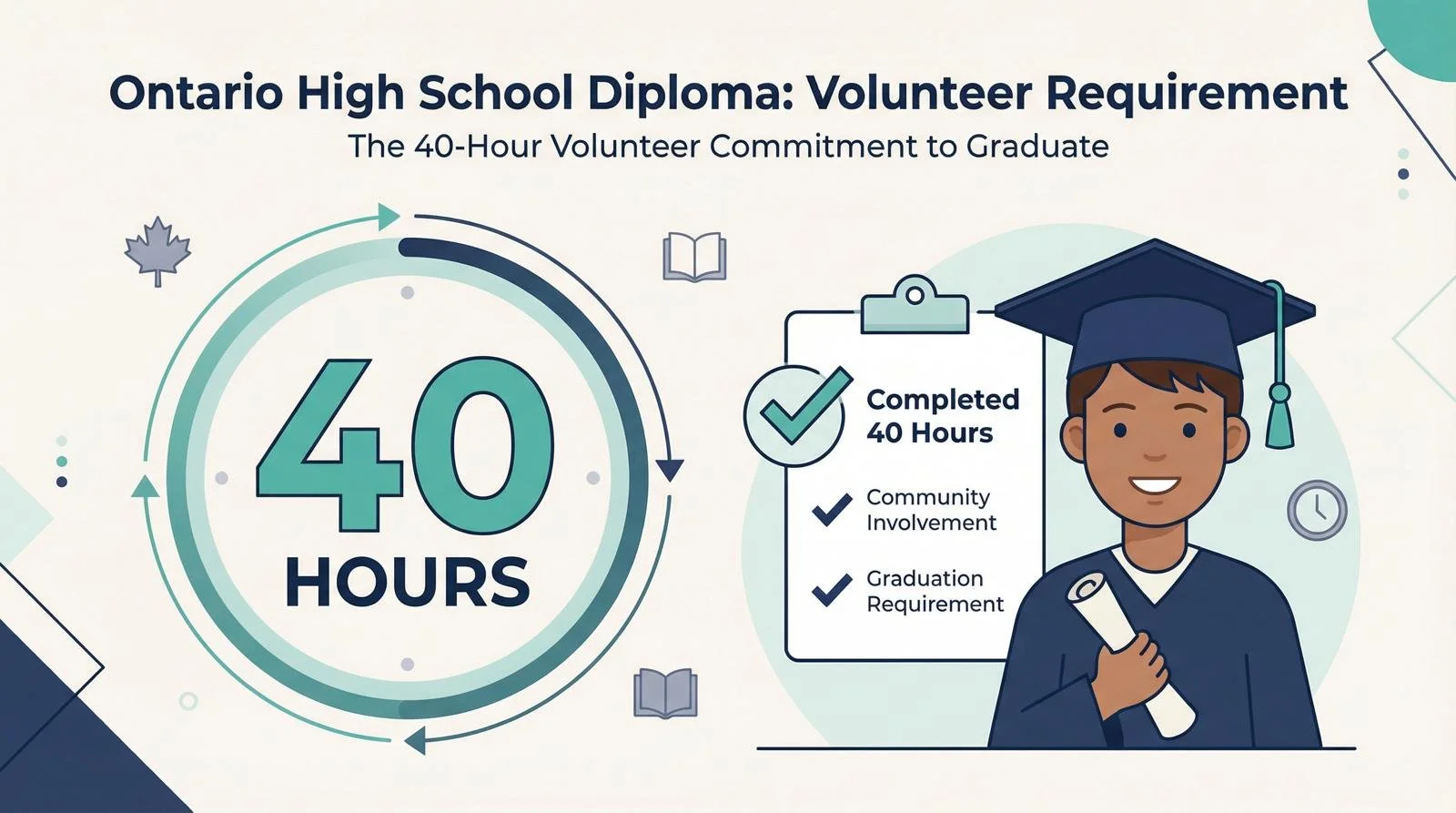
To earn an OSSD, students must complete at least 40 hours of community involvement outside of regular instructional time.
Students can begin accumulating these hours as early as the summer before Grade 9.
Eligible activities include:
Participation in community events and local initiatives
Supporting non-profit organizations and charitable causes
Assisting with school programs such as peer mentoring or event coordination
Completing approved virtual or remote volunteer roles
These experiences are designed to help students develop responsibility, community awareness, and valuable life skills.
What’s New in 2026: Volunteer Achievement Certificates
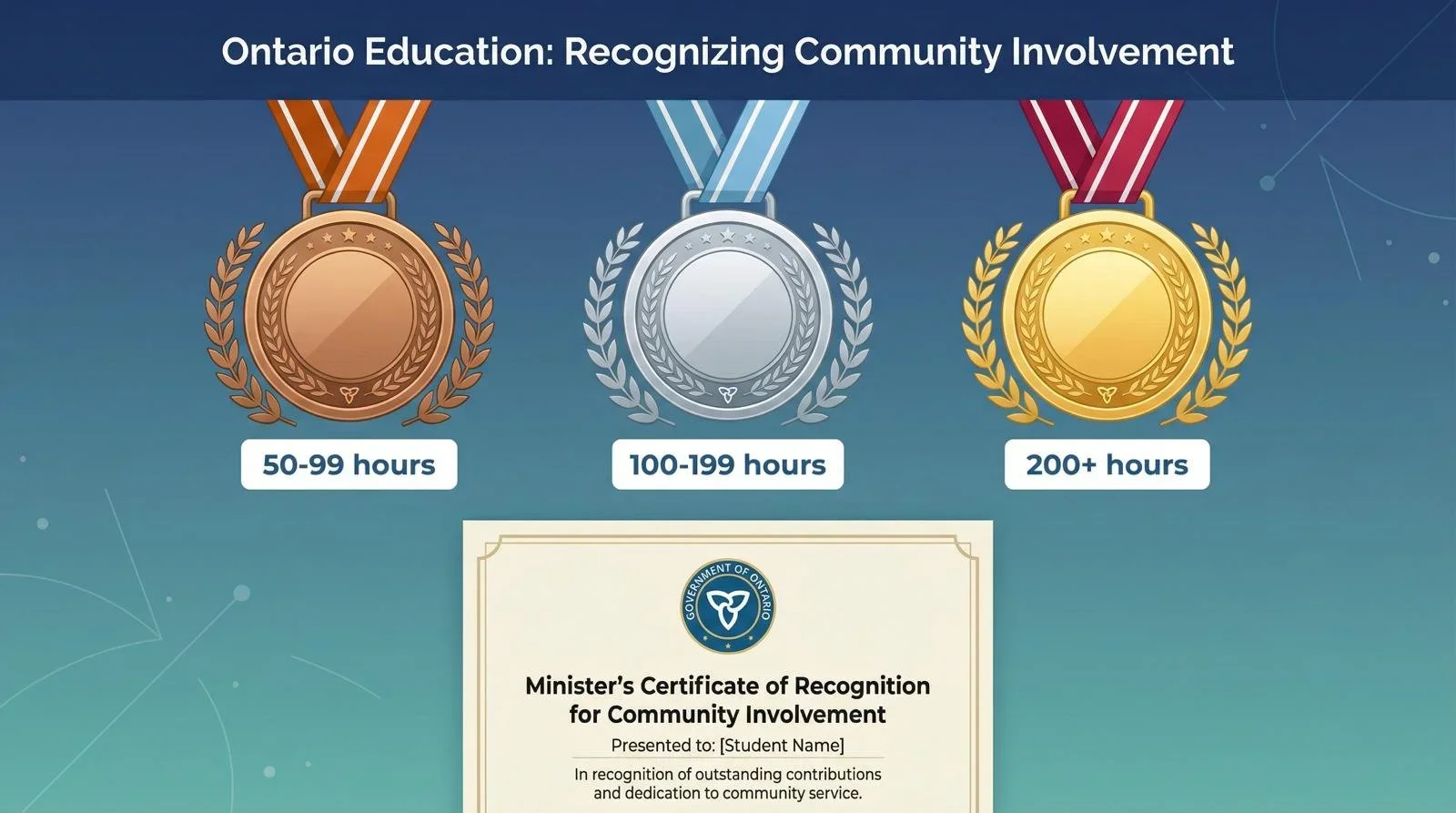
A major update is the introduction of the Volunteer Achievement Certificate Program.
Students can now earn:
Bronze Certificate: 50–99 hours
Silver Certificate: 100–199 hours
Gold Certificate: 200+ hours
These certificates provide formal recognition and strengthen academic and extracurricular profiles.
Why High School Volunteer Hours Matter in Ontario
Volunteer hours are more than a requirement—they are a strategic advantage.
1. Building Transferable, Real-World Skills
Through meaningful community involvement, students develop essential skills such as:
Communication and interpersonal skills
Teamwork and collaboration
Leadership and initiative
Problem-solving and adaptability
These competencies are critical not only in academic settings but also in future careers.
2. Strengthening Post-Secondary Applications
Universities and colleges are increasingly looking for well-rounded applicants.
Volunteer experience demonstrates:
Initiative beyond academics
Commitment to personal growth
Engagement with the community
Students who can showcase meaningful involvement often stand out in competitive admissions processes.
3. Gaining Early Career Exposure
For many students, volunteering serves as their first introduction to structured work environments.
It helps them:
Build confidence in professional settings
Understand expectations in real-world roles
Explore potential career paths early
This early exposure can play a key role in shaping future academic and career decisions.
Choosing Volunteer Opportunities That Align With Your Goals
To maximize the value of your Ontario volunteer hours, it’s important to choose opportunities that align with your interests and long-term goals.
For example:
Healthcare Pathways: Volunteering at hospitals or community health programs
Business & Leadership: Assisting with event planning, marketing, or administrative tasks
Education & Mentorship: Tutoring younger students or supporting youth initiatives
When students choose roles strategically, they not only gain hours—they build a clear and focused personal profile.
How to Make Your Volunteer Hours Truly Count
Completing hours is one thing—making them meaningful is another.
✔ Focus on Contribution, Not Just Completion
Think about the value you bring and the skills you develop, rather than simply tracking hours.
✔ Demonstrate Long-Term Commitment
Consistent involvement with one organization often reflects stronger dedication than multiple short-term roles.
✔ Keep Detailed and Accurate Records

Students should carefully track:
Organization name
Dates and total hours
Supervisor contact information
Accurate documentation ensures validation and supports future academic or job applications.
Presenting Volunteer Experience Professionally
Volunteer work should be presented with the same level of professionalism as paid experience.
When including it on a resume or application, highlight:
Specific roles and responsibilities
Measurable contributions
Skills gained
Examples:
Organized and supported community initiatives
Assisted in team coordination and event execution
Led group activities and contributed to program planning
A well-structured presentation can significantly strengthen applications.
Turning Volunteer Experience Into Long-Term Success
The true impact of volunteering lies in reflection and application.
Students should consider:
What skills they developed
How their experiences connect to future goals
For instance, volunteering in a healthcare environment can demonstrate empathy and communication—key qualities for medical or health-related fields.
When used effectively, volunteer hours become more than a requirement—they become a foundation for future success.
How Aubrey Academy Supports Student Success
At Aubrey Academy, students are supported in approaching volunteer hours strategically—not just as a requirement, but as an opportunity.
This includes:
Guidance in selecting meaningful opportunities
Flexibility to balance volunteering with academics
Support in presenting experiences for post-secondary applications
With a personalized and flexible learning model, students are better positioned to maximize both their academic and extracurricular achievements.
From Requirement to Opportunity
Ontario’s volunteer hour requirement has evolved into something far more valuable than a graduation checklist.
By starting early, making intentional choices, and focusing on meaningful experiences, students can transform their community involvement hours into a powerful advantage for their academic and professional future.
Contact us to discover volunteer opportunities today!
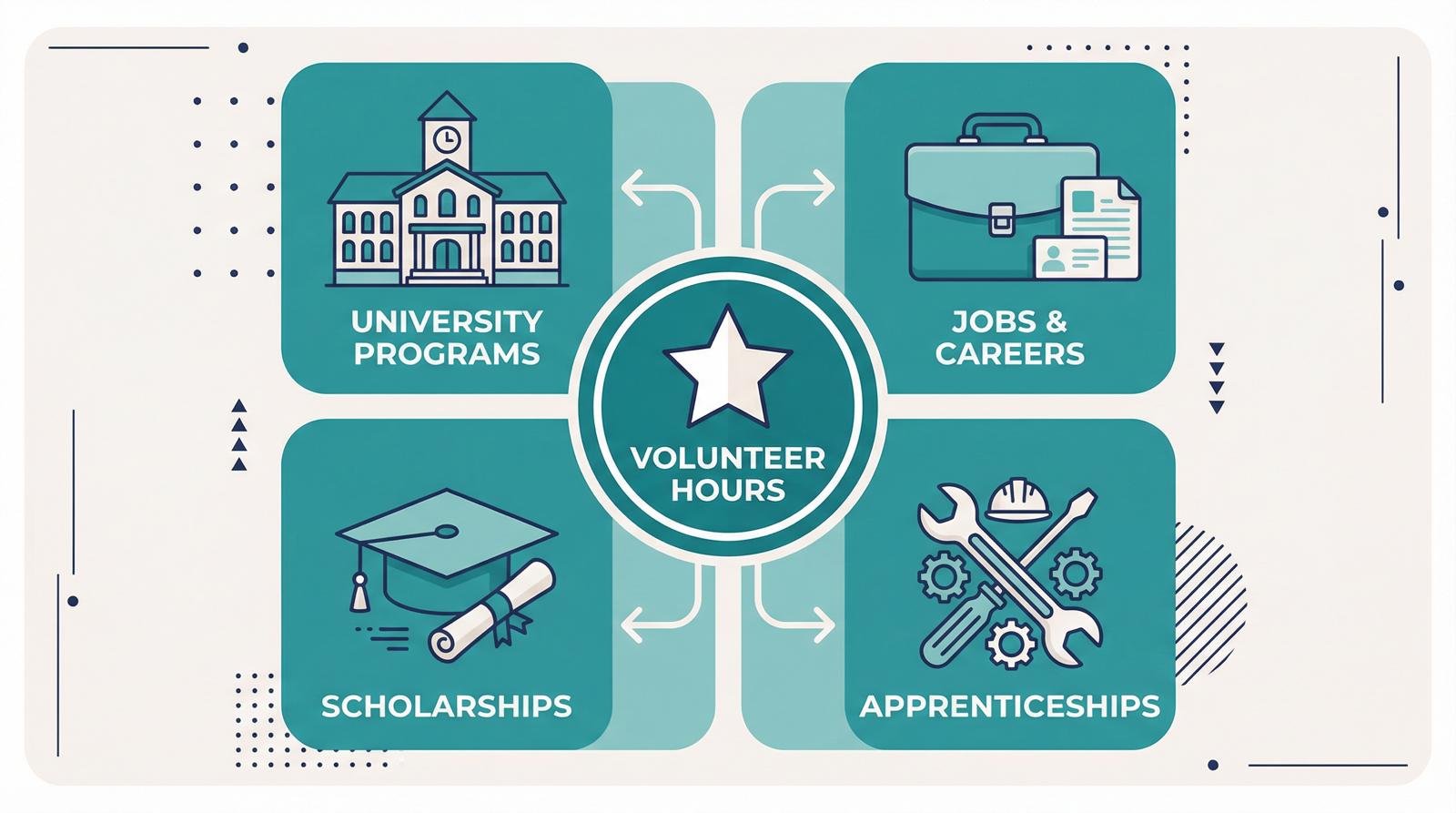

TAS1O – Technology and the Skilled Trades (Grade 9): Now Offered at Aubrey Academy
TAS1O is now a compulsory OSSD credit for Ontario students. Learn what this Grade 9 Technology and Skilled Trades course covers, why it matters, and how Aubrey Academy helps students complete it through flexible online learning.

Grade 9 Technology and the Skilled Trades
The Technology and the Skilled Trades, Grade 9 course (TAS1O) replaces the previous Grade 9 Exploring Technologies (TIJ1O) course from 2009. This course is designed to provide students with opportunities to further explore the engineering design process and develop technological knowledge and skills introduced in earlier grades.
Students live in a world where technologies connect with and impact every part of our lives. The career opportunities in technological fields have grown over the past decade. As such, it is important for all students to be exposed to these fields and career opportunities and to be equipped with the knowledge and skills needed to succeed in the jobs of tomorrow.
Starting with students entering high school in the 2024–25 school year, all students are required to earn a Grade 9 or 10 Technological Education credit, which is a compulsory graduation requirement for the Ontario Secondary School Diploma.
Technology and the Skilled Trades (TAS1O) will be taught starting in the 2024–25 school year. It can be offered as a standalone course or as a broad-based technology (BBT) focus course.
Aubrey Academy is proud to announce that we now offer TAS1O – Technology and the Skilled Trades, a Grade 9 open credit course designed to introduce students to technological education through project-based learning and real-world problem-solving.
This engaging course allows students to explore technology, innovation, and skilled trades while building foundational skills that support future success in secondary school and beyond.
What Is TAS1O – Technology and the Skilled Trades?
TAS1O is a Grade 9 Ontario technological education course that introduces students to the engineering design process, practical problem-solving, and the safe use of tools, materials, and digital technologies.
Students will:
Apply the stages of the engineering design process to solve authentic problems
Design, build, and test prototypes and models
Explore multiple areas of technology and skilled trades
Develop awareness of health and safety practices
Investigate career pathways in technology and skilled trades
There are no prerequisites, making TAS1O accessible to all Grade 9 students regardless of previous experience.
Why TAS1O Matters: Ontario Graduation Requirement
Beginning with students who entered Grade 9 in September 2024, the Ontario Ministry of Education requires that all students earn at least one Grade 9 or Grade 10 technological education credit as part of their Ontario Secondary School Diploma (OSSD) requirements.
TAS1O fulfills this graduation requirement while providing students with meaningful exposure to technology-focused learning early in their high school journey.
This provincial change reflects Ontario’s commitment to preparing students for a rapidly evolving workforce and increasing demand in skilled trades, engineering, manufacturing, construction, and applied technologies.
The Bigger Picture: Preparing Students for Tomorrow’s Workforce
Ontario and Canada continue to experience growing demand for professionals in:
Skilled trades (electricians, carpenters, HVAC, mechanics)
Engineering and applied sciences
Manufacturing and automation
Construction and infrastructure
Renewable energy and sustainability sectors
By introducing technological education in Grade 9, students gain early insight into these pathways and can make more informed course selections in Grades 10–12.
TAS1O helps students connect classroom learning to real-world applications, making education more relevant, engaging, and future-focused.

What Learning Looks Like in TAS1O
Rather than relying solely on traditional worksheets or lectures, TAS1O emphasizes:
Project-based learning
Design challenges
Collaborative problem-solving
Digital tools and simulations
Reflection and iterative improvement
Students are encouraged to test ideas, learn from mistakes, and refine their designs—mirroring how real engineers and technologists work.
Skills Students Develop in TAS1O
Through hands-on and collaborative learning, students build both technical and transferable skills, including:
Critical and creative thinking
Communication and teamwork
Time management and organization
Problem-solving and innovation
Responsibility and safety awareness
These skills support success across all postsecondary pathways: university, college, apprenticeship, and workforce entry.
Who Should Take TAS1O?
TAS1O is well suited for:
Students who enjoy hands-on or visual learning
Students who struggle in heavily text-based courses
Creative and curious thinkers
Students interested in engineering, architecture, or trades
Students who are unsure of their future career path
Because the course is exploratory, it provides a low-pressure environment for students to discover interests and strengths.
How TAS1O Supports Future Course Planning
Completing TAS1O in Grade 9 can lead to:
Grade 10–12 technological education courses
Specialist High Skills Major (SHSM) programs
Co-operative education placements
Apprenticeship-focused pathways
Early exposure helps students build a strong foundation and keeps multiple pathways open.
A Strong Fit for Flexible and Online Learners
At Aubrey Academy, we support diverse learners, including student-athletes, independent learners, and students who benefit from flexible pacing.
Our online-supported TAS1O course maintains alignment with Ontario curriculum expectations while offering structured guidance, clear milestones, and accessible learning materials.
Parent Insight
If your child is uncertain about future plans, TAS1O is an excellent Grade 9 choice. The course fulfills a required graduation credit and provides valuable exposure to practical, real-world learning—helping students discover interests early and build confidence.
Enroll in TAS1O at Aubrey Academy
Registration is now open for TAS1O – Technology and the Skilled Trades (Grade 9).
Give your student the opportunity to explore, design, build, and innovate—while earning a required Ontario diploma credit.
Contact Aubrey Academy today to learn more or begin the registration process.

Understanding Equivalency and PLAR in Ontario: How Students Can Earn Up to 26 High School Credits from Previous Schooling
Moved to Ontario, studied internationally, or returning to school? Learn how PLAR and equivalency can help eligible students receive up to 26 Ontario Secondary School Diploma (OSSD) credits for previous learning.
Students who transfer schools, move to Ontario, or return to education often ask:
“Will my previous schooling count toward my Ontario Secondary School Diploma (OSSD)?”
According to Ontario Ministry of Education policy, students are entitled to have their prior learning evaluated through Equivalency and Prior Learning Assessment and Recognition (PLAR).
These pathways allow students to receive official Ontario credits for learning they have already completed—reducing the number of courses they must take and accelerating their path to graduation.
At Aubrey Academy, we specialize in both processes and help students maximize eligible credits while staying fully compliant with Ministry requirements.
What Is Equivalency in Ontario?
Equivalency applies primarily to Grades 9 and 10.
The Ontario Ministry of Education allows schools to grant equivalency credits when students have completed comparable learning outside Ontario, including:
International school systems
Other Canadian provinces
Private or online schools
Recognized alternative programs
Instead of repeating coursework, schools analyze transcripts and map completed learning to Ontario curriculum expectations.
How Many Equivalency Credits Are Possible?
Under Ministry policy:
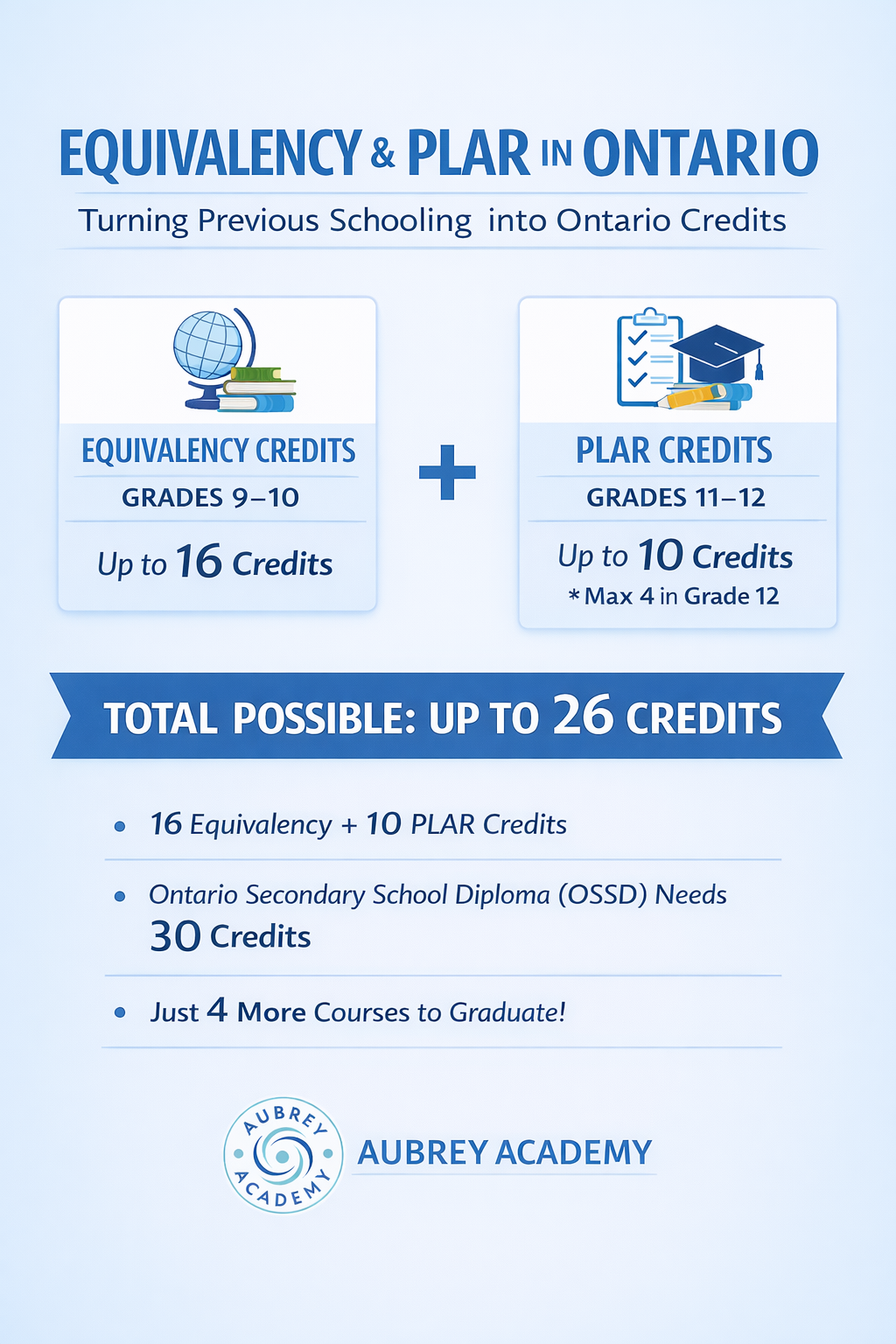
Students may earn up to 16 equivalency credits for Grade 9–10 learning
This typically covers all compulsory Grade 9 and 10 credits
These credits are granted through transcript review and do not require the student to write a course exam again.
Result: Students enter senior high school (Grades 11–12) with a strong credit base.
What Is PLAR (Prior Learning Assessment and Recognition)?
PLAR applies primarily to Grades 11 and 12.
PLAR recognizes that students may already possess the knowledge and skills of an Ontario course through:
Previous high school courses
International curricula
Private school programs
Online learning
Homeschooling
Work or life experience (where applicable)
Instead of repeating the entire course, students demonstrate learning through:
Diagnostic assessments
Assignments or projects
Unit tests
Final exams
Portfolios
If expectations are met, the school grants the credit.
How Many PLAR Credits Are Allowed in Ontario?
According to Ontario Ministry policy:
Students may earn up to 10 PLAR credits toward the OSSD
Of these, no more than 4 PLAR credits may be at the Grade 12 level
The remaining PLAR credits are usually at the Grade 11 level
These credits appear on the Ontario transcript exactly like traditional course credits.
Maximum Credit Scenario
When Equivalency and PLAR are combined:
Up to 16 Grade 9–10 equivalency credits
Up to 10 Grade 11–12 PLAR credits
Total possible: up to 26 credits
Since an OSSD requires 30 total credits, some students may only need to complete 4 additional Ontario courses to graduate. (Exact numbers vary based on individual transcripts and graduation requirements.)
Compulsory Credits Still Matter
Even when using Equivalency and PLAR, students must still meet Ontario’s compulsory credit requirements, including:
English (4 credits)
Mathematics (3 credits)
Science (2 credits)
Canadian Geography
Canadian History
Civics
Career Studies
Health & Physical Education
Arts
French as a Second Language
A Ministry-inspected school ensures that awarded credits properly satisfy these categories.
How the PLAR & Equivalency Process Works at Aubrey Academy
Submit transcripts and academic records
Academic team completes Ministry-aligned review
Eligible equivalency credits are granted
PLAR assessments are assigned (if applicable)
Credits are recorded on Ontario transcript
Graduation plan is created
All documentation is maintained according to Ministry inspection standards.
Are Universities and Colleges OK with PLAR and Equivalency?
Yes! Ontario universities and colleges accept OSSD credits regardless of whether they were earned through:
Traditional coursework
Equivalency
PLAR
What matters is that the credits are issued by a Ministry-inspected Ontario private school following policy.
Why Families Choose Aubrey Academy for PLAR and Equivalency
Ministry-aligned evaluation process
Experienced PLAR assessors
Clear graduation planning
Faster pathway to OSSD
Support for international and newcomer students
Official Ontario report cards and transcripts
At Aubrey Academy, we believe students should never lose years of progress because they changed schools or countries. Ontario’s Equivalency and PLAR policies exist to honour prior learning and create fair access to graduation. With the right school and proper evaluation, students may already be much closer to their OSSD than they realize.
Want to know how many credits you may be eligible for?
Contact Aubrey Academy today for a transcript review and personalized graduation pathway.